MOFCOM slams US' planned 100% additional tariff, says willful threats not right way to get along with China
By Liu Yang and Published: Oct 12, 2025 11:17 PM

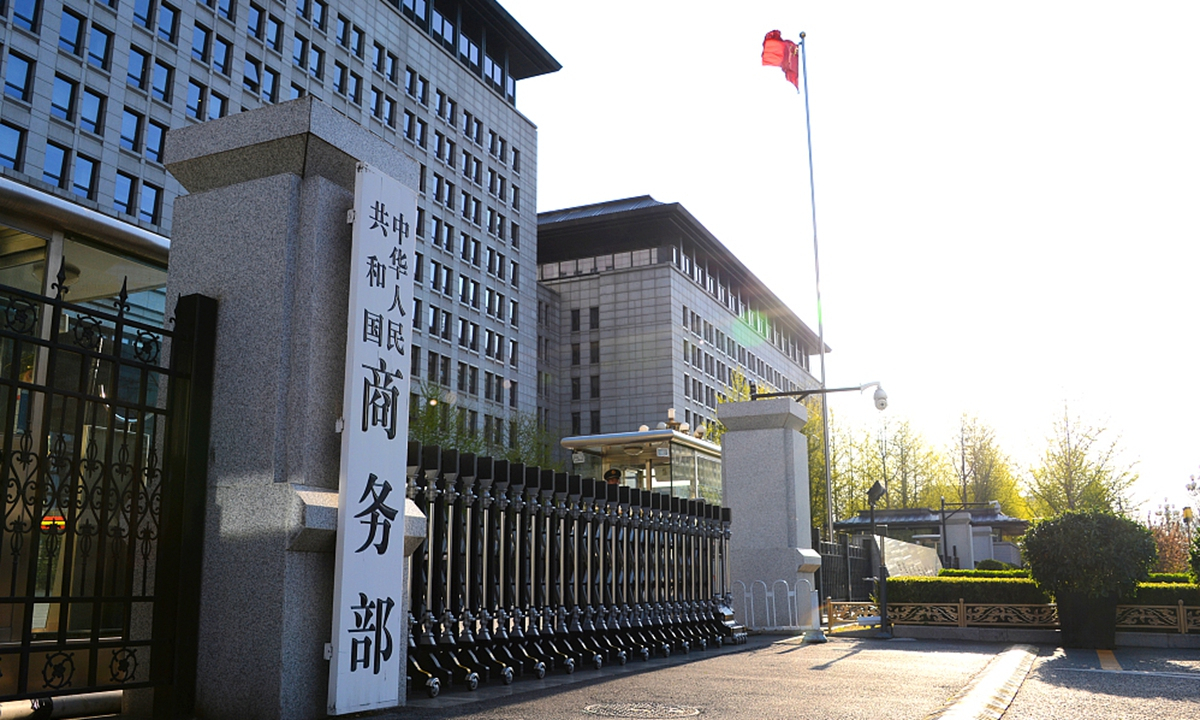
The Ministry of Commerce (MOFCOM) Photo: VCG
China's Ministry of Commerce (MOFCOM) on Sunday slammed the US' announcement that claimed Washington will impose 100 percent tariffs on China and impose export controls on all critical software, saying that willful threats of high tariffs are not the right way to get along with China, while vowing to surely take resolute measures to protect the country's legitimate rights and interests if the US insists on going the wrong way.
MOFCOM's remarks came after the US announced the tariff policy and restrictive measures targeting China on October 10, claiming it was "in response to China's export controls on rare earths and related items."
A MOFCOM spokesperson said that the US remarks reflect textbook "double standards." For a long time, the US has been overstretching the concept of national security, abusing export controls, taking discriminatory actions against China and imposing unilateral long-arm jurisdiction measures on various products including semiconductor equipment and chips. The US Commerce Control List (CCL) covers over 3,000 items, whereas China's Export Control List of Dual-use Items only covers about 900. The US has long imposed the "de minimis" rule for export controls, with a lowest threshold of 0 percent.
These measures by the US side seriously harm the legitimate and lawful rights and interests of companies, have severely disrupted international economic and trade order, and gravely undermine the security and stability of global industrial and supply chains, the spokesperson said.
Particularly since the China-US economic and trade talks in Madrid in September, the US, in just 20 days, introduced a string of new restrictive measures targeting China. It has put multiple Chinese entities on the Entity List and Special Designated National List, arbitrarily expanded the scope of control over businesses with the Affiliates Rule that affects thousands of Chinese companies, and persisted with the implementation of Section 301 measures targeting China's maritime, logistics and shipbuilding industries in disregard of China's concerns and goodwill. The US actions have severely harmed China's interests and undermined the atmosphere of bilateral economic and trade talks, and China is resolutely opposed to them, the spokesperson noted.
China's strengthened export controls are aimed at better defending national and regional stability, which shows the country's responsible role to fulfill non-proliferation and other international obligations. However, the US is once again wielding the tariff stick, which will cast a cloud over the already stagnant global economy and create greater uncertainty, Gao Lingyun, a research fellow at the Institute of World Economics and Politics of the Chinese Academy of Social Sciences, told the Global Times on Sunday.
China's responsible role
The MOFCOM spokesperson said that China on October 9 released export control measures on rare earths and related items, which are normal actions taken by the Chinese government in accordance with laws and regulations to refine its own export control system. As a responsible major country, China always firmly safeguards its national security and international common security, always takes a just and reasonable principled position and implements export control measures in a prudential and moderate manner.
The spokesperson said that China had made a thorough assessment of the measures' possible impact on industrial and supply chains in advance and is certain that the related impact is very limited. Before announcing the measures, China had notified relevant countries and regions through bilateral export control dialogue mechanisms.
The Chinese government will conduct reviews in accordance with laws and regulations, grant licenses to eligible applications, as well as actively considering the applicability of facilitation measures such as general licenses and license exemptions to effectively promote legitimate trade. "I want to emphasize that China's export controls are not export bans. All applications of compliant export for civil use can get approval, so that relevant businesses have no need to worry," the spokesperson noted.
He Weiwen, a senior fellow at the Center for China and Globalization, told the Global Times on Sunday that China's new export control measures aim to prevent diversion for purposes such as the manufacturing of weapons of mass destruction or use by smugglers and terrorists - threats to China's national security and global stability, a concern shared by the international community.
If the US needs rare earths for civilian use, it can obtain licenses through compliance procedures and there is no need for such an overreaction, He said.
The US side has recently rolled out a number of restrictive policies targeting China, especially by wielding the tariff stick under the pretext of China's reasonable and lawful actions, which reveals a fundamental tendency toward inconsistency and unpredictability from the outset, Gao said, noting that China's relevant measures are a just and necessary step to uphold Chinese principles and interests.
Under a CNBC-TV18 video titled "Rare Earth Shock: China's New Export Curbs To Hit Global Supply Chains" on YouTube, a popular comment reads: The US government is the one that created the tariff mess and everything that came with it. China is simply responding to the situation the US started in the first place. So please, don't blame China—blame the party that initiated all this turmoil: the US government.
Under another YouTube video from CNBC Television titled "China tightens rare earth exports: Here's the impact on Tesla," a comment said that "USA can restrict chips to China, then China can restrict rare earths that make those chips. Seems fair to me."
"For the longest time China had no problem buying and using Western stuff. Then you squeezed them, demonized them, probably thinking what worked in the 19th century would do the same trick. Nope. For years the West's been saying rare earth ain't rare, so go make your own why don't you." a comment was posted under a YouTube video from France 24 English with the title of "China further tightens export rules for rare earth elements crucial to tech sector."
Willful threats of tariffs
Gao noted that the Chinese side has always engaged in economic and trade negotiations with the US with sincerity, striving to promote the implementation of negotiation outcomes. However, the US' recent containment policy toward China has already undermined the stable development of China-US economic and trade relations.
"Willful threats of high tariffs are not the right way to get along with China. China's position on the trade war is consistent: we do not want it, but we are not afraid of it," the spokesperson said. China urges the US to promptly correct its wrong practices, adhere to the important consensuses of the phone calls between the two heads of state, protect the hard-won outcomes of consultations, continue to use the China-US economic and trade consultation mechanism, and address respective concerns and properly manage differences through dialogues and on the basis of mutual respect and equal-footed consultation, so as to ensure the stable, sound and sustainable development of the China-US economic and trade relationship. If the US insists on going the wrong way, China will surely take resolute measures to protect its legitimate rights and interests, the spokesperson noted.
He Weiwen said the US has resorted to "maximum pressure" tactics again. However, "it cannot pressure China to serve its own interests through unilateral means. The trade tensions between China and the US over the past months fully demonstrate that moves like this by the US don't work and only exacerbate the situation," the expert noted.
According to CNBC, stocks settled decidedly lower after a rapid decline on Friday following the US' threat of higher tariffs on China. Stocks accelerated selling into the close, with the Dow Jones Industrial Average closing down 878.82 points, or 1.9 percent, at 45,479.60. The S&P 500 lost 2.71 percent to settle at 6,552.51, while the Nasdaq Composite fell 3.56 percent to 22,204.43. The broad-based index's decline was the largest since April 10.
Gao urged the US to take more pragmatic actions, cease its unwarranted suppression of China, and work with the Chinese side on the basis of equal consultation to jointly maintain global economic stability. "Meanwhile, China will leverage multilateral mechanisms to resolutely safeguard its own rights," the expert noted.
RELATED ARTICLES