Only by upholding promises can China-US economic and trade ties stabilize: Global Times editorial
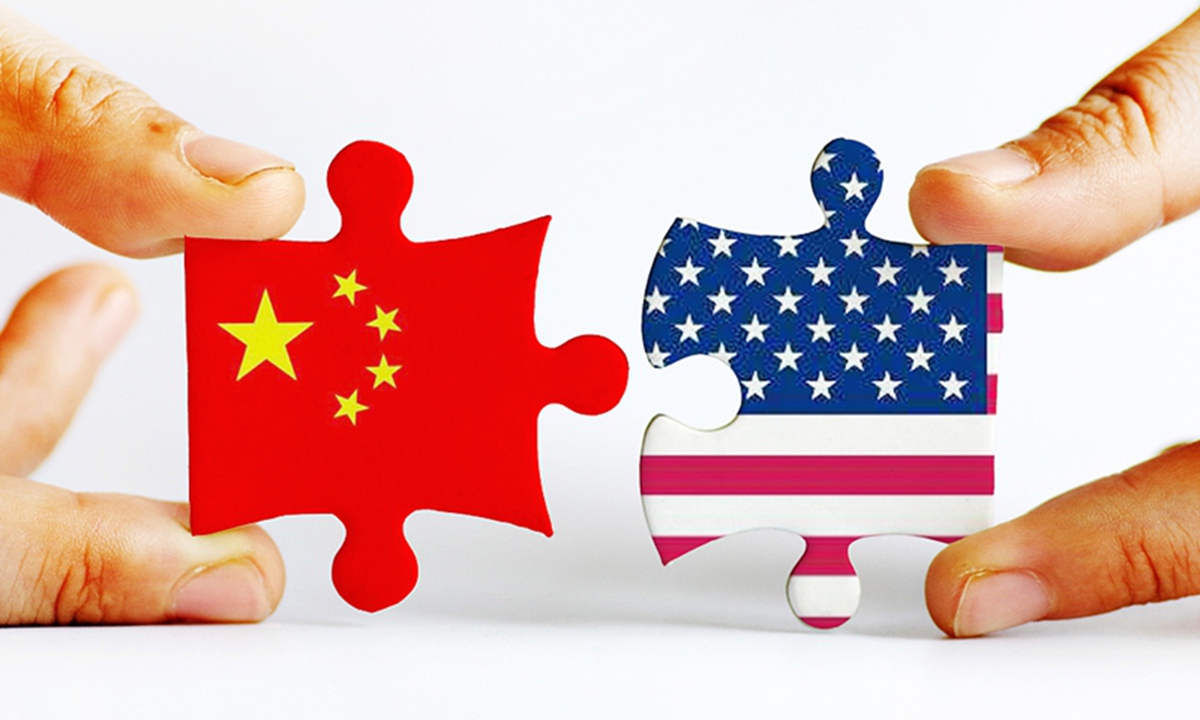
China US Photo:VCG
On Sunday, a spokesperson for China's Ministry of Commerce responded to media inquiries regarding China's recent trade and economic policy measures. The spokesperson clarified China's position on a number of issues, including export controls on rare earths and related items, the US threat of imposing tariffs of 100 percent on China, and the US imposition of port fees on related Chinese vessels. The message delivered by China was clear and resolute: willful threats of high tariffs are not the right way to get along with China. China's position on the trade war is consistent: we do not want it, but we are not afraid to fight one, if it is necessary to safeguard our legitimate development rights.
The incident stemmed from Washington's threat to impose tariffs of 100 percent on China and export control on all critical software, under the pretext of "countering" China's tightening of rare earths export regulations. Viewed from a longer time frame, it is the US that has persistently used tariffs and export controls to interfere with and undermine the normal trade order between China and the US, as well as the atmosphere of bilateral economic and trade talks, seriously harming China's interests. Since the China-US economic and trade talks in Madrid in September, the US, in just 20 days, has introduced a string of new restrictive measures targeting China. The difficulties currently facing China-US trade are entirely the responsibility of the US side.
The US unilateral actions have dealt a heavy blow to global market confidence, raising concerns that the world's two largest economies could once again slip into a trade war. Some analysts argue this proves the fragility of the so-called China-US tariff "truce." We believe that "a person without faith cannot establish himself or herself" - whether commitments between China and the US are "solid" or "fragile" depends on trust, and more importantly, on actions. If the US claims to seek dialogue while simultaneously escalating unilateral measures and resorting to "fabricated justifications" and "trade bullying," it will only deepen the trust deficit. China has always advocated resolving differences through equal consultation, but it will never accept any form of coercion.
China has repeatedly made it clear that its export control measures on rare earths and related items is a legitimate action by the Chinese government to refine its export control system in accordance with laws and regulations.
These actions are not only necessary to safeguard national security, but also fully demonstrate China's steadfast commitment - as a responsible major country - to pursuing world peace, reducing the risk of military conflict, and preventing the proliferation of weapons of mass destruction, in accordance with international norms and common practice.
China's trade and export control policies have always been highly transparent and predictable, and we remain open to trade applications that meet the relevant rules. Before the measures were announced, China had already notified relevant countries and regions through bilateral export control dialogue mechanisms. Products intended for military use are presumed ineligible for licenses, whereas civilian goods are not subject to this restriction. There is no need for excessive reactions from the US, nor should these controls be used as a pretext to instigate a trade war.
By contrast, the US has long overextended the concept of "national security," misused export controls, adopted discriminatory practices toward China, and imposed long-arm jurisdiction measures on a wide range of products, including semiconductor equipment and chips. Yet it has hypocritically criticized China's normal regulatory measures - a clear US "double standard."
China-US economic and trade relations in 2025 have been a journey full of twists and turns. The past has repeatedly proven that both countries stand to gain from cooperation and lose from confrontation is the iron law of China-US relations. Any attempt to pressure or contain China's development is doomed to fail. The consensus reached and the consultation mechanisms established between the two sides have provided a solid framework and effective channels for resolving trade frictions.
China has always maintained an open attitude and stands ready to advance dialogue on the basis of mutual respect, equality, and mutual benefit - but core interests are non-negotiable. It is worth noting that both the US market and public opinion have largely dismissed the White House's latest tariff threats. Liza Tobin, former China director at the National Security Council, recently remarked with frustration that "We're playing 2-D chess while Beijing is playing 4-D chess." China possesses ample strategic composure to handle Washington's moves. If the US continues to pursue unilateral measures guided by a zero-sum mindset, it will only further disrupt global supply chains, harming others without benefiting itself.
At present, China-US economic and trade relations once again stand at a crossroads. On one side stands China - firm in its position, clear in its red lines, and focused on the broader stability of the international trading order; on the other stands the US - reacting emotionally, lacking effective policy tools, and mired in "double standards." A truly healthy and stable economic and trade relationship should be built on mutual respect, fairness, and reciprocity, not on the reckless use of tariffs that undermine established rules.
We urge the US to promptly correct its wrong practices, adhere to the important consensus reached during the phone calls between the two heads of state, protect the hard-won outcomes of consultations, maintain the China-US economic and trade consultation mechanism, and address respective concerns and properly manage differences through dialogues and on the basis of mutual respect and equal-footed consultation, so as to ensure the stable, sound and sustainable development of the China-US economic and trade relationship.
RELATED ARTICLES