China is an important force in ensuring stability, smooth operation of global supply chains: senior official
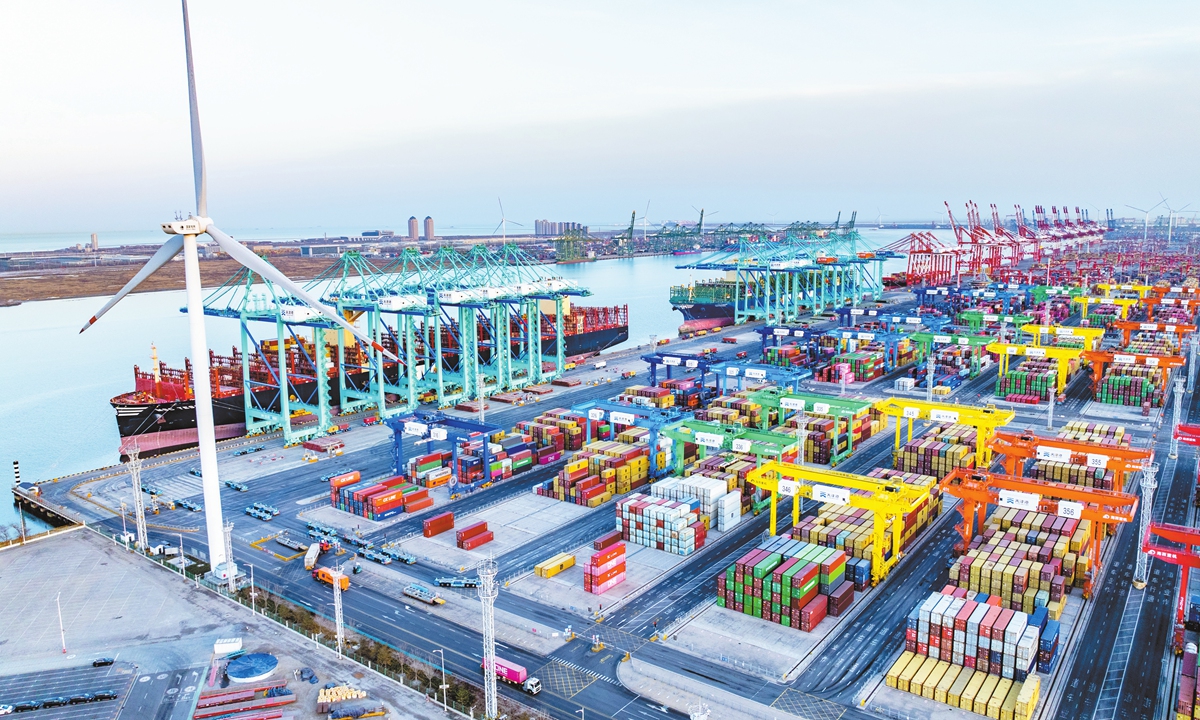
A glimpse of the Tianjin Port in North China's Tianjin Municipality Photo: Courtesy of Tianjin Port
China is an important force in ensuring the stability and smooth operation of global supply chains, said Wang Jun, vice administrator of the General Administration of Customs (GAC), on Monday in Beijing.
With the continuous implementation and effectiveness of China's domestic stocked and incremental pro-growth policies, Chinese foreign trade enterprises will continue to meet international market demands with high-quality supply, which will inject new momentum into China's exports, Wang noted.
The comments were made in response to media questions on the prospects of China's export amid an increasingly complex external environment.
Currently, the process of economic globalization is facing "headwinds and counter-currents." Several international organizations have pointed out that the global economic outlook is fraught with significant risks, with trade policy uncertainty being a major factor constraining global economic development. However, economic globalization is an unstoppable historical trend, and maintaining the resilience and stability of global industrial and supply chains aligns with the common interests of all countries, Wang said.
Data released by GAC on Monday showed that China's export of goods grew by 7.1 percent in the first three quarters of 2025, maintaining positive growth for eight consecutive quarters. Wang said the data showed that China's foreign trade "has effectively addressed various pressures and challenges, maintaining a strong growth momentum."
According to Wang, one of the key drivers fueling the export gain is China's complete industrial system, which lays the foundation for growth. For example, China's manufacturing sector exports jumped by 7.1 percent in the first three quarters, which recorded positive growth for eight consecutive years.
Wang noted that the enhancement of China's innovations has also unleashed greater growth potential. As China accelerates the cultivation of new drivers and advantages in manufacturing, new technologies and new products are emerging rapidly, he said, pointing to China's high-tech products export momentum.
In the first three quarters, China's exports of high-tech products grew by 11.9 percent to reach 3.75 trillion yuan ($528.75 billion), contributing over 30 percent to the overall export growth during the same period, customs data showed.
Wang attributed the growth to Chinese companies' flexibility in adapting to global market demand, which has expanded trade growth opportunities.
For example, Chinese enterprises have introduced split-type air conditioners that allow flexible installation of both indoor and outdoor units. The new products cater to the architectural and climatic characteristics of the European market, which resulted in a more than 20 percent increase in China's air conditioner exports to Europe in the first three quarters, according to Wang.
Global Times
RELATED ARTICLES