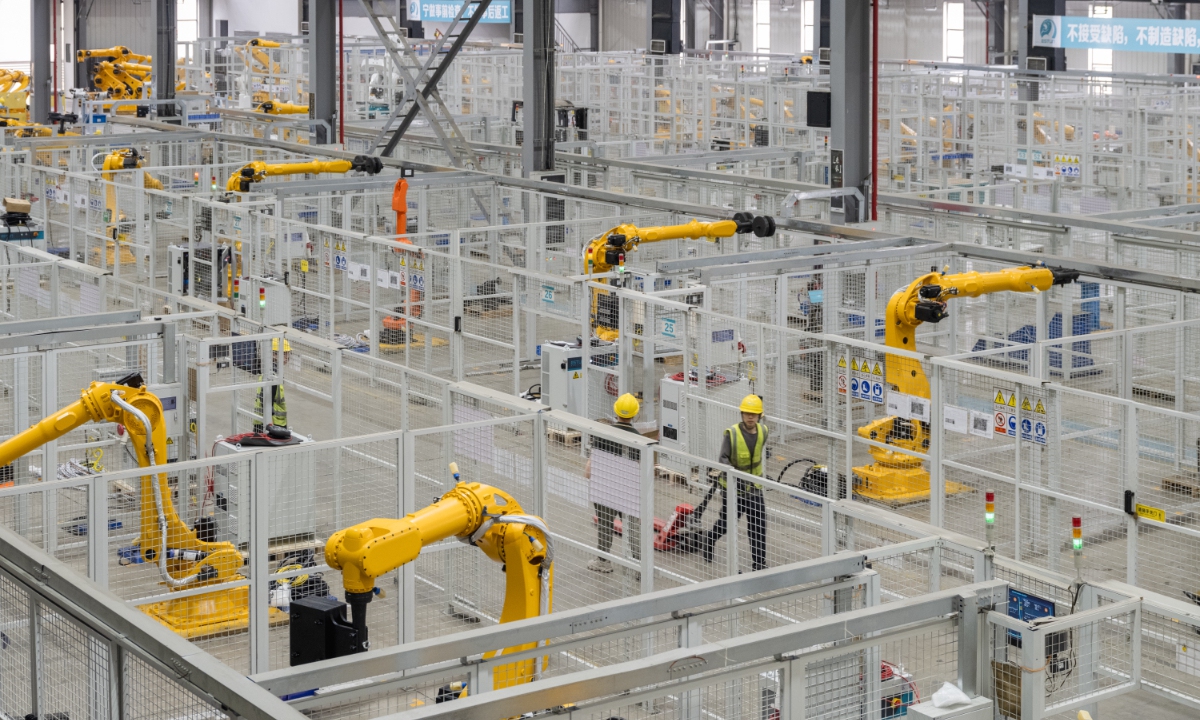
Robotic arms produce robots at a factory of Estun Automation in Nanjing, East China's Jiangsu Province. Photo: VCG
China's industrial robot exports jumped 54.9 percent in the first three quarters of this year, Wang Jun, deputy administrator of the General Administration of Customs (GAC), said at a press conference held in Beijing on Monday.This figure is not only a direct reflection of the global demand for intelligent transformation in the manufacturing sector but also a powerful demonstration of the resilience and upgrading momentum of Chinese manufacturing amid the pressure of complex international competition. How has China's robotics industry come to occupy an increasingly important global position? The answer lies in China's distinctive industrial development logic and its long-term strategic planning.
The rise of China's robotics industry is a classic model of the synergy among national planning, market-driven demand, manufacturing foundation support, and supply chain guarantee.
From the 12th Five-Year Plan Period (2011-15) to the 14th Five-Year Plan Period (2021-25), China has introduced successive policies to support the development of the robotics industry. With the full implementation of the strategy to build a strong manufacturing country, the development of the robotics industry was further elevated to the national strategic level. Long-term planning has charted a clear direction for the development of China's robotics industry. Guided by these policies, resources such as funds and talent have continuously flowed into this field, providing fertile ground for the industry's vigorous growth.
Market demand serves as a strong engine driving the growth of China's robotics industry. With the accelerated global shift to intelligent manufacturing, market demand for industrial robots has surged exponentially. As the world's largest manufacturing country, China itself generates enormous demand for industrial robots. Its vibrant domestic market provides a broad testing ground for local robotics companies, prompting them to continuously pursue technological innovation and product upgrading, while also attracting global robotics giants, further intensifying market competition and driving the entire industry toward higher levels of development.
The nation's manufacturing foundation and supply chain support form a solid backbone for the rise of China's robotics industry. After years of development, China's manufacturing sector has built a comprehensive and well-supported industrial system.
In the field of robotics, China boasts strong capabilities across the entire value chain: from the research and development and manufacturing of core components, to the design and production of robot bodies, and further to system integration and application services. This complete industrial chain and robust supply chain capacity endow China's robot industry with significant advantages in cost control, production efficiency, and product quality, enabling it to secure a firm foothold in the global market.
During the 14th Five-Year Plan Period (2021-25), China's newly installed industrial robots accounted for more than 50 percent of the global total, Minister of Industry and Information Technology Li Lecheng said at a press conference in September. These figures reveal that China's robotics industry has moved beyond following, and in some areas, achieved parallel development and even taken the global lead.
China's robotics industry may still lag behind the global forefront in some areas, such as core components and high‑end algorithms, but its industrial sector has demonstrated notable strategic resilience and breakthrough capability. The attitude of facing gaps and proactively addressing challenges is precisely why the sector can sustain long‑term growth.
The rise of China's manufacturing sector in the global industrial chain, epitomized by its robotics industry, is essentially rooted in the perfect integration of national planning and implementation. This integration has evolved gradually under China's unique industrial development model. Backed by these structural advantages, China's manufacturers have earned their place in global markets, which is the fruit of decades of strategic foresight and unwavering implementation.
The intelligent, green, and services-oriented transformation represents the future of global manufacturing. As this transformation unfolds, China, by leveraging its formidable manufacturing strengths, has become a pivotal force providing new impetus and opportunities for worldwide industrial advancement. Consequently, China's role in the global industrial chain is an inevitable outcome of this global trend, an outcome that no tariff barriers or other non-market measures can distort.
RELATED ARTICLES