China imposes special port fees on US ships; a justified move for fair global shipping: ministry
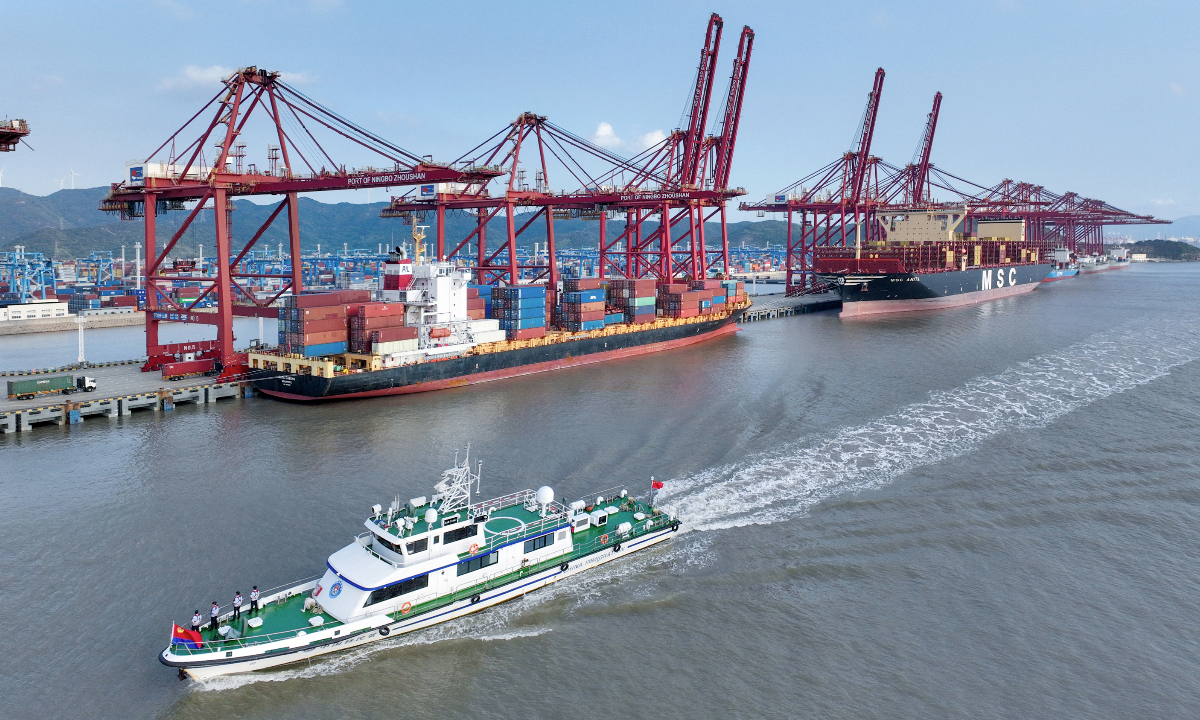
View of a container terminal of Ningbo Zhoushan Port in East China's Zhejiang Province on October 13, 2025. Photo: VCG
China's Ministry of Transport on Tuesday announced 10 implementation measures as the country starts to charge special port fees on ships owned or operated by US enterprises, organizations and individuals, in a move to safeguard the legitimate rights and interests of Chinese shipping industry and enterprises while ensuring fair competition in international shipping, according to statements on the ministry's website.
Ships subject to the special port fees also include those owned or operated by entities where US enterprises, organizations and individuals hold a direct or indirect stake of 25 percent or more, as well as all the US-flagged and US built vessels, the ministry said.
The vessels built in China under the first to fourth items shall be exempt from the special port fees. Vessels without load that enter Chinese shipyards solely for repair purposes, as well as other vessels otherwise determined to be exempt, shall also be exempt from the fees, according to the document.
The Transport Ministry outlined a phased escalation for the special port fees on eligible US vessels berthing at Chinese ports, which will initially be 400 yuan ($56) per net ton from Tuesday and increase annually on April 17 for the subsequent three years.
Specifically, the special port fees on eligible US vessels berthing at Chinese ports will be charged 640 yuan per ton starting from April 17, 2026, 880 yuan per ton starting from April 17, 2027, and 1,120 yuan per ton starting from April 17, 2028, according to the ministry.
For the same vessel, the collection of special port fees shall not exceed five voyages within one year. April 17 of each year shall serve as the commencement date of the annual billing cycle.
The shipowner or its agent shall, seven days prior to the vessel's estimated arrival at a Chinese port, report relevant information including country of build, flag and owner to the maritime administration authority at the port of destination, and pay the fees. The maritime administration authority at the port of destination shall verify all pre-arrival vessel information. If underreporting or omission of the information is detected, the vessel owner or its agent shall be required to supplement the reported information, according to the ministry.
Failures to comply with these measures released by the Ministry of Transport, including failure to fully the fees, shall result in the maritime administration authority prohibiting the vessel from processing entry/exit formalities. Vessels that evade payment shall settle outstanding fees before their next port docking in China, it said.
The ministry announced on October 10 that China will charge special port fees on ships owned or operated by US enterprises, organizations and individuals starting from Tuesday, in response to the US decision to levy additional port fees on Chinese ships after a Section 301 investigation, according to the ministry.
"It is a justified move to safeguard the legitimate rights and interests of Chinese maritime industry and enterprises while ensuring a fair competition environment for international shipping industry," the ministry said in a separate statement on Tuesday, noting that the US actions have seriously violated WTO rules and the China-US maritime transport agreement and caused severe disruption to maritime trade between the two countries.
The US measures to levy port fees on China-linked ships are typical unilateralist and protectionist actions with clear discriminatory characteristics, while China's countermeasures are necessary and defensive moves, Lü Daliang, a spokesperson of the General Administration of Customs of China, said at a press conference on Monday.
It is hoped that the US will acknowledge its mistakes, work with China to move forward and return to the right path of dialogue and consultation, Lü said.
RELATED ARTICLES