Container ship arrives in UK via China-Europe Arctic route, demonstrating viability of northeast passage
By Published: Oct 14, 2025 05:01 PM

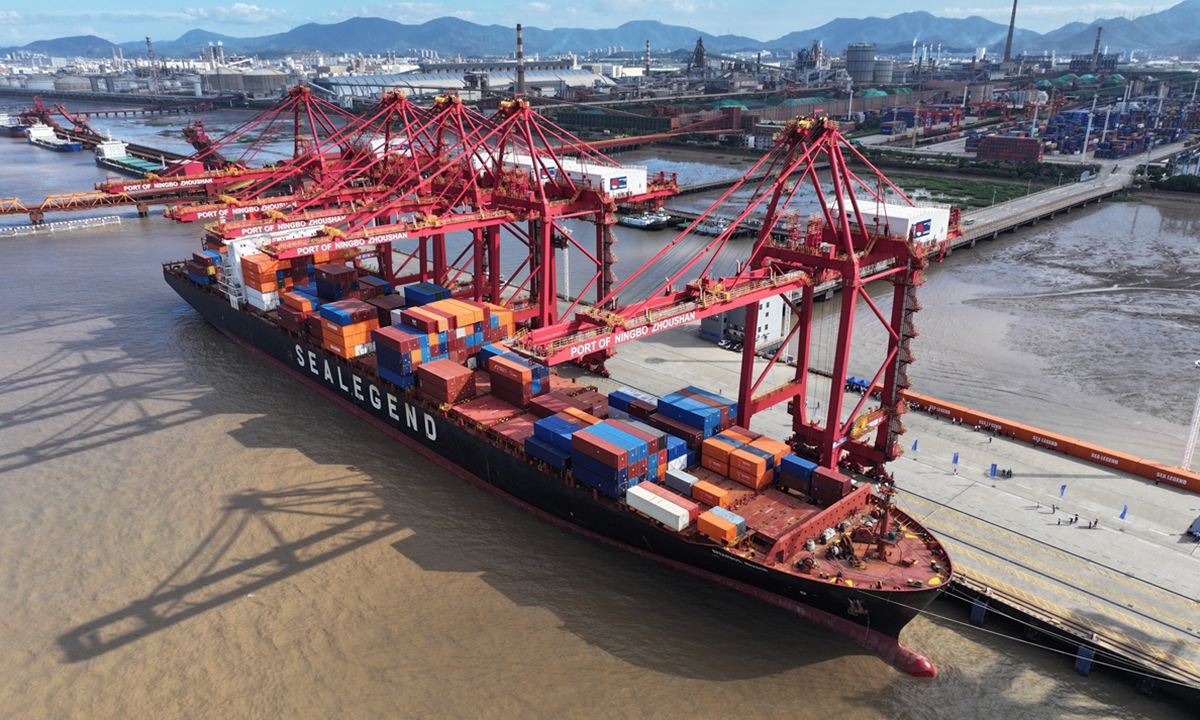
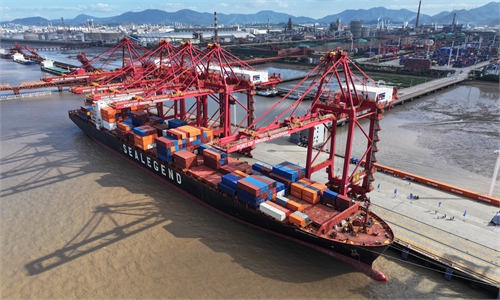
The Istanbul Bridge container ship berths at the Beiyi Container Terminal in Ningbo-Zhoushan Port, East China's Zhejiang Province, on September 22, 2025. Photo: Courtesy of Ningbo Zhoushan Port
The container ship Istanbul Bridge arrived late on Monday (UK time) at Felixstowe, the UK's largest container port, via the Arctic shipping route, marking the inaugural voyage of the world's first China-Europe Arctic container express route and demonstrating the commercial viability of the northeast passage, state broadcaster CCTV reported.
The Istanbul Bridge left Ningbo-Zhoushan Port, East China's Zhejiang Province, on September 23.
The China-Europe Arctic Express route links a number of major Chinese and European ports, including Ningbo, Shanghai, Qingdao, and Dalian on the Chinese side, and Felixstowe in the UK, Rotterdam in the Netherlands, Hamburg in Germany, and Gdańsk in Poland on the other.
Slashing the shipping period to just 20 days, the route is the fastest container route between major Chinese and European ports, according to CCTV. It was the fastest delivery in the history of container shipping, and the third delivery route between China and Europe.
This compares with traditional routes bypassing the Cape of Good Hope taking about 50 days, and those going through the Suez Canal taking about 40 days and the roughly 25 days needed by the China-Europe Railway Express.
According to statistics from the customs authority in Ningbo, the value of goods exported through the first voyage was about 1.4 billion yuan ($197 million), including clothing, energy storage cabinets, power batteries and other goods.
The route represents an emerging international shipping artery connecting East Asia and Europe, and is of great value in optimizing the global supply chain and promoting economic and trade cooperation along the route, according to a Chinese analyst.
"Trade between China and the EU has remained robust despite the volatile global trade landscape and having a third route, in additional to the traditional sea routes and the China-Europe freight train service, will add stability and inject new vitality to bilateral trade," Cui Hongjian, director of the Department of European Studies, China Institute of International Studies, told the Global Times on Tuesday.
Seaborne trade remains the main channel for international trade, and connectivity is paramount in supporting stable and sound trade growth. The proof of commercial viability as shown in this voyage is highly significant for efforts to diversify trade routes, Cui said, noting that providing a new logistics route for global trade networks is another contribution China has made to maintaining the stability of the global supply chain.
The EU is the largest trading partner of Ningbo Port, according to Ningbo Customs. In the first eight months of this year, total trade between Ningbo Port and the EU reached 330.74 billion yuan, a year-on-year increase of 12 percent, accounting for about 18 percent of Ningbo Port's total foreign trade.
The route has greatly beefed up the delivery efficiency of logistics between China and Europe, and the shipments include photovoltaics, lithium batteries, and electric vehicles, which are indeed urgently needed in Europe, CCTV reported, citing operators of the route.
Since the voyage was conducted in an opportune window of time, no icebreaker service was used. As the distance is much shorter, the route also reduces carbon emissions significantly, according to operators.
The opening of this route also demonstrated China's commitment to cooperation and development in Arctic affairs, the CCTV report noted.
In 2018, China released a white paper titled "China's Arctic Policy," saying that China hopes to work with all parties to build a "Polar Silk Road" through developing the Arctic shipping routes.
RELATED ARTICLES