China’s trend-driven toy brands are fueling a global ‘chao play’ wave, emerging as arising force in exports
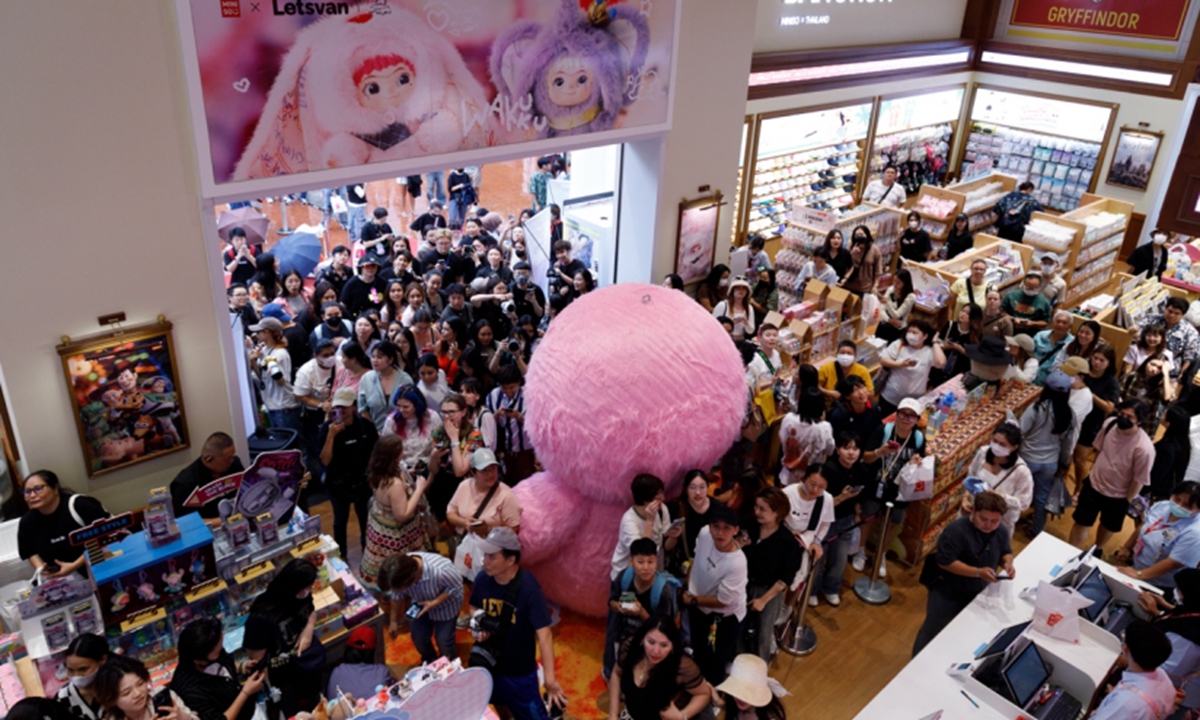
Chinese pop toy maker Letsvan's pop-up event at MINISO's Thailand store attracts large crowds of consumers on June 2, 2025. Photo: Courtesy of Letsvan
Apple CEO Tim Cook made his first stop in China at Pop Mart's THE MONSTERS 10th anniversary exhibition during his visit to Shanghai on Monday afternoon.
At the venue, Cook toured original LABUBU sketches and a lineup of collectibles with Pop Mart founder Wang Ning and LABUBU artist Kasing Lung. Lung demonstrated how he creates LABUBU on an iPad Pro, while Wang presented Cook with a surprise gift — LABUBU, according to a statement Pop Mart sent to the Global Times.
As this year marks LABUBU's 10th anniversary, Pop Mart has launched a yearlong global tour for THE MONSTERS, with stops planned in Beijing, Taipei, Hong Kong, Tokyo, Paris and New York, according to the statement. The tour illustrates how China's homegrown cultural IPs are transforming from niche domestic phenomena into worldwide collectibles, insiders said.
China's latest trade data show that "Made-in-China trendy products" have become new export growth engines. In the first three quarters of 2025, China's exports of festive goods, dolls and animal-shaped toys exceeded 50 billion yuan ($6.9 billion), reaching more than 200 countries and regions, the country's General Administration of Customs (GAC) said on Monday.
In recent years, many "guochao" (Chinese trendy) products have become global hits, gaining favor with overseas consumers and emerging as new highlights in China's exports.
Their worldwide popularity reflects the influence of traditional Chinese culture, showcases the creativity of Chinese exporters, and is underpinned by the solid strength of Chinese manufacturing, the GAC said.
Export boom
Chinese toy makers are expanding rapidly worldwide, turning "chao play" into a new export phenomenon.
Trading-card brand Kayou officially announced in October 2024 its plan to tap into overseas markets, launching its "go global" strategy. It first targeted Southeast Asia with pop-up stores in Malaysia and flagship operations in Hong Kong and Macao that cover the region, while also building partnerships in Europe and the US.
Kayou's localization strategy reflects differing market tastes: Western consumers favor sports and competitive cards, while Southeast Asia leans toward anime IPs — boosted by the success of the Chinese animated film Ne Zha.
"We aim to share high-quality Chinese cultural products with global consumers," a Kayou representative told the Global Times.
Blind-box products are also gaining momentum in global markets. According to the company data, Pop Mart has now reached consumers in more than 90 countries and regions through multiple cross-border e-commerce platforms. In 2024, its online overseas revenue jumped 834 percent year-on-year to 1.46 billion yuan ($200 million), with sales on its official website up 1,246 percent and TikTok emerging as its fastest-growing channel, surging more than 5,700 percent, according to Xinhua.
Meanwhile, lifestyle retailer MINISO continues to strengthen its global footprint. In the second quarter of 2025, its overseas revenue reached 1.9 billion yuan ($260 million), up 28.6 percent year-on-year, with a total of 3,307 overseas stores across more than 100 countries and regions.
The brand's strategy of opening large-format flagship stores in prime locations — from Seoul's Gangnam area to Melbourne's Swanston Street and Bangkok's Bang Kapi district — has reinforced its brand image and broadened its audience.
A mature overseas logistics network is also providing strong support for this global expansion. According to Cainiao, the logistics arm of Alibaba, several leading Chinese toy and lifestyle brands now use its overseas warehouses in the US, Europe, and Southeast Asia. Through services such as store replenishment, one-click e-commerce fulfillment, and reverse logistics, packages reach overseas consumers within an average of 72 hours, Xinhua reported.
Distinct advantages
Chinese designer toys are increasingly defined by cultural depth, Zhang Yi, CEO of the iiMedia Research Institute, told the Global Times on Tuesday.
"The shift from products to cultural IPs shows how China's toy exports have evolved from simple goods to creative symbols with emotional resonance," Zhang said. "In the past, many relied on foreign IPs, but now original Chinese creations like LABUBU embody the cultural confidence, blending Nordic fairy-tale imagery with Eastern aesthetics to captivate global audiences."
Zhang noted that leading Chinese brands are also embracing localization, moving away from one-size-fits-all strategies to tailor content for different markets. "In North America, some brands promote their stories through documentary-style marketing, while in Southeast Asia they align with local traditions, sustainability trends, and folk culture. This flexible, locally grounded approach enables Chinese 'chao play' to better connect with diverse audiences," he said.
Insiders note that China's toy export boom also rests on the integration of advanced technology with design and production. According to GAC data, Chinese toy manufacturers are leveraging 3D printing and smart prototyping to shorten new-product development cycles from 15 days to just three, enabling a shift from scale leadership to technological leadership.
Sun Lijuan, owner of Hongsheng Toys in Yiwu, said interactive toys with smart features are particularly popular in South America, the Middle East, and Africa, with overseas buyers rushing to place orders ahead of Christmas.
Sun is among the first merchants in Yiwu International Trade City to adopt AI in foreign trade. She has used AI to attract more overseas clients, cut costs, and even assist in product design.
"This combination of creativity and technology has elevated the entire supply chain," Zhang said. "Chinese companies are not just exporting toys — They're exporting integrated design capabilities and cultural expression."
"Social media has become a key force behind the global rise of Chinese 'chao play,'" Zhang said. "Online interaction and sharing among users have created a powerful social influence, accelerating the spread of this culture. Through platforms like TikTok, Chinese toy brands can connect directly with consumers and adapt quickly to market feedback. Pop Mart's LABUBU, for example, has evolved into a kind of 'social currency' among young people, reflecting taste, identity, and a sense of belonging."
Blind-box maker Letsvan told the Global Times that it has established marketing and distribution networks in more than 20 countries and regions, including those in Southeast Asia and North America, with strong growth through TikTok and Singapore-based online shopping platform giant Shopee. In June, its WAKUKU line co-launched with MINISO in Thailand, drawing local celebrities and large crowds.
Chinese brands have precisely captured the emotional needs of younger consumers. Compared with traditional toys, designer toys carry stronger emotional value. Emotion-driven consumption has become a global trend among young people, with China's Consumer Association noting that emotional release is now a key factor shaping youth purchasing decisions, Zhang said.
RELATED ARTICLES