ARTS / CULTURE & LEISURE
Stories of welcome often told by tourist sites’ most banal facilities
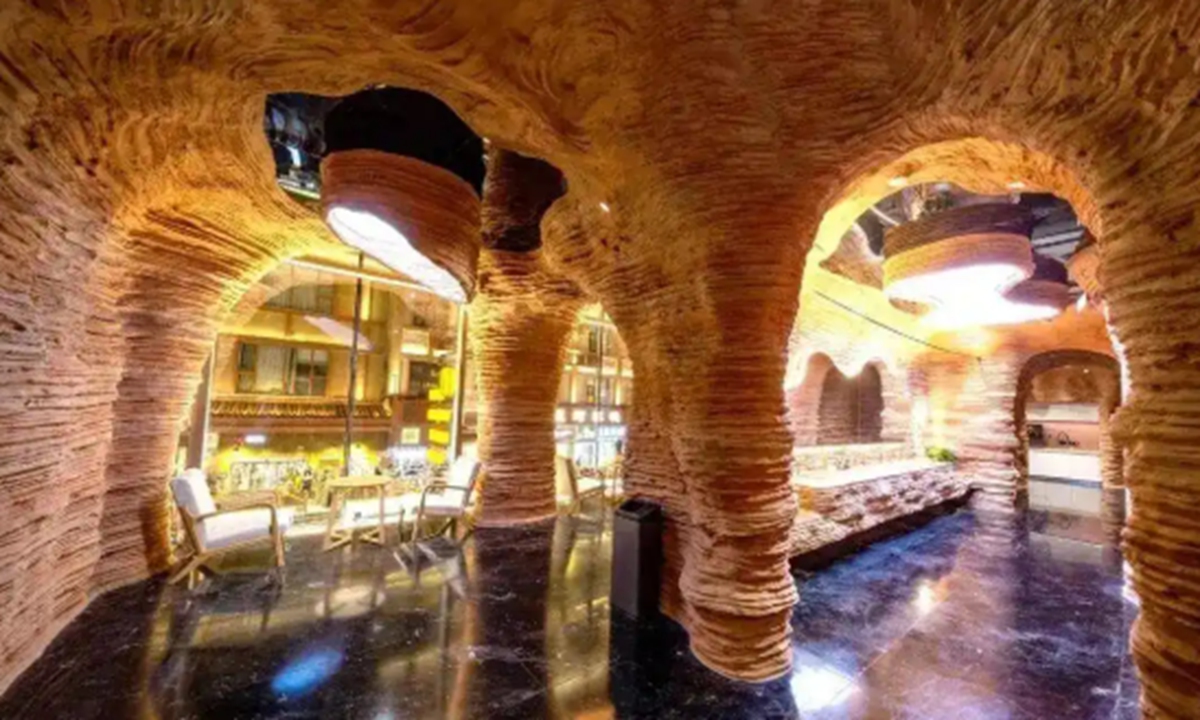
Photo: screenshot
Once again, Dunhuang in Gansu Province, one of China's most popular cultural tourism destinations, has gone trending on social media sites such as Sina Weibo and Instagram. But this time, it's not for its iconic Mogao Caves. Instead, a public toilet at the city's night market has stolen the spotlight.Unlike many public toilets, Dunhuang's is far from basic. It features decor inspired by the Yardang landforms and ornaments adorned with mural motifs, making even foreign visitors exclaim that they "want to come back to China again" because of the toilet. Behind its popularity lies the power of details: Sometimes, the most unassuming infrastructure speaks to the true quality of tourism services.
What has drawn people to the restroom is the striking contrast it creates. Traditionally, public toilets, as service infrastructure, are often evaluated by their mere functionality. User comments like "It is clean" or "It works well" are praises for such a facility since most public restrooms are stereotyped as being dirty.
But the Dunhuang restroom goes beyond just "clean" or "useful." Its aesthetic design is not just for showing how good a public toilet can be, but quietly speaks to visitors that even their most basic needs are being thoughtfully considered right along every other facet of their experiences in the city.
In other words, this seemingly banal facility can unlock visitors' favorability for a tourist destination. With the lowest-hanging fruit achieving broader city promotion, such wisdom should be noted by other sites promoting local tourism.
The toilet's decorations are also thoughts-provoking. They are not just some random aesthetic decisions, but deeply inspired by Dunhuang's local culture, showcasing the region's aesthetics. In the past, a city's core scenic areas were believed to be most appropriate to exhibit regional cultures. For example, the Mogao Caves are regarded as a symbol of Dunhuang.
Often, the cultural presentations at such sites are revered from afar, making them somewhat distant from its visitors. But, by channeling these elements into public facilities, the lofty cultural history they resemble instantly becomes more approachable by ordinary people. Through simple interactions with their users, these humble and practical facilities can carry forward local aesthetics, making them live longer in visitors' memories. More profoundly, they can even intrigue people to experience a particular culture.
"This is next-level cultural soft power," a netizen commented on Instagram.
Indeed, the Dunhuang toilet is one of many examples across China that show how public infrastructure can make cultural tourism of different regions stand out with their own specialties.
At the Ancient Kiln & Folk Customs Museum in Jingdezhen, Jiangxi Province, elements of blue-and-white porcelain pieces are incorporated into the designs of sinks, street lamps, and trash bins, emphasizing the local ceramic culture. At the Jingzhang Railway Heritage Park, industrial relics like old rails have been repurposed into installations, highlighting an innovative approach to integrating industrial heritage with tourism. Even the Yangchenghu Service Area in Jiangsu Province has been transformed into a miniature garden showing off the Jiangnan region's aesthetics, attracting thousands of visitors even on weekdays.
These facilities, so often overlooked, are challenging the formulaic approach to public infrastructure. They are like humanistic warm touches delivered by current tourist services. On a deeper level, such facilities signal a subtle shift across China's tourism development from a focus on grand cultural and natural landscapes toward curating experiential services. Therefore, what is valuable is not the facilities themselves, but the newly emerged mentality behind them.
Be it a toilet, highway service area or porcelain bins, public facilities have undoubtedly set a new benchmark for cultural tourism services. While their success is commendable, it is crucial to recognize that such infrastructure should not be designed to be a short-term stunt or sensational appeal.
Instead, they require long-term maintenance and management. Only through sustainable care can it be ensured they will continue to serve the public consistently with quality service. That is to say, the true success of the Dunhuang toilet will only be truly seen after five or 10 years, determined by whether the facility can still provide visitors the same sense of delight and surprise.
These facilities must also mature beyond their roles as photo opportunities for a specific locale. They should begin to drive more high-quality services to emerge across the entire region. The ultimate goal is to shift resources from concentrating on a few showcase projects to ensuring that high-quality facilities are widely accessible.
The author is a reporter with the Global Times. life@globaltimes.com.cn
RELATED ARTICLES