
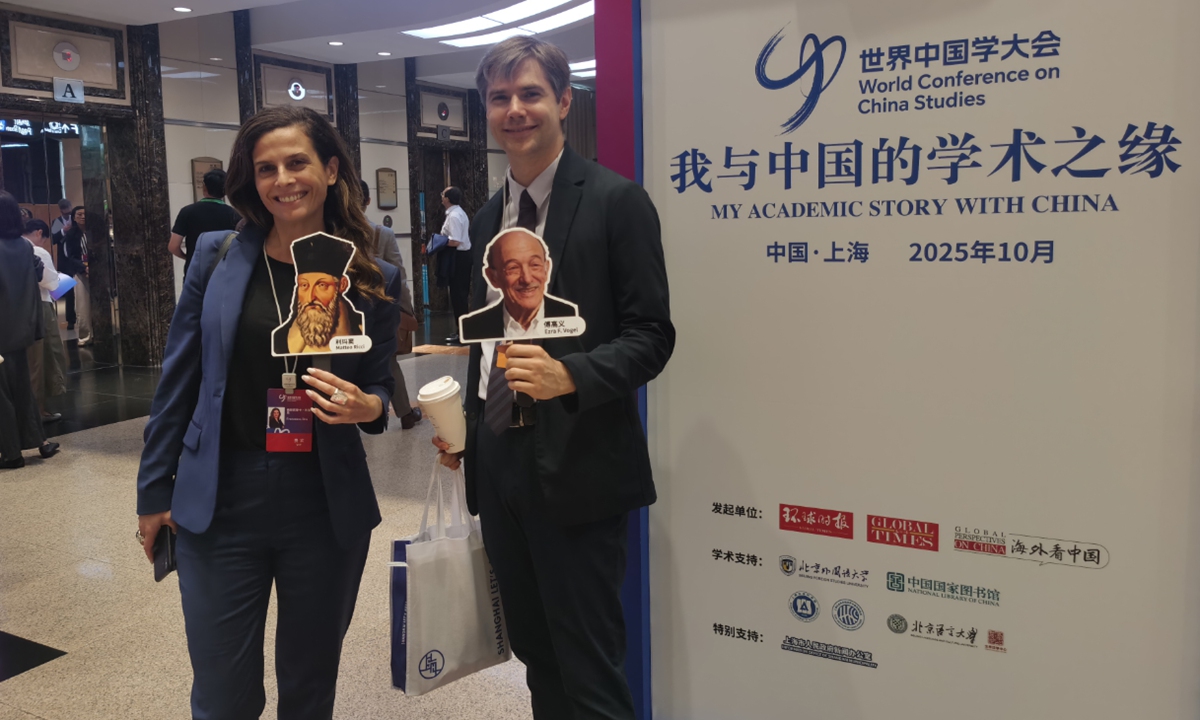
Shanghai has entered a "global China Studies moment" as it is gathering over 500 scholars from around the world in Shanghai for the Second World Conference on China Studies from Monday to Wednesday. In this city, which has witnessed countless dialogues and integration of Eastern and Western civilizations and written its own chapter in modern civilization, global China Studies researchers are once again examining China and the world, as well as history and the future through an academic lens.
Shanghai has entered a "global China Studies moment" as it is gathering over 500 scholars from around the world in Shanghai for the Second World Conference on China Studies from Monday to Wednesday. In this city, which has witnessed countless dialogues and integration of Eastern and Western civilizations and written its own chapter in modern civilization, global China Studies researchers are once again examining China and the world, as well as history and the future through an academic lens.
"Viewing the world in a Chinese context, seeing China from a global context," "breaking the information cocoon," and "the West's misreading and underestimation of China" were among the most frequently mentioned keywords at Tuesday's opening ceremony and keynote forums.
Li Bozhong, a chair professor of Humanities at Peking University, stated in his speech at the opening ceremony that studying China is not only an obligatory task for Chinese scholars but also a common mission for scholars worldwide. Therefore, it is essential to "view the world in a Chinese context and see China from a global context."
This "world" is no longer a Western-centric one, but increasingly the world of the "Global South" frequently referenced by global scholars.
Martin Jacques, a renowned British writer and commentator, noted at the opening ceremony that there are many international students in Chinese universities, most of whom come from the Global South rather than Europe or the US.
"We can also see that the globalization of China Studies research is no longer Western-centered. China has never been Westernized, nor will it be. To understand China, we must look at its own context and must not forget the roots of China's history and its modern characteristics."
In Jacques' view, a major difference between Chinese modernization and Western modernization lies in whether it benefits the world or plunders it. He said that within just a few decades, China has shifted from high-speed growth to high-quality development, achieving the greatest economic transformation in human history. It now leads the world in many emerging fields and provides development opportunities for the "Global South."
At the conference and forums, the Global Times observed a greater presence of participants from the "Global South" actively engaging in discussions on topics ranging from China's technological advancements to urban governance and the characteristics of its modernization. As one scholar at the event remarked, this signifies a shift in China Studies from a "Western-dominated discipline" to a "dialogue of diverse civilizations."
"Striving to break free from the Western narrative framework of misunderstanding" has also become a mission and sentiment mentioned by many guests, both on and off the stage.
Helwig Schmidt-Glintzer, professor emeritus for East Asian Literature and Culture at the University of Goettingen, told the Global Times, "My research clearly shows growing interest in China in African and South American countries. China is increasingly respected and noticed worldwide, and these studies no longer rely on European perspectives of China."
Nomin Enkhbat, a Chinese language teacher from Mongolia, told the Global Times in fluent Chinese, "In the field of China Studies research, the research perspectives of Western scholars may be more in line with Western contexts, but scholars from developing 'Global South' countries pay greater attention to 'what China's experience can bring to us.'"
The discussions at the main venue are a collision of ideas, while the details outside the venue show how "China Studies" has evolved from an academic topic into a tangible passion.
The frenzy at the exhibition area was particularly representative of this. Many attendees lingered at a booth showcasing the "recommended bibliography for world China Studies," flipping through books. A guest from Pakistan remarked, "In the past, we could only read English translations to learn about China. Now we can access original Chinese texts directly. This change speaks volumes."
This "looking East" enthusiasm for China Studies echoed the experience Thomas Gold, a professor of Sociology at the University of California, Berkeley, had in Shanghai's Pudong New Area: "In 1980, a Chinese friend invited me to his mother's rural home in Pudong for a meal. We took a bus to the Huangpu River ferry terminal, then another bus into the countryside, and walked a long distance to reach his mother's house. Back then, there were no skyscrapers, let alone metro systems, highways, maglev trains, or international airports. Now, the world knows Pudong as one of the most modern and technologically advanced regions on Earth." Driving from Pudong Airport into the city, I truly felt like Granny Liu from Dream of the Red Chamber [Note: a rural person who becomes completely disoriented and overwhelmed in a magnificent mansion]."
Gold pointed out that when China began its reform process, it once learned from the development models of other economies; but now, the situation is exactly the opposite as more and more countries are sending engineers and economists to China to learn and gain experience.
On Monday afternoon, one day before the opening of the conference, foreign guests conducted an on-site visit in Shanghai. They experienced the urban charm of Shanghai where future intelligence and culture converge, learned about Shanghai's model of urban governance and cultural protection, and explored the era's answer to "why China has become what it is today" through the striking practice of a "Chinese path to modernization."
Observing the practice of cultural mutual learning in Shanghai - a city that has witnessed the historical "Eastward spread of Western Learning" and "Westward spread of Eastern Learning" - is undoubtedly an excellent approach, said the foreign visitors.
Ana Flávia Machado, a scholar from Brazil, kept taking notes throughout the visit. "All the details have left a deep impression on me," she said, emphasizing the word "hope" in particular. In her view, China, which has developed rapidly in just a few decades, has given Brazil and other Global South countries a glimpse of hope. "I hope Brazil can learn from China's experience."