GT Voice: Canada’s concrete actions crucial to overcoming challenges in trade ties
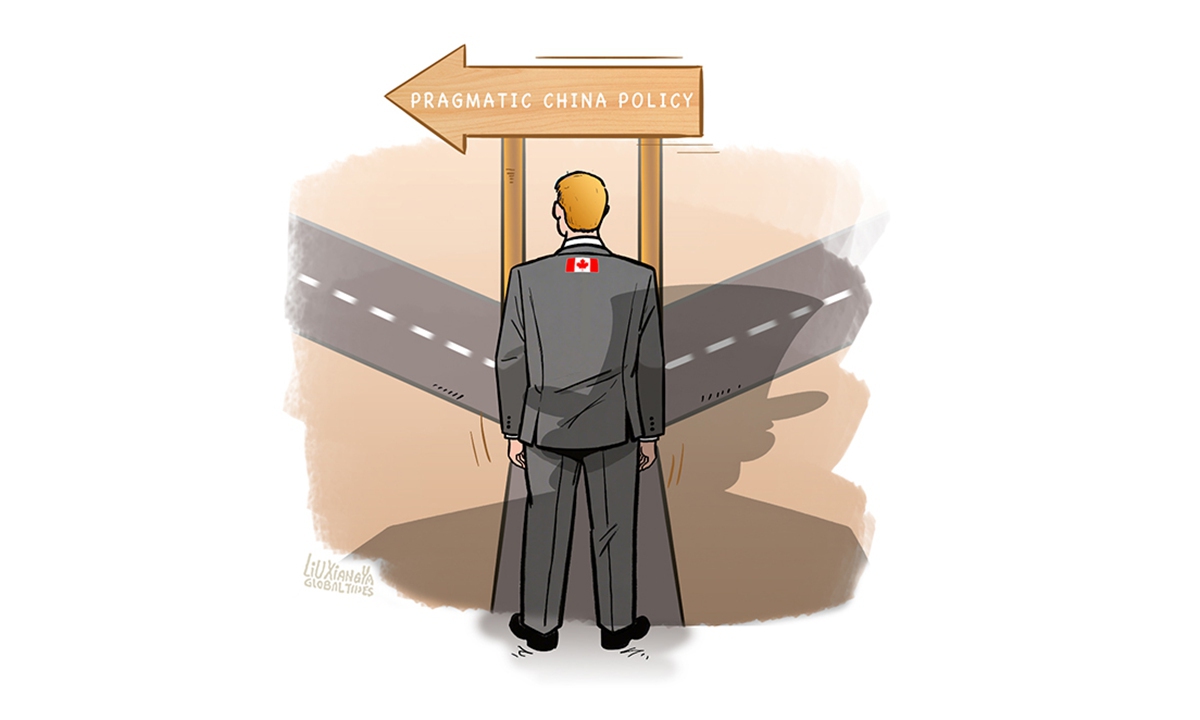
Illustration: Liu Xiangya/GT
Canada's Minister of Foreign Affairs Anita Anand will visit China from October 16 to 17 at the invitation of Wang Yi, member of the Political Bureau of the Communist Party of China Central Committee and Chinese foreign minister, a Foreign Ministry spokesperson announced on Tuesday.The news has undoubtedly drawn attention and expectations to the development of China-Canada relations, especially in the economic and trade sphere, amid the complicated global economic and trade landscape. Whether Canada can strike a pragmatic balance in its China policy based on its real economic interests has become a focal point.
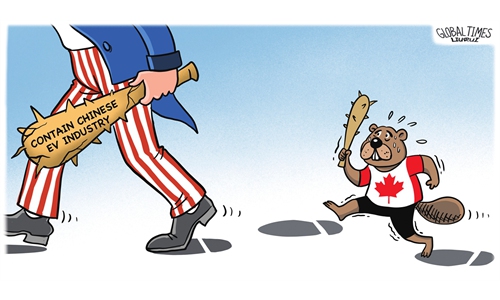
Over the past few years, Canada's policy toward China has followed the global strategic adjustments of the US, even targeting China as a strategic competitor in its overall political and economic layout. In terms of economic and trade policies, this "following" characteristic is manifested in a more direct and concrete manner. Canada has repeatedly aligned its economic and trade measures with those of the US: it has followed suit in imposing a 100 percent tariff on Chinese electric vehicles (EVs) and imposed punitive tariffs on steel and aluminum products from China.
While these actions may appear to be "standing with an ally," Canada's key domestic industries and regional economies have a deep dependence on the Chinese market. As one of the world's largest consumer markets, China is an important growth market for Canadian companies and a key destination for Canadian exports such as canola, seafood and energy. By unilaterally erecting trade barriers, Canada has deprived agricultural, manufacturing and other domestic industries of valuable market opportunities and driven up costs across domestic supply chains.
When it comes to trade issues with Canada, China's stance has always been clear. During an interview with Canadian mainstream TV network CTV News on October 10, Chinese Ambassador to Canada Wang Di stated that the trade disputes between China and Canada are not caused by China.
China is not the one to blame in this whole process. The problem originates from the Canadian side. So, if Canada takes the initiative to correct its policies, China will adjust its measures accordingly.
"China is willing to expand exchanges and cooperation with Canada in various areas, including the top-level exchanges between the two countries, which I believe play an irreplaceable and important role in advancing the bilateral relationship," Wang Di noted.
The key problem facing the current China-Canada economic relationship is to ensure the latter's action, especially its strategic alignment with the US, does not come at the expense of China's interests or undermine normal trade relations between China and Canada.
As a sovereign country, Canada may maintain close security and economic links with the US, but that doesn't necessarily mean that it has no room to adjust its policy toward China. The key question is whether Canada will continue to formulate its China policy primarily by "whether the US is satisfied," or whether it is willing to consider its relations with China from a more pragmatic, realistic perspective that better serves the interests of both sides.
If Ottawa takes concrete steps to remove discriminatory measures and engage in negotiations with Beijing in a sincere manner, China-Canada trade could quickly overcome current obstacles. On the contrary, continued hesitation and adherence to strategic alignment would ultimately miss development opportunities and lead to a lose-lose scenario.
The world economy is facing multiple challenges, including slowing growth, supply chain restructuring, and the rise of protectionism. Countries around the world are in greater need of strengthening economic and trade cooperation and smoothing cooperation channels to overcome these difficulties together. China boasts a super-large market and a complete industrial system, while Canada has unique competitiveness in fields such as agricultural products, minerals, and energy. Bilateral cooperation can inject impetus into each other's economies and contribute to the stable recovery of the global economy.
RELATED ARTICLES