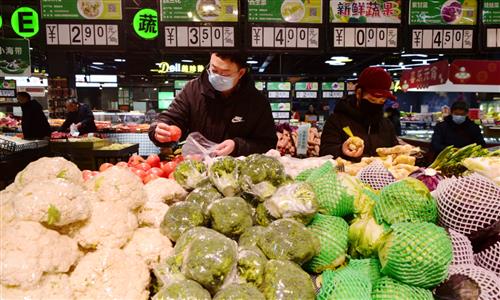
China's consumer market remains stable in Sep, with CPI down 0.3% year-on-year and up 0.1% month-on-month
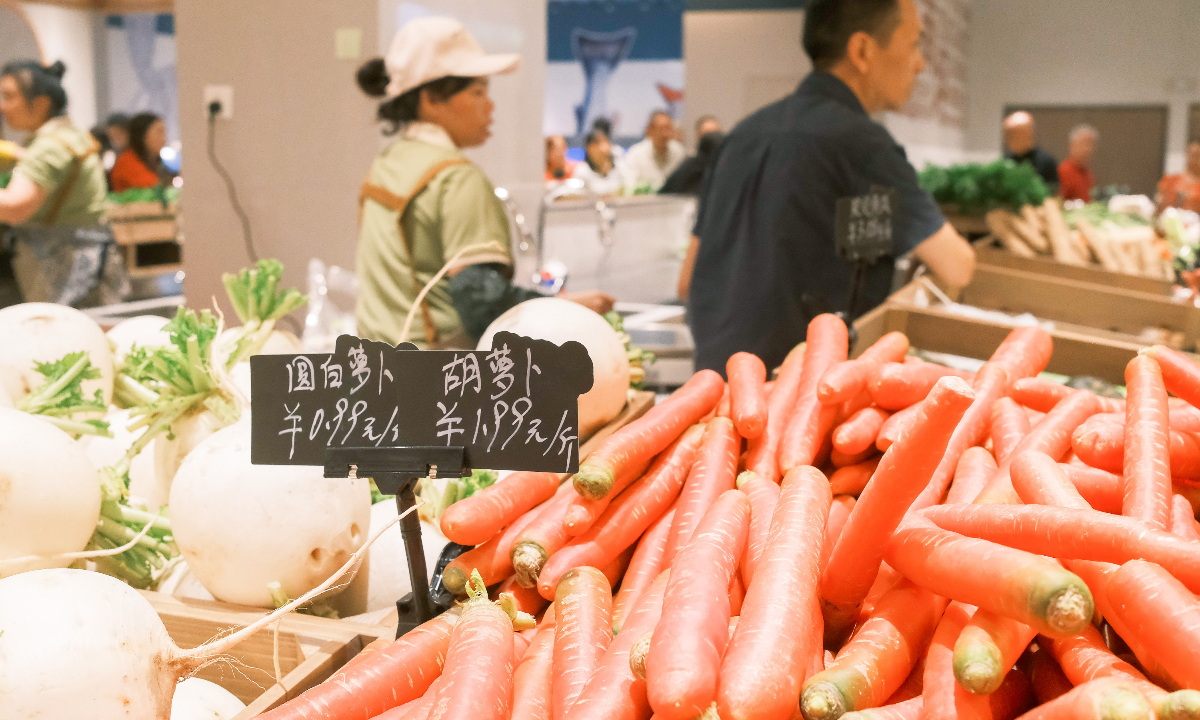
Visitors shop for fresh fruits and vegetables at the newly opened Longfor Chongqing Riverside Paradise Walk on September 30, 2025, in Southwest China's Chongqing Municipality. Photo: VCG
China's Consumer Price Index (CPI) fell 0.3 percent year-on-year in September, while rising 0.1 percent month-on-month, indicating steady momentum in domestic consumption, the National Bureau of Statistics (NBS) said on Wednesday.China's CPI fell 0.3 percent year-on-year, with prices down 0.2 percent in urban areas and 0.5 percent in rural areas. Food prices dropped 4.4 percent, while non-food prices rose 0.7 percent. Prices of consumer goods fell 0.8 percent, and service prices increased 0.6 percent. For the first nine months of 2025, the CPI edged down 0.1 percent from a year earlier.
CPI rose 0.1 percent month-on-month in September. Prices in urban areas were flat, while rural prices increased 0.2 percent. Food prices climbed 0.7 percent, non-food prices edged down 0.1 percent, consumer goods rose 0.3 percent, and service prices dipped 0.3 percent.
Dong Lijuan, chief statistician with the NBS, said China's consumer market remained generally stable in September. The CPI rose 0.1 percent month-on-month and fell 0.3 percent year-on-year, while core CPI excluding food and energy increased 1.0 percent year-on-year, marking the fifth consecutive month of expansion.
In September, prices of food, tobacco and alcohol dropped 2.6 percent year-on-year, dragging down the CPI by about 0.74 percentage points, according to the NBS. Among major food categories, vegetable prices fell 13.7 percent, eggs 11.9 percent, and meat 8.4 percent — with pork prices down 17.0 percent — while fresh fruit prices declined 4.2 percent and grain prices edged down 0.7 percent. In contrast, aquatic product prices rose 0.9 percent, pushing CPI up by about 0.02 percentage points.
Prices in other seven major categories rose year-on-year in September. Prices for other goods and services, household items, and clothing increased by 9.9 percent, 2.2 percent, and 1.7 percent, respectively, while healthcare, education and culture, and housing rose by 1.1 percent, 0.8 percent, and 0.1 percent. Transportation and communication prices fell 2.0 percent.
In September, prices of food, tobacco and alcohol rose 0.5 percent month-on-month, pushing up the CPI by about 0.13 percentage points. Among food items, vegetable prices rose 6.1 percent, eggs 2.7 percent, and fresh fruit 1.7 percent, contributing increases of 0.13, 0.02 and 0.03 percentage points to the CPI, respectively. In contrast, aquatic product prices fell 1.8 percent and pork prices declined 0.7 percent, dragging the CPI down by about 0.04 and 0.01 percentage points.
Month-on-month, prices in four categories rose, one was unchanged and two fell. Prices for other goods and services and clothing rose 1.3 percent and 0.7 percent, while household goods, services and healthcare edged up. Housing remained flat, and prices for transport, communication and culture fell slightly.
Dong also said that as China continues to advance the development of a unified national market and improve market competition, the Producer Price Index (PPI) remained flat month-on-month in September, while falling 2.3 percent year-on-year, narrowing by 0.6 percentage points from August.
The PPI remained flat month-on-month for the second consecutive month in September. According to the National Bureau of Statistics, improved supply and demand conditions helped stabilize prices in several industries, Dong said.
Prices for coal processing rose 3.8 percent, coal mining 2.5 percent, and ferrous metal smelting 0.2 percent, all posting gains for two months in a row. Prices for photovoltaic equipment turned from a 0.2 percent decline to a 0.8 percent increase. In contrast, prices for non-metallic mineral products and lithium batteries fell 0.4 percent and 0.2 percent, but at a slower pace than the previous month, according to Dong.
Meanwhile, lower global oil prices drove declines in domestic petroleum-related industries, with crude oil extraction prices down 2.7 percent, refined oil down 1.5 percent, organic chemical raw materials down 0.6 percent, and chemical fiber manufacturing down 0.2 percent, according to Dong.
Global Times
RELATED ARTICLES