China unveils homegrown 90GHz real-time oscilloscope, shattering decades of foreign tech blockade
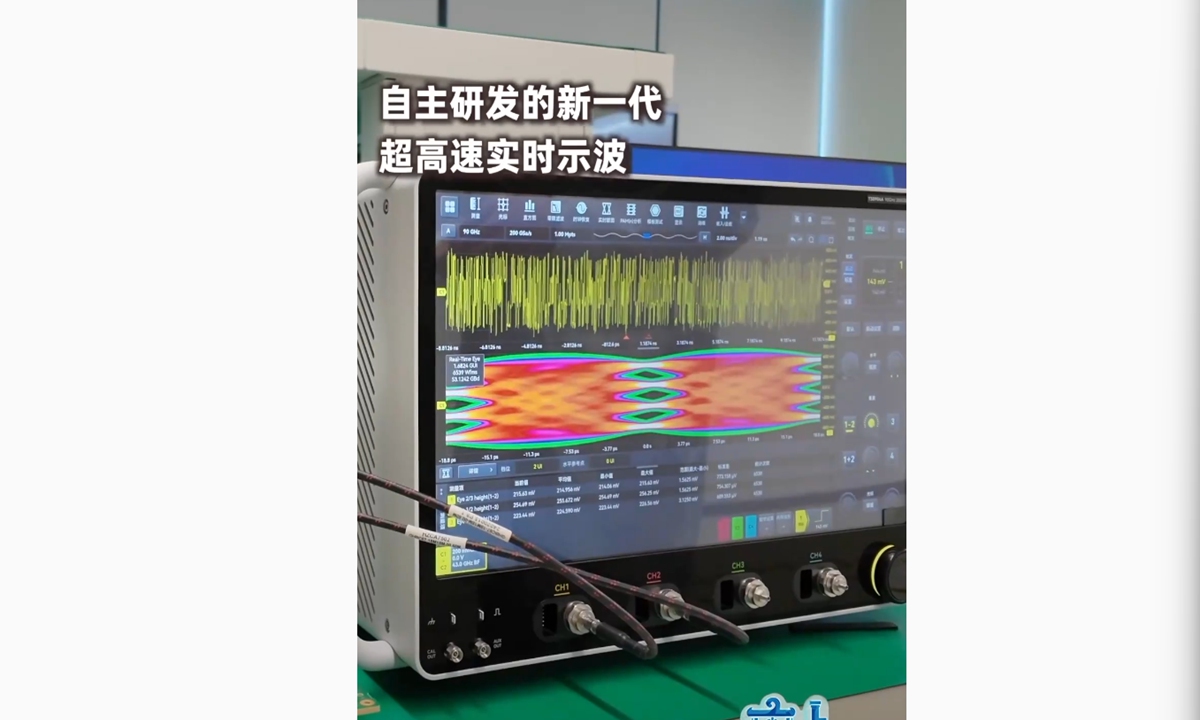
Chian's homegrown 90GHz ultra-high-speed real-time oscilloscope is unveiled at the 2025 Greater Bay Area (GBA) Semiconductor Industry Ecosystem Expo on October 15, 2025. Photo: video screenshot from CCTV News
China unveiled its homegrown 90GHz ultra-high-speed real-time oscilloscope on Wednesday, a major milestone in high-end electronic measurement technology that shatters the decades-long foreign tech stranglehold, state broadcaster CCTV News reported.
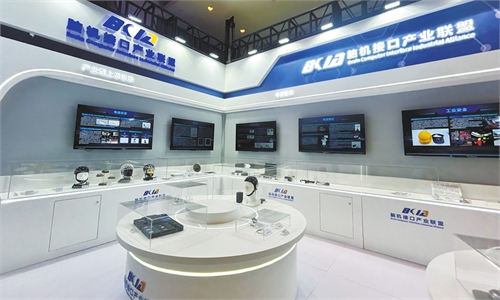
This achievement was announced at the 2025 Greater Bay Area (GBA) Semiconductor Industry Ecosystem Expo, a major industry event running from Wednesday to Friday.
It marks China's oscilloscope technology reaching cutting-edge international levels, ushering in the era of the "China Standard" for ultra-high-speed signals in telecommunications field, according to another report by Xinhua News Agency.
The product boosts the key performance of domestically made oscilloscopes by 500 percent, while integrating innovative features like intelligent auto-optimization and server-grade computing power. It boasts a sampling rate of up to 200 billion samples per second and a memory depth of 4 billion sample points, enabling precise capture and analysis of transient signals in nano-scale chips, the CCTV News report said.
The instrument will provide critical support for research and development in China's next-generation telecommunications, artificial intelligence, and aerospace related technologies.
Oscilloscopes, as essential upstream equipment in science and industry, are widely used in product research and development, testing, and manufacturing. They convert invisible electrical signals into visible images, serving as the "eyes" and "ruler" for engineers and scientists.
Overseas high-end oscilloscopes achieve bandwidths exceeding 60GHz, while domestic models fall below 20GHz, presenting a bottleneck for China's high-end oscilloscopes.
The leap from 20GHz to 90GHz bandwidth stems from years of relentless R&D efforts and deep collaboration between industry, academia, and research.
Liu Sang, CEO of Longsight Tech, the developer, said that it requires sustained integrated innovation, involving cross-disciplinary fusion and systemic optimization across foundational materials, precision manufacturing, core chips and algorithm, per the Xinhua report.
Collecting signals under ultra-high bandwidth, for instance, is as challenging as trying to catch a waterfall with a strainer — the slightest instability makes it difficult to filter out the essential data, Liu said, adding, "Through countless rounds of algorithm optimization, we have significantly enhanced "marking" efficiency, achieving a comprehensive upgrade in signal acquisition and processing performance, boosting testing efficiency, and enabling leaps across multiple product generations."
Currently, the oscilloscope has been applied and tested at multiple enterprises and research institutions, including Huawei and Shanghai Jiao Tong University, Xinhua reported.
In August this year, Longsight Tech, the Institute of Microelectronics of the Chinese Academy of Sciences, and other primary contributors to the core technologies and applications of ultra-high-speed real-time oscilloscopes received the 2025 First Prize for Technological Invention from the China Instrument and Control Society.
Cui Xiaohai, a researcher at the National Institute of Metrology, said the innovative breakthrough in ultra-high-speed real-time oscilloscopes will help promote "Chinese standards," and help innovation in semiconductors, 6G, optical communications, and smart vehicle driving.
At the 2025 GBA Semiconductor Industry Ecosystem Expo, the new product has drawn widespread attention from industry players. The event covers more than 60,000 square meters of exhibition space, with over 600 participating companies and a lineup of high-profile forums offering innovative firms a prime platform to connect with global standards, according to Xinhua.
Global Times
RELATED ARTICLES