Exclusive: Washington's threat on Chinese cooking oil likely focuses on 'used cooking oil,' proves ineffective as leverage: industry source
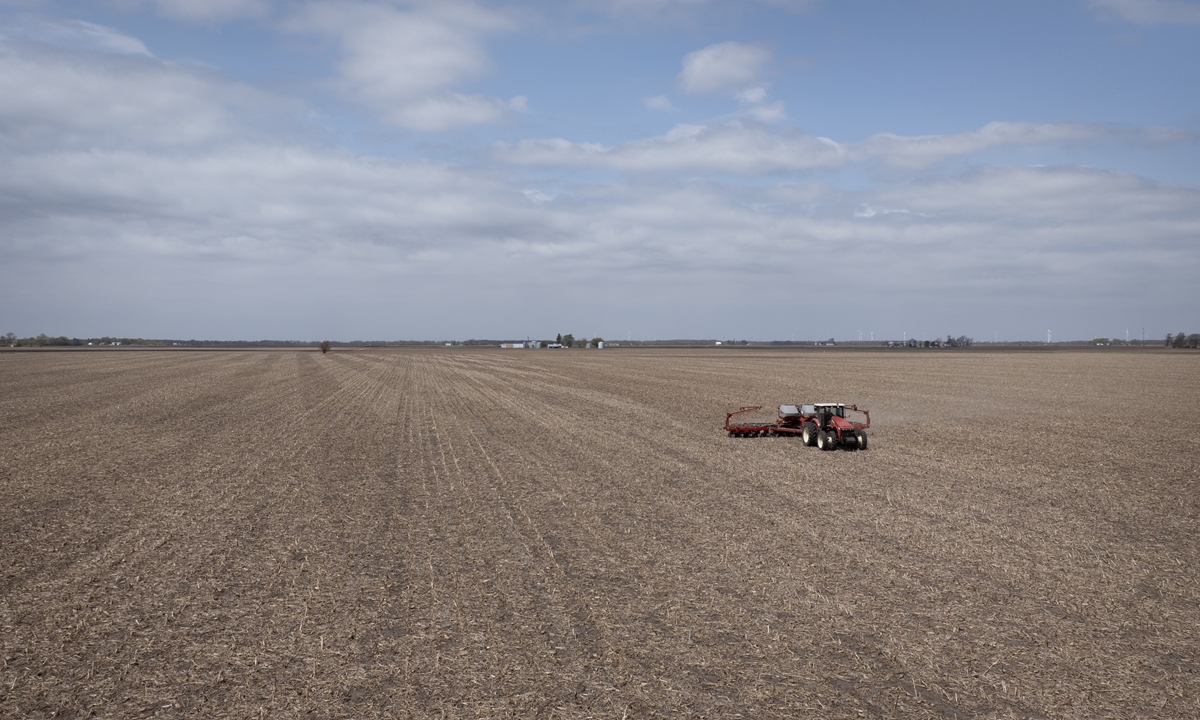
Dan Duffy uses a tractor to plant soybeans on land he farms with his brother on April 28, 2025 near Dwight, Illinois, US. Duffy, like many farmers, is concerned about the long-term impact tariffs may have on soybean exports to China as China looks to other countries like Brazil and Argentina, the world's largest and third largest producers of soybeans, for a cheaper alternative. Photo: VCG
The US administration threatened on Tuesday to halt purchases of Chinese cooking oil in response to China's reduced imports of American soybeans. But an industry insider told the Global Times on Wednesday that Washington's claim about "terminating business with China related to cooking oil" likely refers to suspending imports of China's used cooking oil (UCO).
The US administration said on Tuesday that it is considering "terminating business with China having to do with Cooking Oil" in retaliation for Beijing refusing to buy US soybeans, according to a CNBC report on Tuesday.
China is the world's largest consumer and importer of soybean oil and edible oil, and it exports very little edible oil, the insider noted. In 2024, China exported about 4,000 tons of edible oil to the US, worth roughly $10 million, data showed.
By contrast, the US is the largest destination for China's exports of used cooking oil. In 2024, China exported more than 1 million tons of such oil to the US, valued at over $1 billion, per industry data.
This shows that the value of China's exports of used cooking oil to the US last year was about 100 times that of its edible oil exports to the country. "So, it can be inferred that when the US side claims it considers 'not buying Chinese edible oil,' it likely refers specifically to 'not buying Chinese used cooking oil,'" the insider said.
Used cooking oil, once collected and processed, can be utilized as a raw material for renewable energy products such as biodiesel, the insider said. As the world accelerates its green transition, demand for used cooking oil has exceeded supply both in domestic and international markets.
"Even if the US stops buying from China, there is no shortage of buyers for China's used cooking oil," the insider said, stressing that such a move would ultimately prove ineffective as leverage against China.
Data from the US Department of Agriculture (USDA) show that the country's imports of edible oil for food use mainly come from Canada, Indonesia, and the European Union.
Chinese exports of used cooking oil to the US were already in retreat, Bloomberg reported. Having hit a record 1.27 million tons — worth $1.2 billion — in 2024, Chinese sales of processed edible oils to the US, mainly UCO, have plunged this year after Beijing scrapped tax relief on exports. Over the first seven months, sales were 387,000 tons versus 684,000 tons in the same period last year, according to Bloomberg, citing the US Department of Agriculture.
When asked to comment on the US administration's accusation of China of "purposefully not buying" soybeans from the US" and its claims that it is considering terminating trade in cooking oil with China in retaliation, Chinese Foreign Ministry spokesperson Lin Jian said at a regular press conference on Wednesday that China's position on the economic and trade issues between China and the US is consistent and clear.
Tariff and trade wars have no winners and do not serve any party's interest. The two sides need to address relevant issues through consultation on the basis of equality, respect and mutual benefit, Lin said.
Global Times
RELATED ARTICLES