Shanghai-Singapore cooperation demonstrates resilience and progress despite global uncertainties
By Published: Oct 15, 2025 10:22 PM
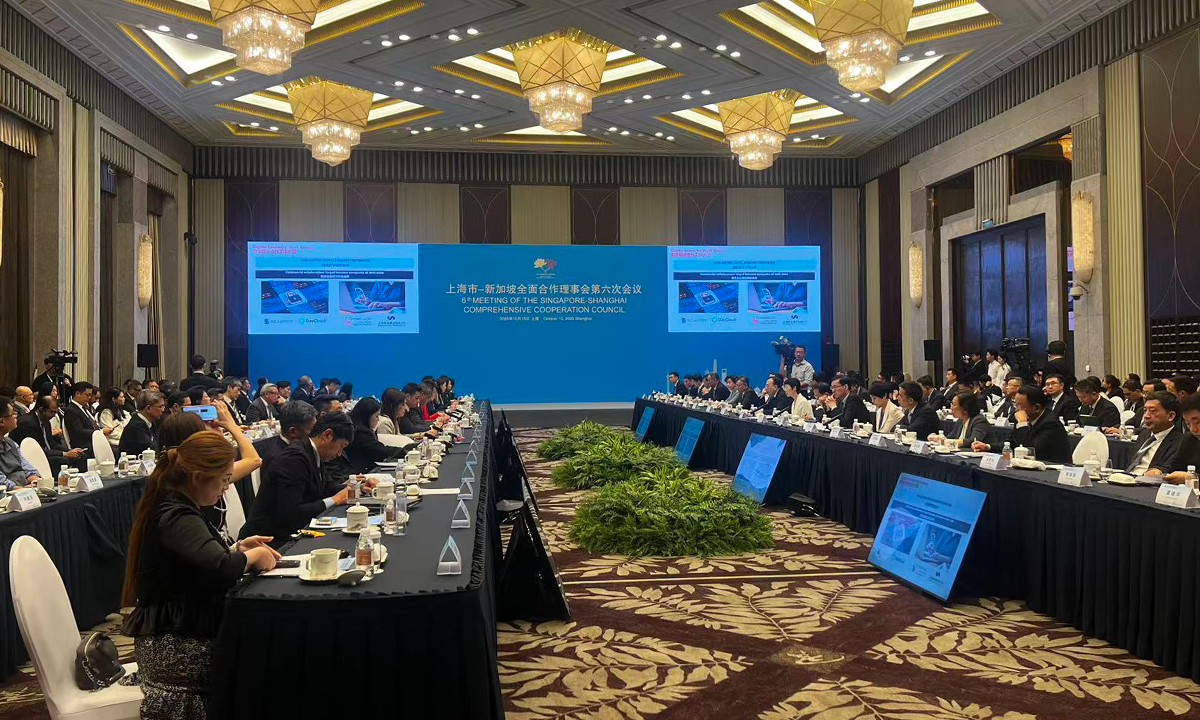
The 6th meeting of the Singapore-Shanghai Comprehensive Cooperation Council (SSCCC) is held in Shanghai on October 15, 2025. Photo: Wang Jiamei/GT
The 6th meeting of the Singapore-Shanghai Comprehensive Cooperation Council (SSCCC) was held in Shanghai on Wednesday, marking a more solid step forward in deepening pragmatic cooperation between Shanghai and Singapore across various fields.
This year marks the 6th anniversary of the establishment of the SSCCC, and the two regions have implemented 52 cooperation memorandums of understanding (MOUs) in areas such as the Belt and Road Initiative, fintech innovation, digital economy, urban governance, and people-to-people exchanges, Shanghai's Mayor Gong Zheng said at the meeting on Wednesday.
In the first half of this year, the trade volume between Shanghai and Singapore reached nearly 65 billion yuan ($9.1 billion). During the same period, 171 Singaporean companies were newly established in Shanghai, with the actually utilized foreign investment exceeding $1.4 billion. By the end of the first half of this year, Shanghai had launched a total of 666 direct investment projects in Singapore, with the recorded investment surpassing $8.5 billion, according to Gong.
"Although the global landscape has remained uncertain, our partnership has demonstrated resilience and also robust progress," Edwin Tong, Singapore's minister for law and second minister for home affairs, said. "This is rather the fruit of intentional,a very sustained collaboration over the years."
A total of 18 memoranda of cooperation between Singapore and Shanghai were signed at the meeting, including a cooperation memorandum between Shanghai International Arbitration Center and Ministry of Law, Singapore, a memorandum between Science and Technology Commission of Shanghai Municipality and Enterprise Singapore, a memorandum between Shanghai International Intellectual Property Operation Management Co and Sinnobator and Singapore's KLTAN LLC, and a memorandum between Shanghai Xinwei Technology Co and OIP Technology.
Commenting on the cooperation memorandums, Pan Xi, chairman of Shanghai International Intellectual Property Operation and Management Co, said that Shanghai's strengths lie in institutional innovation and policy flexibility, while Singapore's advantages are in international standardization and a sound legal system. The two sides are highly complementary.
"We can learn from Singapore's mature experience in international arbitration, impartial rulings, and trade secret protection. Simultaneously, Shanghai's explorations in the financialization of intellectual property, digital operation, and the commercialization of scientific and technological achievements can provide new ideas for Singapore," Pan told reporters on Wednesday.
"Singapore is a very important international partner for our 'bringing in' and 'going global' push. Singapore naturally shares cultural commonalities with China, and communication is relatively easy, not to mention Singapore's world-class universities," Ren Jia, chairman of Shanghai Xinwei Technology Development Co, told the Global Times on Wednesday.
For tech startups in Shanghai, especially in more sensitive fields like integrated circuits, semiconductors, and smart sensors, Singapore is a crucial gateway if they want to achieve global expansion, Ren noted, adding that Shanghai, meanwhile, also hopes to attract overseas tech startups and teams to Shanghai.
"For entrepreneurial teams from Singapore, if they aim for industrialization and market application, China is a very suitable market," Ren said.
This year also marks the 35th anniversary of the establishment of diplomatic relations between China and Singapore. China has been Singapore's largest trading partner in goods for 12 consecutive years, and Singapore the largest source of new investment in China. Singapore is the first Southeast Asian country to sign a bilateral free trade agreement with China, was also among the first countries to support China's reform and opening-up policies.
RELATED ARTICLES