ARTS / CULTURE & LEISURE
Inheritor's creative take breathes new life into ancient art 'Gaotai Shehuo'
Rising above tradition
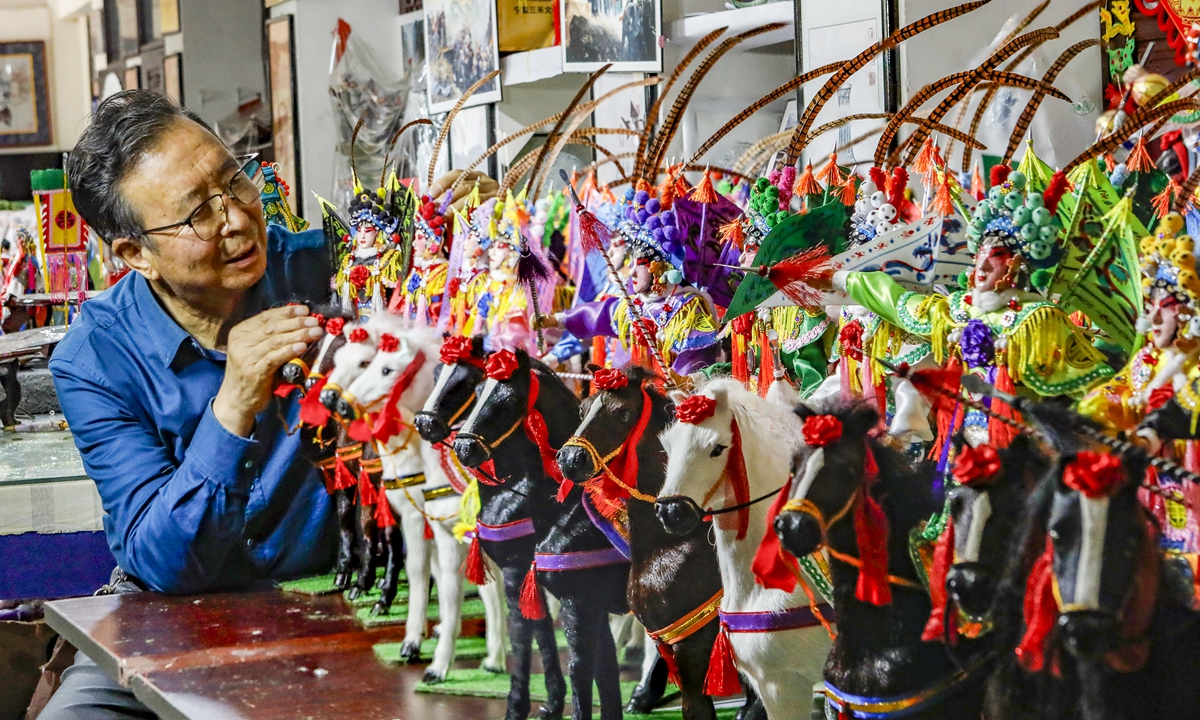
Zhang Guoqin checks on the Shehuo miniatures. Photo: Courtesy of Zhang Guoqin
At an intangible cultural heritage (ICH) exhibition event recently held in Longde county, Northwest China's Ningxia Hui Autonomous Region, Gaotai Shehuo, a time-honored folk performance sprouting from the county, saw performers, dressed like characters from ancient legends, parade on elevated platforms to the resounding beat of gongs and drums, seeming to step out from the long river of history.
Zhang Guoqin, inheritor of the national ICH Gaotai Shehuo, told the Global Times that he was happy to see that many young people have been engaged in the preparations of the exhibition parade during the Mid-Autumn Festival, which is one of the ICH exhibition events held across Ningxia during the holidays.
The so-called Gaotai, or high platform, refers to a structure adapted from traditional offering tables by folk artists into 12-meter-tall raised stages.
Children around the age of 10, dressed in opera costumes and wearing heavy makeup, portray characters from classical Chinese masterpieces such as The Romance of Sui and Tang Dynasties and The Romance of the Three Kingdoms, Zhang said.
Originating from ancient sacrificial activities to pray for a good harvest about 2,000 years ago, the Gaotai Shehuo parade performance usually held during the Spring Festival is a comprehensive folk art form that integrates traditional Chinese opera, painting, paper craft, iron forging, woodwork, sculpture and mechanics.
It was inscribed on the national ICH list in 2008. Later, stilt walkers, yangko dancers, lion dancers, and waist drum troupes also joined the parade.
Every year, the making of props for Gaotai Shehuo requires a tremendous investment of time and the collective efforts of many local folk artisans.
The process integrates a wide range of traditional crafts, including welding, ironwork, woodworking, sculpture, clay modeling and painting.
In addition, both the creation of props and the performances themselves rely heavily on theatrical knowledge.
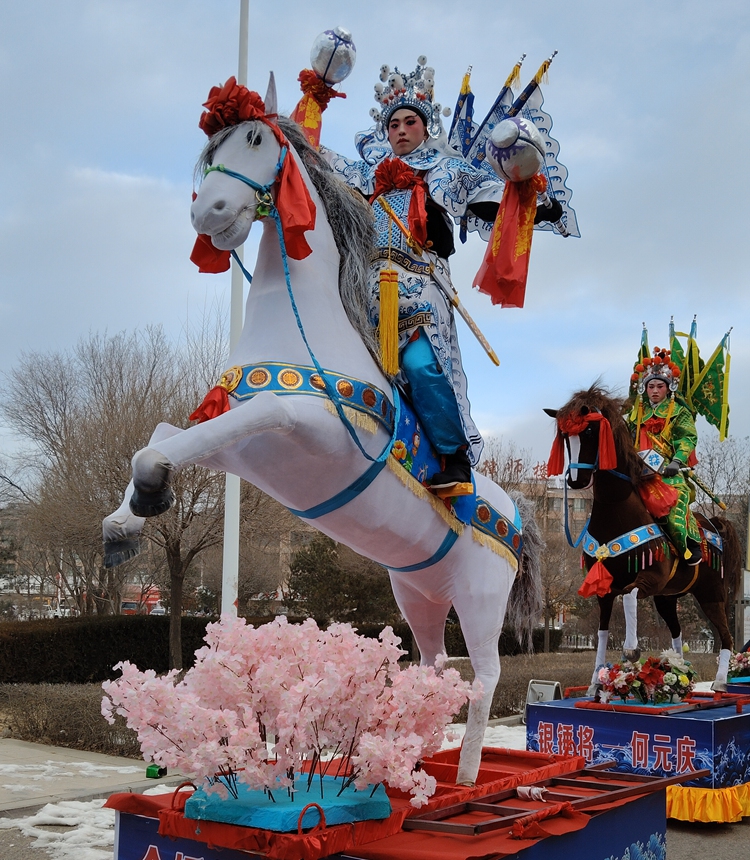
A man performs Gaotai Shehuo during a parade. Photo: Courtesy of Zhang Guoqin
Preserved in miniature
From the inheritor's perspective, the value of Gaotai Shehuo lies not only in passing down this unique folk performance, but also in preserving and carrying forward the diverse folk crafts that have been handed down through generations since ancient times.
Since taking up the cultural heritage from his family in 1978, Zhang acknowledged that the biggest challenge of carrying forward the crafts is the dwindling number of participants and he has been exploring ways to get more young people interested and engaged in the cause.
In recent years, building on the tradition of Gaotai Shehuo, 71-year-old Zhang has gradually developed a distinctive artistic style of his own.
Through his creative efforts, he transformed the props into miniature exhibition pieces, enabling more people to appreciate its profound value at any time.
"I transform the techniques I have mastered over decades into scaled-down Shehuo miniature exhibits. In the past, people could only see them during the first month of the lunar year, but now, through exhibitions, both locals and tourists have the chance to learn about Gaotai Shehuo at any time, such as the craftsmanship involved in making the characters' hats and costumes," he noted.
"I currently work on these creations every day, presenting the memories I have accumulated over the years, so that future inheritors can follow these standards in their own work," said Zhang.
Rooted in Yellow River
Inheritor Zhang noted that as a folk art derived from the area along the Yellow River, the Gaotai Shehuo is not only an artistic expression of the agrarian civilization along the river, but also a vessel of the people's collective memory and spiritual beliefs rooted in Yellow River culture.
"The ancient rituals to worship the earth and pray for good harvest align with the widespread practices of nature worship and ancestor veneration in the Yellow River basin, reflecting people's reverence for and gratitude toward nature and the land," he said.
"When we bring to life the heroic figures of the classic literature on lifted platforms during the parade, the imposing vigor is reminiscent of the mighty image of the Yellow River," Zhang said.
Wan Yaping , president of Ningxia Intangible Cultural Heritage Safeguarding Association, told the Global Times that the continued inheritance of Ningxia's intangible cultural heritage has been nurtured by the Yellow River culture.
Among the nine provinces (regions) along the Yellow River, Ningxia is the only one whose entire territory is covered by the Yellow River basin .
"It is the nurturing of the Yellow River that has given birth to Ningxia's rich and diverse intangible cultural heritage. All of Ningxia's intangible cultural heritages are intricately connected with the Mother River and constitute an integral part of Yellow River culture," Wan noted.
Founded in June, the establishment of the association highlighted a key step in breaking through the bottlenecks in the development of ICH protection in Ningxia.
It not only provides a platform for inheritance and innovation, but also attracts industry talent and promotes the protection, transmission, dissemination, and development of ICH, according to Wan.
"Leveraging digital technologies, we are currently working on creating perceptible and immersive interactive spaces and scenarios for intangible cultural heritage, in order to attract more young people to participate in its preservation and transmission, and to inject new vitality into its development," said Wan.
RELATED ARTICLES