Chinese experts criticize US for weaponizing visas as Panama says embassy threatened cancellations over China ties
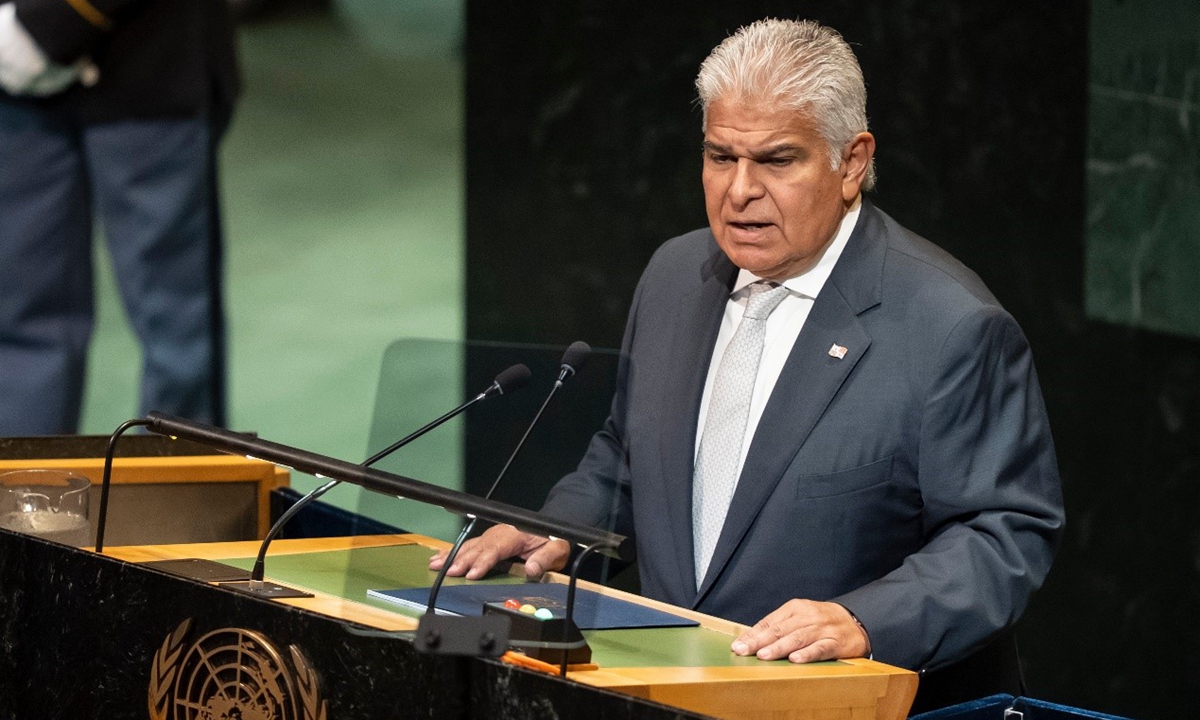
Panama President José Raúl Mulino speaks during the 80th session of the United Nations General Assembly, on September 24, 2025, at UN headquarters. Photo: VCG
Panama President José Raúl Mulino said Thursday that someone at the US Embassy has been threatening to cancel the visas of Panamanian officials as the Trump administration pressures Panama to limit its ties to China, the Associated Press (AP) reported Thursday.
Chinese experts criticized the US' move of weaponizing visas, noting that by interfering in other countries' affairs without clear legal or moral justification under international law, the US is undermining its own international credibility.
Responding to a question at his weekly news conference, Mulino said without offering evidence that an official at the US Embassy is "threatening to take visas," adding that such actions are "not coherent with the good relationship I aspire to maintain with the US." He did not name the official.
According to AP, US Ambassador to Panama Kevin Marino Cabrera said in a statement Thursday that "a visa is a privilege, not a right." He cited a US policy announced in September by the State Department to restrict visas to Central American citizens who engage in cooperation with China to undermine the rule of law in the region.
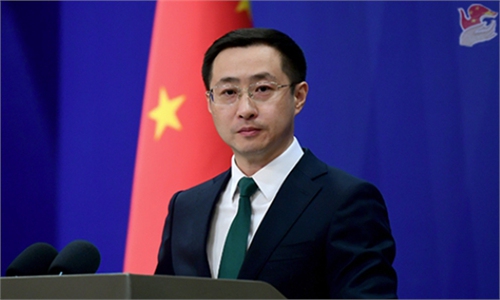
Previously, in response to US Secretary of State Marco Rubio's claim that Washington was restricting visas for this reason mentioned by Cabrera, Chinese Foreign Ministry spokesperson Lin Jian said at a regular press conference in September that China deplores and firmly opposes the US' baseless vilification, coercive diplomacy and blatant interference and sabotage against China's relations with Central American countries.
The US' inflammatory finger-pointing at Central American countries' exchanges and cooperation with China is entirely groundless and shows the US' complete lack of respect for Central American countries. That once again reflects how the US is accustomed to bullying the "small guys" in international relations. The statement once again reveals relevant politician's deep-seated ideological bias and Cold-War mentality, Lin said.
Weaponizing visas will not scare off the sober-minded. Nor will it hold back the flourishing ties between China and Central American countries. China will continue to strengthen exchange and cooperation with Central American countries, contribute to the prosperity of local communities, and deliver more tangibly to their peoples, the spokesperson added.
However, the US has recently been frequently using visa policy as a diplomatic tool in Latin America.
In April, former Costa Rican President and Nobel Peace Prize laureate Óscar Arias said he had his visa to enter the US revoked, CNN reported. Three months later, the vice president of Costa Rica's Congress also said that the US Embassy told her the US had revoked her visa because of alleged contacts with Chinese side, according to The Hill.
According to BBC News, in September, Colombian President Gustavo Petro used his speech at the UN to deliver a scathing rebuke of US strikes on boats suspected of being used to transport drugs, arguing that the actions were not about controlling the drug trade but about using "violence to dominate Colombia and Latin America." Shortly afterward, the US announced it would revoke Petro's visa.
The current US government has repeatedly hyped the "Panama Canal issue" and the so-called "China threat," using them to pressure Panama.
In February this year, Rubio began his first official foreign trip with a stop in Panama. According to Reuters, Rubio warned Panama's President Jose Raul Mulino that Washington will "take measures necessary" if Panama does not immediately take steps to end what the US President sees as "China's influence and control over the Panama Canal."
Panama's government and some experts reject that assertion, mainly because the ports are not part of the canal's operations. The canal is operated by the Panama Canal Authority, an autonomous agency overseen by the Panamanian government, Reuters reported.
Interfering with other companies and countries arbitrarily, without regard for international law or any principles of international morality, ultimately only damages the US's own reputation, shooting itself in the foot, Lü Xiang, a research fellow at the Chinese Academy of Social Sciences, told the Global Times on Friday.
"The US has long treated Latin America as its 'backyard' and is particularly wary of China deepening ties with countries in the region. Its intentions appear highly sinister, using the Panama Canal issue to drive a wedge between China and Latin America," Jiang Shixue, a professor at the Center for Latin American Studies at Shanghai University, told the Global Times on Friday.
"The weaponization of visas will not end here. Unrestrained, the US may carry out more actions in the region that violate international law and moral principles," Lü added.
RELATED ARTICLES