China accelerates decarbonization, charting path to sustainable future
Clean surge, clear strategy

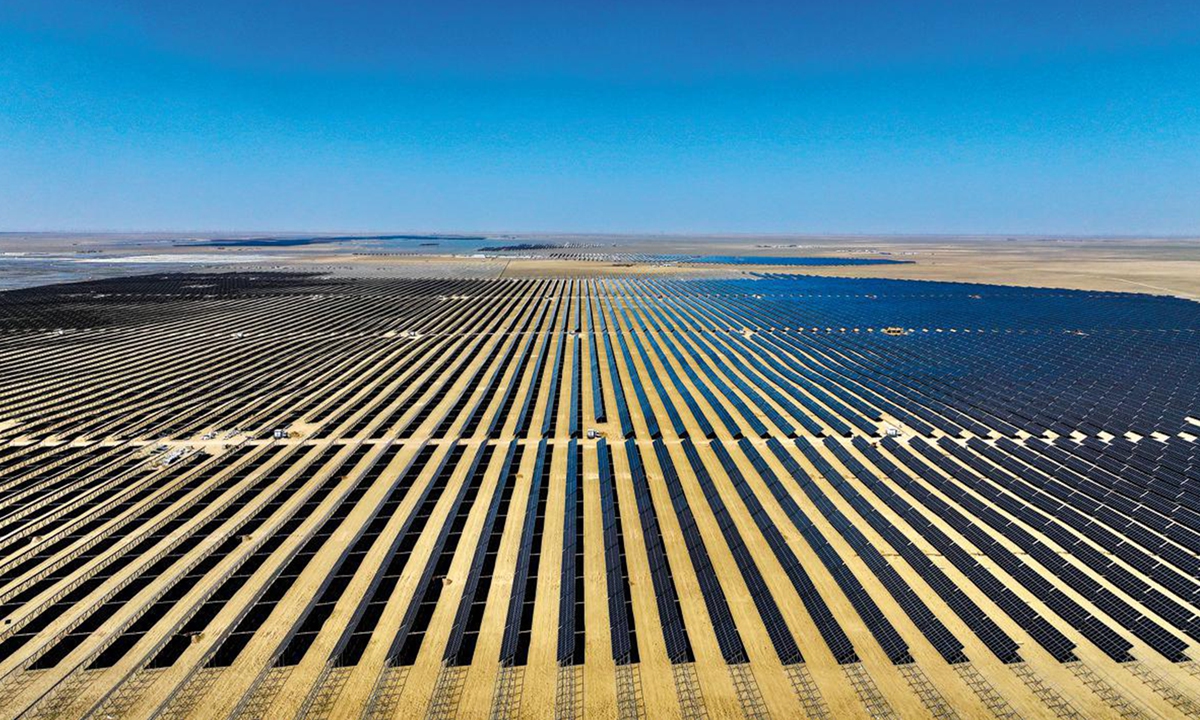
An aerial view of a large photovoltaic plant in China's desert, where vast arrays of solar panels stretch endlessly across the arid landscape Photo: MF
On September 14, in the arid expanse near the Gobi Desert in North China's Inner Mongolia Autonomous Region, a landmark wind farm was inaugurated - boasting 150 turbines, each with a capacity of 10 MW, arranged in a matrix structure that ranks as the largest of its kind worldwide. Operated by the Inner Mongolia Energy Group, the facility is projected to generate up to 5.44 billion kilowatt-hours of clean electricity annually, slashing carbon dioxide emissions by nearly 5 million tons each year.The project underscores China's elevated emphasis on ecological and environmental protection, which now holds priority status alongside energy and food security. This strategic focus forms the foundation of China's commitment to peak carbon emissions by 2030 and achieve carbon neutrality by 2060.
According to China's National Bureau of Statistics, China's total economic output in 2023 has increased 223 times compared to 1952, with an average annual growth rate of 7.9 percent. Specifically, China's GDP surpassed 126 trillion yuan (about $18 trillion) in 2023. The GDP in 1952 was just 67.9 billion yuan.
China has also developed the 41 major industrial categories according to the United Nations Industrial Classification.
Moreover, Chinese industrial automation has now surpassed that of any European country, even overtaking Germany in the number of industrial robotic machines installed per 10,000 workers.
More and more Chinese companies have become global leaders, capturing increasing market shares in their respective sectors. Chinese shipyards have secured about 70 percent of new global orders; China's share of the global electric vehicle (EV) market has reached about 76 percent; and Chinese solar panels account for over 80 percent of the global share, according to media reports.
This indicates that, particularly since the 1990s, China has risen to the forefront of global manufacturing in a relatively short timeframe. Rapid development has given rise to certain ecological and environmental challenges, such as air and water pollution. However, China has recognized that it cannot pursue development at the expense of the ecological environment.
It has clearly prioritized ecological and environmental protection, rejecting the outdated path of chasing short-term economic growth by sacrificing the environment. Therefore, China has taken proactive steps. It has explicitly positioned ecological and environmental protection as a critical priority, embedding principles like green, low-carbon development, and sought cooperation with other countries, with Italy being key among them.
For instance, large-scale Chinese offshore and utility-scale projects have established cooperation with Prysmian in the supply of submarine and terrestrial cables. Prysmian is a Milan-based group that has grown into a global leader in the cable sector, and it has maintained a presence in China for many years, operating several manufacturing facilities. The production of low-nitrogen chemical fertilizers is one of the flagship products of the Maire-Nextchem group, which has won several contracts in China for the restructuring of highly polluting chemical plants.
In the field of hydrogen and multi-molecule networks, two leading Italian companies, Snam and De Nora, have launched cooperation projects with Chinese players along the green hydrogen production chain. And then there are countless plants installed for industrial efficiency and heat recovery, ORC and large heat pumps from Turboden for steel, cement and glass, and energy efficiency systems for buildings produced in Suzhou by Carel, while the Chinese plants of Italmatch, a multinational group based in Genoa, have made a significant contribution to industrial water purification treatments.
What has happened in recent years has demonstrated China's decision-making responsiveness, which has modified its strategy related to its productive identity along the way.
China anchored its policy on utilizing low-impact technologies, developing electric vehicles, advancing renewable energies, and scaling up massive reforestation, all of which synthesize the careful reconciliation between the environment and production.
Some data confirms this trend: In the field of clean energy, China is the largest investor, with $625 billion spent in 2024, accounting for 31 percent of the global total equivalent to about $2 trillion, according to the Energy Transition Review published in October. It is also a leader in investments in electrolyzers for low-emission hydrogen production, holding 60 percent of global production capacity, according to the International Energy Agency.
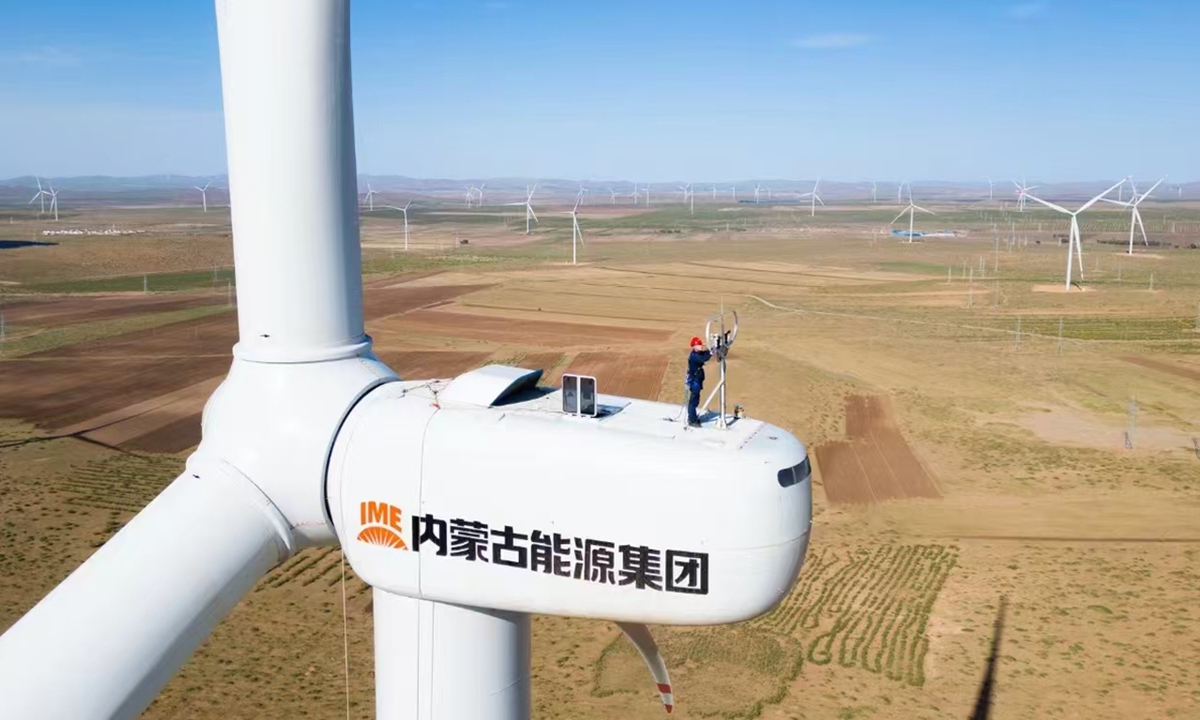
A view of a wind farm in North China's Inner Mongolia Autonomous Region Photo: MF
Ma Jun, a researcher with 20 years of experience at the Institute of Public and Environmental Affairs, stated that China "is determined to maintain an extensive industrial system while controlling pollution levels and decarbonizing the economy."In this process, Italy's expertise and technological knowledge in environmental protection, energy transition, and related scientific fields can provide valuable support to China. There exists significant potential for collaboration between the two sides in various specific areas such as renewable energy, green technologies, and energy conservation and emissions reduction.
RELATED ARTICLES