New regulations to boost tourism, consumption in S.China’s Hainan to be implemented starting Dec 1: media report

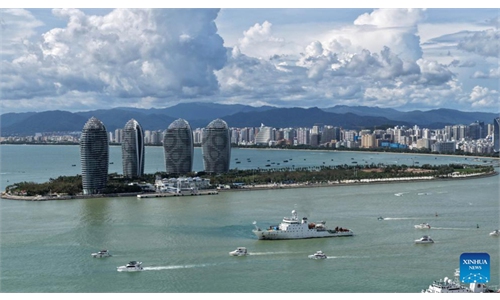
This aerial drone photo taken on Sept. 4, 2025 shows the cruise ship "Star Voyager" of Star Cruises docking at Sanya Phoenix Island International Cruise Port in Sanya, south China's Hainan Province. The cruise ship carrying approximately 1,200 tourists from 16 countries and regions made its first visit to Sanya and inaugurated its maiden voyage on the Chinese mainland. (Photo: Xinhua)
In an effort to further broaden the opening-up of the tourism and consumption sector in South China's Hainan Province, local authorities have promulgated new tourism regulations designed to build the island into a globally influential hub for international tourism and consumption as it accelerates preparations for full free trade port operations later this year, according to a CCTV News report on Friday.
The regulations, which will take effect on December 1, 2025, provide a comprehensive legal framework covering tourism planning and resource protection, industry development and promotion, openness and internationalization, business operations and consumer protection, safety and emergency response, and market supervision, said the CCTV News report.
Experts said that this package of measures is a part of a larger push to attract global players and position the island as a world-class international tourism hub, as it moves into the next stage of its free trade port development.
Hainan Free Trade Port will officially launch island-wide independent customs operations on December 18, 2025, Xinhua News Agency reported. Chen Tiejun, director of the provincial department of tourism, culture, radio, television and sports said during a press conference on Friday that "the island-wide independent customs operation will not only inject strong momentum into development across Hainan, but also open unprecedented space for high‑quality tourism growth." Chen said that the new regulations on the tourism sector will help expand the opening-up of the tourism consumption sector, foster new business formats, improve service quality and unleash consumer potential, providing a firm legal basis for Hainan's goal to become a world‑class international tourism and consumption hub.
Notably, the new rules are expected to ease restrictions on foreign investment, allowing qualified foreign-owned and joint venture travel agencies, as well as performance groups, to operate in Hainan, according to the CCTV News.
Restrictions on foreign investment in the tourism sector will be gradually loosened or removed. Qualified foreign-owned and joint venture travel agencies will be allowed to operate outbound tours (excluding Taiwan regions), and foreign-invested performance troupes with Chinese majority ownership will be permitted, said Lin Chonggao, deputy director of the Legislative Affairs Commission of the Standing Committee of the Hainan Provincial People's Congress.
The regulations also permit, in designated key tourist zones, nightlife and performance venues to operate through the night — tourism zones will allow 24-hour bars and entertainment venues, said Lin.
Another notable change allows qualified foreign tour guides to work in the Hainan Free Trade Port after passing the required skill certifications. The rules also encourage the development of "performance + tourism" formats, supporting major concerts, music festivals and film festivals, welcoming international‑level performances, and encouraging foreign investment in booking agencies and venues. The regulations permit the establishment of foreign‑invested performing troupes so long as they are Chinese‑controlled, said the CCTV report.
Meanwhile, the regulations place strong emphasis on market integrity and consumer protection. They require licensing or filing for relevant activities, clearly delineate operating areas, ban the use of unlicensed or unsuitable vessels and fishing boats for passenger transport, and push the sector toward professionalization and high‑end services. Authorities said these measures are aimed at building secure foundations for Hainan's aspirations to become a "paradise for maritime sports" and a "destination for low-altitude tourism."
It also cracks down on unethical practices that disrupt the order of the tourism market. For instance, agencies are prohibited from offering tours at unsustainable prices and directing tourists to unlicensed or unsafe shops. Tactics such as threats, insults, or service denial to pressure tourists into shopping or extra-cost activities are clearly banned. Violators will face a five‑year ban from industry practice once found to involve in serious violation.
With enforcement beginning in December 2025, stakeholders in the tourism industry, from investors and operators to travelers themselves, can expect a more secure, transparent, and welcoming environment in Hainan, Lin added.
Global Times
RELATED ARTICLES