‘What harms China could oftentimes also harm America, and even worse,’ says Nvidia CEO Jensen Huang, as ‘China market share drops to 0 from 95%’

Nvidia founder and CEO Jensen Huang talks with Sequoia Capital partner Konstantine Buhler in New York at a Citadel Securities event on October 6. Photo: Screenshot from the video published by Citadel Securities on YouTube
Nvidia founder and CEO Jensen Huang said the company's position in China has dropped from 95 percent of the advanced chip market to zero, as the US semiconductor giant is not allowed to sell its advanced products to mainland companies under US export restrictions, the South China Morning Post reported.
Huang made the remarks at a Citadel Securities event during his talk with Sequoia Capital partner Konstantine Buhler in New York on October 6. A video of the interview was published on Wednesday, according to the report.
During the talk, Huang said that "what harms China could oftentimes also harm America, and even worse." "At the moment, we're 100 percent out of China," Huang said. "Hopefully, we will continue to explain and inform and hold on to hope for a change in policy," the CEO said during the talk, per the report.
Huang's comment echoed his long-held position that Nvidia has to sell its products to China or the market will be handed over to Chinese competitors, according to the South China Morning Post.
Despite various US restrictions, China leverages its full industrial chain technology to advance research and development, continuously promoting industrial upgrading, with such capabilities demonstrated in fields like semiconductors, Ma Jihua, a veteran tech analyst, told the Global Times on Friday.
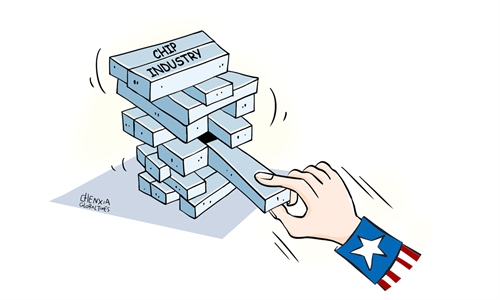
Ma noted that US' unreasonable restrictions on China's semiconductor industry will only accelerate China's efforts to advance its industrial capabilities, produce independent and self-reliant products, and strengthen its own supply chain.
"This will lead to US competitors being excluded from the Chinese market by market forces, while China's diverse chip application scenarios will no longer rely on US semiconductor products. American companies risk losing not only the rapidly growing and promising Chinese market but also their global market shares due to diminished competitiveness," Ma warned.
Global Times
RELATED ARTICLES