OPINION / GLOBAL MINDS
Global green transition demands Europe-China cooperation, not blame
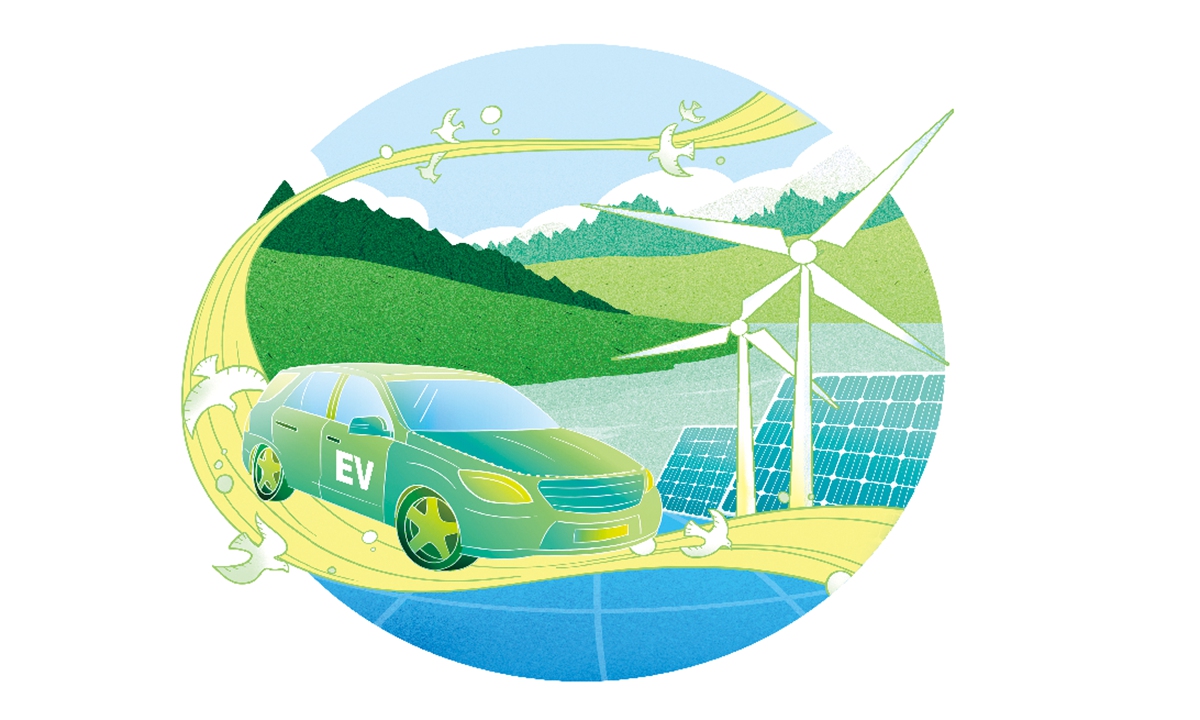
Illustration:Liu Rui/GT
Editor's Note:
Just weeks before the 2025 UN Climate Change Conference (COP30) in November, the EU's top climate envoy labeled China's climate efforts a "disappointing plan," underscoring a deepening divide between the two. With the US withdrawing from its climate commitments, can the world weather further division between the two major blocs? In a recent interview with Global Times (GT) reporter Xia Wenxin, Patrick Nijs (Nijs), former Belgian ambassador to China and co-founder of the EU-China Joint Innovation Center, shared his viewpoints on China's newly announced climate goals in September, the country's green development and green cooperation with Europe.
GT: You have been living in China since stepping down as the ambassador in 2013. Based on your personal experience and observations, what changes have you witnessed in China's green development over this period, and what contributions do you think it has made to the world?
Nijs: China's green transition in the economy is not a recent development. While the country initially prioritized rapid economic growth following the reform and opening-up in the 1980s, there was a growing public awareness of environmental consequences in the early 2000s. China's green transition efforts gradually intensified and a strong policy direction was established, notably with the arrival of Chinese President Xi Jinping. His leadership has been crucial in driving this transformation and advancing progress. Since then, China has moved with remarkable speed, advancing comprehensively across all areas, including environmental protection, ecological restoration, green energy development, and waste and water management.
Given China's scale and global influence, its ecological commitment now serves as vital leverage in addressing shared planetary challenges. The urgency is clear: Our survival depends on rapidly shifting toward a circular economy, changing how we interact with nature and halting resource depletion. It's not about saving the planet. It's about ensuring our humanity's future.
GT: China submitted its new Nationally Determined Contributions together with other countries in the latest UN Climate Summit. It pledges to "reduce economy-wide net greenhouse gas emissions by 7-10 percent from its peak levels, striving to do better." While many recognize China's positive contributions to climate governance, some critics argue that this goal is too conservative. How would you respond to such criticism?
Nijs: Since the 2015 Paris Agreement, global efforts have fallen short of what's needed to tackle the climate crisis. Every country is navigating its own challenges, faced with complex domestic issues. China's reliance on fossil fuels, particularly coal, makes progress challenging. However, China is striving to do its best. It has committed to peaking carbon dioxide emissions by 2030 and achieving carbon neutrality by 2060, with the recent UN statement signaling its intent and endeavor to move faster. But with a population of 1.4 billion, transformation cannot happen overnight.
What's needed now is not blame but cooperation. Climate change is a global issue that demands a unified response - not unilateral finger-pointing. All countries must move beyond their own political games, understand each other's challenges and work with China. Otherwise, our future generations will face dire consequences.
GT: Some argue that Europe's climate influence is fading due to internal disagreements over climate goals. In your view, what challenges is Europe currently grappling with in advancing climate governance? Is it still possible for Europe to bridge these differences?
Nijs: Europe stands among the leaders in addressing environmental issues, and like China, is striving to do its best despite significant challenges. Since the 1970s, we have cultivated a strong ecological culture, driven largely by grassroots and youth movements. Efforts such as the European Green Deal demonstrate Europe's continued commitment. But we now face a rising far-right movement that threatens this progress, and if these far-right forces gain power, Europe could follow the US into climate change denial - a dangerous scenario we must prevent. The fossil fuel industry's lobbying also resists change, yet Europe's political resolve remains strong enough to advance. The pace of progress, however, is a major concern - both in China and Europe. With US total denial, we must confront the urgent question: where are we headed? It's time to wake up.
GT: Both Chinese and EU leaders have agreed that green is the defining color of China-EU cooperation. How do you interpret this statement? What do you believe are the prospects for future China-EU green cooperation?
Nijs: It is obvious that Europe and China are the two major blocs genuinely driving the green transition forward. This makes the present state of their relationship all the more troubling. As someone deeply involved in China-EU relations since my posting as [Belgium's] Consul General in Shanghai in 1997, I have never seen ties in such poor shape, and this is deeply alarming. It is tragic that today, when facing a shared global threat, the relationship between these two vital partners has deteriorated severely.
To reset this relationship between the two sides, we must re-engage concretely on common challenges, above all, the green transition. This is the only viable path forward. That is why I'm strongly pushing to establish the Wutong-Acacia Forum in Moganshan, which brings European and Chinese stakeholders together - not just for dialogue, but for practical collaboration directly tackling climate challenges. We must do everything possible to strengthen green cooperation. It is the most evident and powerful basis on which to rebuild a positive, cooperative and forward-looking partnership between Europe and China.
GT: Given your profound understanding of both China and European perspectives, do you believe there exists a misunderstanding in Europe regarding China's efforts and achievements in the green revolution?
Nijs: There is definitely a misunderstanding of China in Europe. Many Europeans still view China through outdated lenses, failing to grasp reality. Media manipulation reinforces a distorted European public opinion about China, especially its efforts in greening its economy. In Europe, discourse about China is dominated by criticism, not collaboration.
This attitude prevents meaningful progress. We must learn to accept each other as we move forward together to combat climate change. So how can we change this? As a retired ambassador, my influence is limited. China's outreach efforts, while valuable, are often dismissed as mere propaganda. We need new ways to communicate - to show the real China. Though I'm not optimistic in the short term, I believe in "pessimism of the intellect, optimism of the will." As long as we continue acting, change remains possible.
GT: President Xi proposed the Global Governance Initiative at the "Shanghai Cooperation Organization Plus" Meeting in Tianjin. In your opinion, how could this initiative be applied in the field of climate governance and China-EU green cooperation?
Nijs: I was deeply impressed by President Xi's vision for global governance. This initiative embodies a coherent philosophy in China's foreign policy - one that champions multilateralism, amplifies the voice of the Global South and advocates dialogue over confrontation.
Yet the West has largely dismissed this vision, taking a shortsighted stance. Instead of criticism, we should seek to engage and collaborate. The same applies to environmental challenges: Our current global governance system is inadequate, and change is essential.
The West must abandon the habit of lecturing other nations. While our democracies have merits, they are not the only model. We cannot impose our system on others. China offers a different approach that deserves understanding and cooperation.
As a global citizen living in China, I believe there can be no global solution without China's leadership. The country is transitioning from an underdog to a giant - a complex process that demands support, not negativity. We must recognize this shift and work together toward shared governance goals.
RELATED ARTICLES