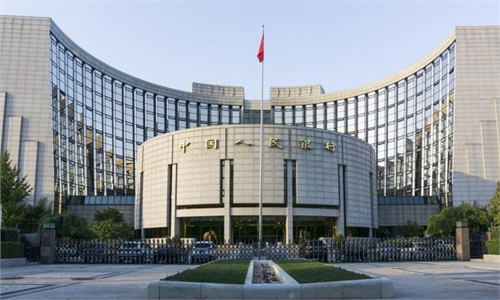
PBC to enhance cross-border yuan payment
Broader channels boost foreign investors’ access to China’s growth: expert
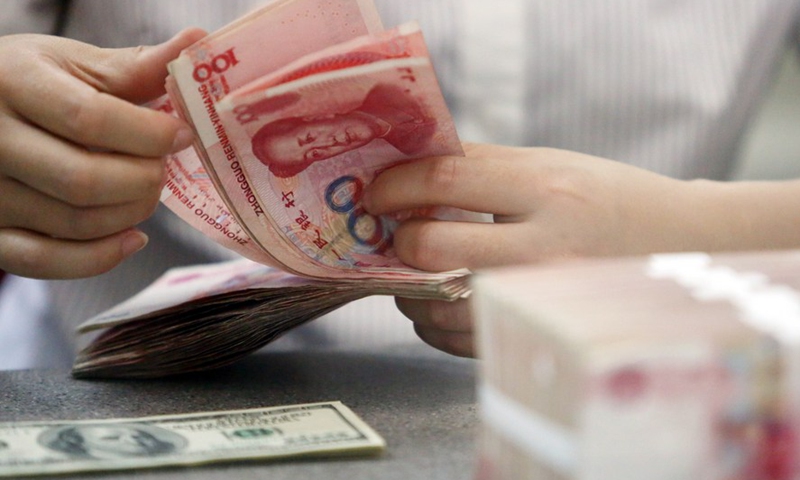
File photo shows a worker counts Chinese currency Renminbi (RMB) at a bank in Linyi, east China's Shandong Province. (Xinhua/Zhang Chunlei)
China's central bank has voiced its commitment to further improve the yuan's cross-border payment system and deepen openness and cooperation in the cross-border payment sector, an official of the People's Bank of China (PBC) said in an interview with the Financial News, as the nation continues to report notable achievements in this field.
In the first half of 2025, the number of active inbound mobile payment users in China exceeded 10 million, with transaction volume and value up 162 percent and 149 percent year-on-year respectively, the official with the PBC's payment and settlement department said in an article published by the Financial News, a publication run by the PBC, on its official WeChat account on Sunday.
The official noted that foreign visitors to China are becoming increasingly familiar with and receptive to mobile payments, with scanning QR codes now their primary payment method.
Thanks to joint efforts from all parties, a diversified payment service system featuring the parallel development and mutual complementarity of bank cards, mobile payments, and cash has taken shape, significantly improving payment convenience for foreigners in China, said the official.
Cross-border payment systems serve as the "arteries" of global monetary flows, providing vital support for international trade, investment, and financial stability, PBC Governor Pan Gongsheng said at the 2025 Lujiazui Forum held in Shanghai, Xinhua News Agency reported.
As the global cross-border payment system evolves toward greater efficiency and diversification, the nation has made significant progress in this field, with the Cross-Border Interbank Payment System (CIPS) increasingly serving as a key channel for yuan transactions. A Chinese expert said that these achievements have played a key role in advancing the internationalization of the yuan.
As of the end of September, more than 1,700 domestic and overseas participants had joined the CIPS, with its services reaching more than 5,000 banking institutions across 189 countries and regions, the official told the Financial News.
In 2024, the CIPS processed 175 trillion yuan (24.55 trillion) in cross-border yuan transactions, up 43 percent year-on-year, with an average annual growth rate of 40.3 percent since the start of the 14th Five-Year Plan period (2021-25), according to the official.
The yuan had become China's largest settlement currency for cross-border transactions and one of the world's top three currencies for trade financing and global payments, and it ranked third in weighting within the IMF's Special Drawing Rights currency basket, Pan said at a press conference on September 22.
China's ongoing economic transformation and industrial upgrading have strengthened its competitiveness, making the country the world's largest trader in goods and providing a solid material foundation for the international use of the yuan, said Bian Yongzu, executive deputy editor-in-chief of Modernization of Management magazine.
With major commodity exchanges in Shanghai, Dalian in Northeast China's Liaoning Province, and Zhengzhou in Central China's Henan Province adopting yuan-denominated trading, China's influence in the global commodity pricing system has been steadily rising, Bian told the Global Times on Sunday.
In addition, China has continued to advance cross-border payment connectivity this year, facilitating smoother flows of funds and people across borders.
In line with the trend of deeper integration between the Chinese mainland and Hong Kong, the PBC and the Hong Kong Monetary Authority successfully achieved direct connectivity between the two regions' fast payment systems on June 20, the PBC announced via its official website. The move was aimed at deepening financial cooperation and providing residents with a safer, more efficient, and convenient cross-border remittance service, said the announcement.
In recent years, China has continued to improve its cross-border financial infrastructure, including the CIPS, the digital yuan, and overseas branches of Chinese banks, gradually forming a secure, efficient and interconnected global yuan transaction network, according to Bian. The improvement of this infrastructure has significantly lowered the cost of cross-border yuan use, enhanced convenience, and boosted the currency's global circulation and appeal, Bian said.
He added that China's ongoing financial opening—spanning banking, insurance and securities—along with liberalization measures in free trade zones such as in Shanghai and South China's Hainan Province, is creating broader investment channels for overseas investors. As a result, the yuan's investment function continues to strengthen, becoming an increasingly important instrument for foreign investors to participate in China's capital market and share in the country's economic growth.
RELATED ARTICLES