SOURCE / PRESS RELEASE
Supported by 5G-A technology, China's Nanjing sees rapid development of low-altitude economy
"Whirrr…" an unmanned drone lifted off from the helipad of Baixin Pharmacy near Tianyuan West Road in Nanjing, capital city of East China's Jiangsu Province, carrying over 10 test drugs across urban airspace. In only 13 minutes, the drone reached a designated location 7.4 kilometers away in Zijinshan Science and Technology City.
This is a video clip being shown in the exhibition hall of China Telecom Nanjing Branch on September 24. In Nanjing, China Telecom, Baixin Pharmacy, and Nanjing Zijinshan Technology Industry Development Group have jointly launched regular routes for drone-based medical delivery. Drones operate in established flight corridors between pharmacies and communities, creating an aerial emergency channel that provides immediate access to critical medicine.
Emergency medicine delivery is only an example of the burgeoning low-altitude economy. Powered by 5G-A technology, low-altitude applications are reshaping the skies. Nanjing, one of the leading cities for high-tech innovation and a major economic center in the lower reaches of the Yangtze River Delta, has become a pivotal player in this new industry.
"In recent years, China Telecom has accelerated the development of low-altitude economy as well as its applications. The company took the lead in establishing a specialized subsidiary - China Telecom Unmanned Technology (Jiangsu) Co Ltd - to actively conduct innovative research and development on the integration of artificial intelligence (AI) and drone technologies in the low-altitude economy sector. It has built a Fly as a Service product service system, comprising one integrated low-altitude service solution base, one low-altitude intelligent network, three core platforms, and numerous application scenarios," Chen Mei, director of the Science and Technology Innovation Center of the subsidiary, told Global Times.
China Telecom Unmanned Technology (Jiangsu) Co's self-developed platform supports more than 3,000 devices operating online, featuring 5G remote flight control, AI-powered aerial views, and real-time modeling capabilities.
The platform now covers 28 provinces across the country, establishing over 10 mature application scenarios and over 400 benchmark demonstration projects across emergency response, logistics, firefighting, rescue, and other sectors. With monthly flight operations exceeding 10,000 times, it demonstrates strong large-scale operational capabilities, Chen said.
The low-altitude economy refers to economic activities conducted within low-altitude airspace - within 600 meters above ground. It mostly takes the form of general aviation, with aircraft like drones and helicopters.
The low-altitude economy has a wide range of applications like logistics, tourism, transportation, and emergency rescue and response operations. In China alone, the market size of the low-altitude economy is projected to grow to 1.5 trillion yuan ($210.6 billion) in 2025 and to 3.5 trillion yuan by 2035, according to calculation by the Civil Aviation Administration of China (CAAC).
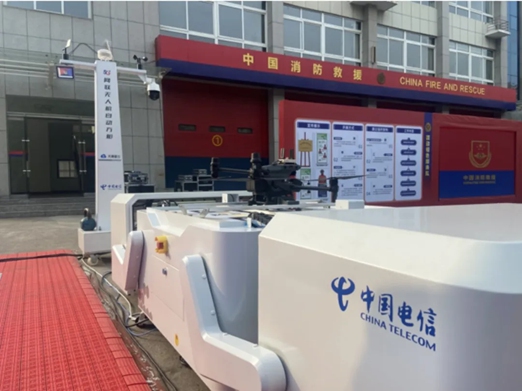
In terms of emergency response and firefighting, China Telecom has established a two-minute emergency firefighting circle. Drone bases have been set up in three core areas of Jiangxinzhou, a remote island in Nanjing, with lidar-equipped robots patrolling every two hours. In 2024, an unmanned drone detected spontaneous ignition in riverside grasslands 12 minutes in advance, increasing efficiency sixfold. In addition, one minute after a fire broke out, they generated a 3D model and transmitted data via the 5G-A network to support fire-fighting decisions.
In the medical rescue operations for major sports events, China Telecom has established the "Golden Four-Minute Lifeline for Emergency Rescue." Taking the island-wide marathon as an example, three drones equipped with Automated External Defibrillators (AEDs) patrol at 500-meter intervals, responding five times faster than ground units. In 2024, this system provided life-saving support to over 20,000 marathon participants during the event, achieving 100% zero-delay medical coverage for large-scale activities throughout the year.
As economic activities expand from the ground to low altitudes, coordinating terrestrial and low-altitude networks and addressing their mutual interference are becoming increasingly important. This necessitates a transformation for operators from ground-only networks to air-ground integrated networks. China Telecom has adopted air-ground coordination and vertical wide-angle technologies to establish a 5G-A low-altitude intelligent network covering over 3,000 square kilometers of Nanjing's main urban areas. This network is currently the largest and most technologically advanced of its kind in the industry. It supports single-carrier low-altitude communication and seamless evolution toward multi-carrier air-ground integrated communication. By leveraging intelligent beam management and air-ground interference coordination technologies, it prevents fragmented coverage and frequent handovers, delivering highly reliable low-altitude communication that enables real-time drone video transmission. The vertical wide-angle technology extends the vertical angle to 60 degree for continuous ground-to-air coverage below 600 meters. It underpins high-precision air traffic management systems, including traffic signal control, ensuring stable digital routes for rescue operations.
To make unmanned drones fly safely, efficiently, and reliably, China Telecom Nanjing Branch has established a city-wide 5G-A low-altitude communication network, forming a three-dimensional "air traffic control system" to achieve precise identification, tracking, and management of unmanned drones, Liu Yansong, director of Wireless Network Maintenance Center of China Telecom Nanjing Branch, told Global Times.
"Through network improvement, we can keep communication latency within milliseconds," Liu said, noting that it ensures real-time remote control and data transmission for drones while providing stable and reliable "digital air corridors" for diverse low-altitude uses.
China's three major telecom carriers have deployed 5G-A networks in over 300 cities across 31 provinces and regions. These deployments cover key areas such as central business districts, transportation hubs, and industrial parks, with the potential to serve 50 million users. 5G-A delivers a tenfold boost in speed, latency, and connectivity, marking a major technological leap.
As the low-altitude economy enters a new phase of scaled development, the 5G-A intelligent low-altitude network jointly built by China Telecom and its industry partners is emerging as the "air artery" of digital cities. With extensive application including air delivery, emergency rescue, environmental protection, and urban governance, this invisible 5G-A low-altitude intelligent network is fundamentally reshaping the blueprint of urban low-altitude development economic development.
Global Times
This is a video clip being shown in the exhibition hall of China Telecom Nanjing Branch on September 24. In Nanjing, China Telecom, Baixin Pharmacy, and Nanjing Zijinshan Technology Industry Development Group have jointly launched regular routes for drone-based medical delivery. Drones operate in established flight corridors between pharmacies and communities, creating an aerial emergency channel that provides immediate access to critical medicine.
Emergency medicine delivery is only an example of the burgeoning low-altitude economy. Powered by 5G-A technology, low-altitude applications are reshaping the skies. Nanjing, one of the leading cities for high-tech innovation and a major economic center in the lower reaches of the Yangtze River Delta, has become a pivotal player in this new industry.
"In recent years, China Telecom has accelerated the development of low-altitude economy as well as its applications. The company took the lead in establishing a specialized subsidiary - China Telecom Unmanned Technology (Jiangsu) Co Ltd - to actively conduct innovative research and development on the integration of artificial intelligence (AI) and drone technologies in the low-altitude economy sector. It has built a Fly as a Service product service system, comprising one integrated low-altitude service solution base, one low-altitude intelligent network, three core platforms, and numerous application scenarios," Chen Mei, director of the Science and Technology Innovation Center of the subsidiary, told Global Times.
China Telecom Unmanned Technology (Jiangsu) Co's self-developed platform supports more than 3,000 devices operating online, featuring 5G remote flight control, AI-powered aerial views, and real-time modeling capabilities.
The platform now covers 28 provinces across the country, establishing over 10 mature application scenarios and over 400 benchmark demonstration projects across emergency response, logistics, firefighting, rescue, and other sectors. With monthly flight operations exceeding 10,000 times, it demonstrates strong large-scale operational capabilities, Chen said.
The low-altitude economy refers to economic activities conducted within low-altitude airspace - within 600 meters above ground. It mostly takes the form of general aviation, with aircraft like drones and helicopters.
The low-altitude economy has a wide range of applications like logistics, tourism, transportation, and emergency rescue and response operations. In China alone, the market size of the low-altitude economy is projected to grow to 1.5 trillion yuan ($210.6 billion) in 2025 and to 3.5 trillion yuan by 2035, according to calculation by the Civil Aviation Administration of China (CAAC).
In terms of emergency response and firefighting, China Telecom has established a two-minute emergency firefighting circle. Drone bases have been set up in three core areas of Jiangxinzhou, a remote island in Nanjing, with lidar-equipped robots patrolling every two hours. In 2024, an unmanned drone detected spontaneous ignition in riverside grasslands 12 minutes in advance, increasing efficiency sixfold. In addition, one minute after a fire broke out, they generated a 3D model and transmitted data via the 5G-A network to support fire-fighting decisions.
a two-minute emergency firefighting circle
In the medical rescue operations for major sports events, China Telecom has established the "Golden Four-Minute Lifeline for Emergency Rescue." Taking the island-wide marathon as an example, three drones equipped with Automated External Defibrillators (AEDs) patrol at 500-meter intervals, responding five times faster than ground units. In 2024, this system provided life-saving support to over 20,000 marathon participants during the event, achieving 100% zero-delay medical coverage for large-scale activities throughout the year.
As economic activities expand from the ground to low altitudes, coordinating terrestrial and low-altitude networks and addressing their mutual interference are becoming increasingly important. This necessitates a transformation for operators from ground-only networks to air-ground integrated networks. China Telecom has adopted air-ground coordination and vertical wide-angle technologies to establish a 5G-A low-altitude intelligent network covering over 3,000 square kilometers of Nanjing's main urban areas. This network is currently the largest and most technologically advanced of its kind in the industry. It supports single-carrier low-altitude communication and seamless evolution toward multi-carrier air-ground integrated communication. By leveraging intelligent beam management and air-ground interference coordination technologies, it prevents fragmented coverage and frequent handovers, delivering highly reliable low-altitude communication that enables real-time drone video transmission. The vertical wide-angle technology extends the vertical angle to 60 degree for continuous ground-to-air coverage below 600 meters. It underpins high-precision air traffic management systems, including traffic signal control, ensuring stable digital routes for rescue operations.
To make unmanned drones fly safely, efficiently, and reliably, China Telecom Nanjing Branch has established a city-wide 5G-A low-altitude communication network, forming a three-dimensional "air traffic control system" to achieve precise identification, tracking, and management of unmanned drones, Liu Yansong, director of Wireless Network Maintenance Center of China Telecom Nanjing Branch, told Global Times.
"Through network improvement, we can keep communication latency within milliseconds," Liu said, noting that it ensures real-time remote control and data transmission for drones while providing stable and reliable "digital air corridors" for diverse low-altitude uses.
China's three major telecom carriers have deployed 5G-A networks in over 300 cities across 31 provinces and regions. These deployments cover key areas such as central business districts, transportation hubs, and industrial parks, with the potential to serve 50 million users. 5G-A delivers a tenfold boost in speed, latency, and connectivity, marking a major technological leap.
As the low-altitude economy enters a new phase of scaled development, the 5G-A intelligent low-altitude network jointly built by China Telecom and its industry partners is emerging as the "air artery" of digital cities. With extensive application including air delivery, emergency rescue, environmental protection, and urban governance, this invisible 5G-A low-altitude intelligent network is fundamentally reshaping the blueprint of urban low-altitude development economic development.
Global Times
RELATED ARTICLES