Chinese tech firms showcase new humanoid robots, underlining rapid advances in service robotics
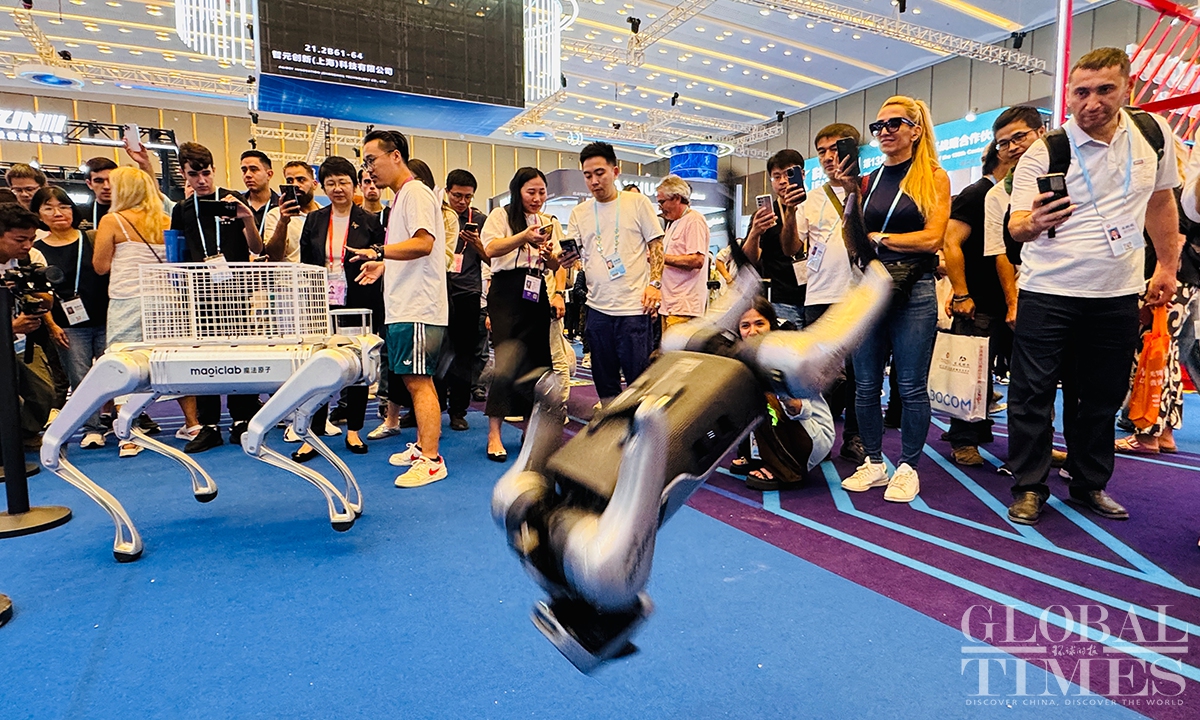
Buyers watch the performance of robotic dogs at service robots zone of the 138th Canton Fair in Guangzhou, South China's Guangdong Province, on October 16, 2025. Photo: Chi Jingyi/GT
Chinese tech firms have unveiled next-generation humanoid robots, highlighting the country's rapid advances in service robotics and its accelerating push toward large-scale commercialization, a Chinese expert said.
Unitree Robotics on Monday unveiled a new 1.8-meter-tall humanoid robot named Unitree H2, which moves with remarkable agility and grace, showing major progress in motion flexibility, according to a video the company sent to the Global Times.
In the video, the company revealed key details about the H2 robot, which mimics dance moves and smoothly performs martial arts moves, demonstrating impressive balance and control. The model, featuring 31 degrees of freedom across its body, is Unitree's fourth humanoid robot after the H1, G1 and R1.
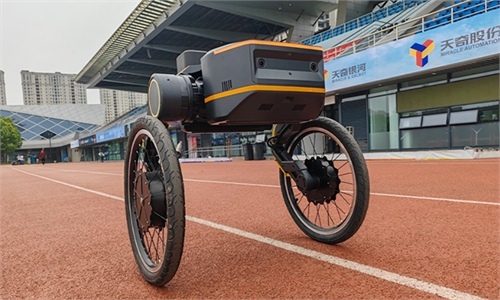
On the same day, Direct Drive Tech launched D-infinite, the world's first modular embodied robot that supports multi-form integration, heavy-load mobility and five-hour endurance. The release highlights China's fast-moving robotics sector, as companies accelerate iteration and the commercialization of embodied intelligence technologies to expand real-world industrial and service applications, according to a statement the company sent to the Global Times.
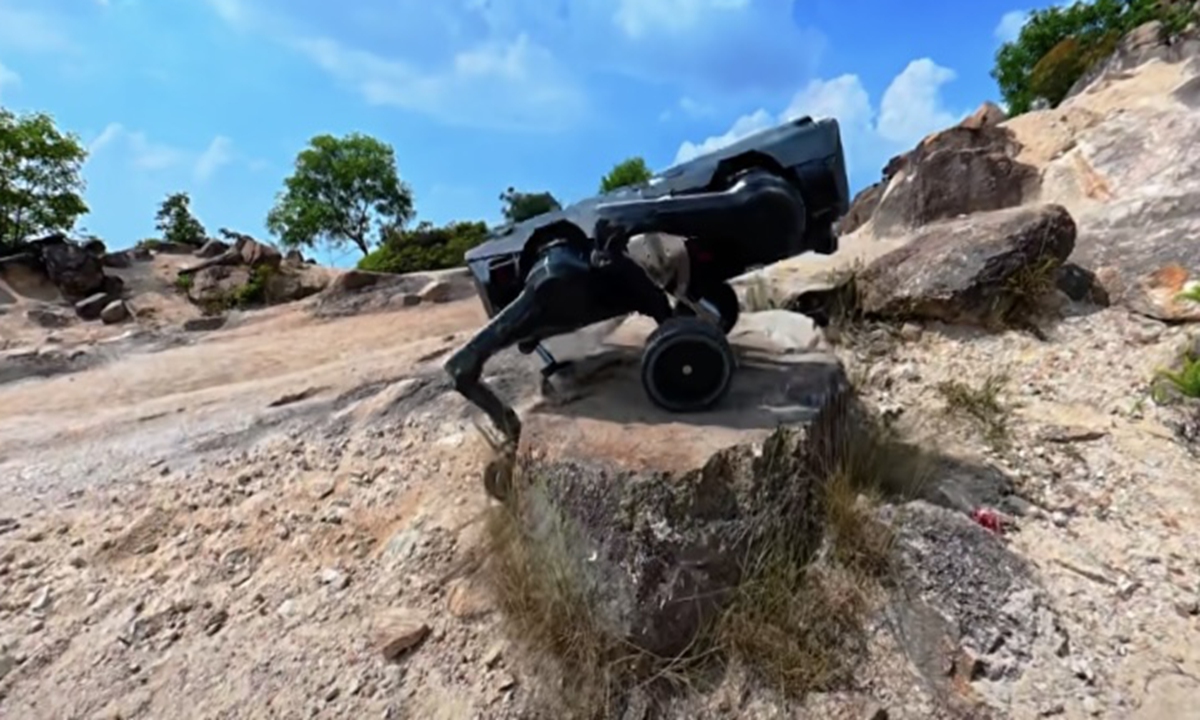
D-infite, a fully modular embodied intelligent robotic dog launched by Direct Drive Tech Photo: Courtesy of Direct Drive Tech
On October 16, Agibot launched the Genie G2, designed for industrial reliability with high-performance actuators, multiple sensors and an artificial intelligence computing platform. With enhanced software-hardware integration, the robot handles precision industrial operations while also performing patrol and guidance tasks in commercial environments, the company said on its official website.
On September 9, humanoid robot producer UBTECH and the Beijing Humanoid Robot Innovation Center launched Tiangong Walker, a full-sized research and education robot now available on JD.com. Prices range from 299,000 to 779,000 yuan ($41,500-$108,200) to meet the diverse needs of institutions and universities, according to a statement UBTECH sent to the Global Times.
At the recently concluded first phase of the 138th Canton Fair, a dedicated service robot section was set up to showcase cutting-edge innovations and bridge the "last mile" from AI breakthroughs to commercial applications. The exhibition, covering 4,200 square meters, brought together 46 leading companies, according to China Media Group.
"China's service robot industry enjoys a strong structural advantage thanks to its complete domestic supply chain — from core components like reducers and sensors to final assembly," Wang Peng, an associate research fellow at the Beijing Academy of Social Sciences, told the Global Times. "This integrated system allows faster upgrades, lower costs and stronger coordination between suppliers and manufacturers.
"Chinese companies also benefit from a fast pace of real-world testing," Wang said. "They can quickly adapt products to local needs, such as elder care in rural areas or medical assistance in county hospitals, supported by national and local policies that offer funding, pilot sites and infrastructure for innovation."
While China has made notable progress in humanoid robotics, the commercialization of service-use models still faces considerable hurdles, Liu Gang, chief economist at the Chinese Institute of New Generation AI Development Strategies, told the Global Times.
"The intelligence level of current humanoid robots remains far below that of the human brain, making natural interaction with humans still difficult," Liu said. "High production costs also keep these robots out of reach for most consumers."
However, with increasing investment and faster localization, more Chinese enterprises are expected to join research and development efforts, accelerating innovation in the field. "Once key components achieve large-scale domestic production, China's humanoid robot R&D and applications will see significant growth," Liu added.
In 2024, China's Ministry of Industry and Information Technology and six other departments issued guidelines to boost future industries, identifying humanoid robots as among the first to be applied in intelligent manufacturing, home services and special operations. The Chinese Institute of Electronics projects China's humanoid robot market could reach 870 billion yuan by 2030, according to media reports.
RELATED ARTICLES