IN-DEPTH / IN-DEPTH
China plays vital role in boosting Asia-Pacific prosperity: GT survey of 16 nations
Drivers of shared growth

Cityscape of Beijing Photo: VCG
Editor's Note:
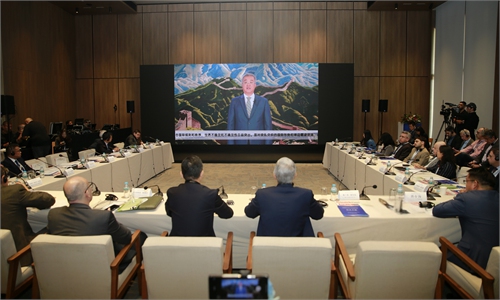
The 32nd APEC Economic Leaders' Meeting is set to be held in South Korea from October 31 to November 1. Against this backdrop, on October 13, at the 2025 China-South Korea Media Cooperation Forum held in Seoul, South Korea, the International News Department of People's Daily and the Global Times Institute jointly released a key report titled "An Asia-Pacific of Vitality: Public Opinion Across 16 Countries." The report shows that APEC's achievements in promoting regional cooperation and its contributions to regional development and prosperity have been highly recognized by the public. Notably, most respondents believe that China plays an indispensable and important role in the development and prosperity of the Asia-Pacific region. Approximately 90 percent of respondents hold the view that continuously deepening the Asia-Pacific partnership of mutual trust, inclusiveness, and win-win cooperation is crucial for their own country's development. The public expects to further deepen cooperation in various fields under the APEC framework.
The survey, conducted from August 25 to September 12 across 16 counties, including Australia, Canada, China, Japan, South Korea, and the US, garnered 9,077 valid responses through multilingual questionnaires in 11 languages such as English, Japanese, and Korean.
Survey results show that 85 percent of respondents believe APEC has contributed to regional economic development, social progress, and improvement of people's well-being, with nearly 70 percent viewing the contributions as "great contribution" or "moderate contribution." Most respondents recognize APEC's achievements in advancing economic and technological cooperation, facilitating cross-border mobility, maintaining the stability of industrial and supply chains, supporting innovative growth, and advancing sustainable and inclusive growth. Over 80 percent of respondents agree that development cooperation under the APEC framework has brought more international cooperation opportunities, greater development prospects, and access to more advanced technologies to their home countries.
Tangible public benefits
The survey found that cooperative projects initiated by APEC have delivered tangible benefits to people in the Asia-Pacific region. For each of the 8 types of cooperative projects listed in the survey, 50 to 60 percent of respondents said that they themselves, their relatives, or acquaintances have benefited from these projects. Digital economy cooperation was the most beneficial project type for respondents, followed by the development of online learning platforms and the establishment of skill certification networks.
Liu Chenyang, director of the APEC Study Center of Nankai University in Tianjin, told the Global Times that one of the key trends of APEC in recent years is the translation of more cooperation initiatives and plans into concrete projects, covering a wide range of fields. Particularly in digital economy and innovation, APEC has turned initiatives into demonstration projects through its committees, working groups, and government-industry-academia cooperation mechanisms, and advanced their implementation with funds established by APEC. "Ordinary people can truly feel APEC's role through the implementation of these projects," he said.
There are a majority of respondents across the 16 economies that view the entire Asia-Pacific as an interdependent community with common interests and a shared future. And over 70 percent of respondents expect Asia-Pacific economies to work together to building a dynamic, harmonious, and prosperous Asia-Pacific family. Three-quarters of respondents support their home countries in participating more actively and deeply in cooperation under the APEC framework.
To strengthen human resource capacity building, vocational skill development, and youth talent cultivation, APEC has established vocational training bases and cross-border online learning platforms, launched scholarships for young people, organized short-term exchange visits, and held youth innovation forums such as the "APEC Voice of the Future." Survey data shows that over 80 percent of respondents are interested in APEC's vocational and educational training programs as well as exchange initiatives like youth innovation forums, and more than 60 percent of respondents express willingness or strong willingness to participate in such projects.
The survey also reveals that over 50 percent of respondents believe their home countries are moving toward "greater openness and cooperation" in economic development. Respondents from Vietnam and China show the strongest consensus with 80 to 90 percent holding this view. In contrast, over half (53 percent) of US respondents believe their country has become more protectionist and isolationist - a proportion far higher than that of other countries.
In an interview with the Global Times, Zhang Jianping, deputy director of the academic committee at the Chinese Academy of International Trade and Economic Cooperation, emphasized that APEC's progress has long been driven by "twin engines" - economic globalization and regional economic integration. However, he noted that certain developed countries are now pursuing deglobalization, unilateralism, and trade protectionism, severely disrupting global economic governance through bullying tactics and long-arm jurisdiction, which has imposed significant challenges and pressure on APEC's collaborative atmosphere.
Despite these headwinds, Zhang stressed that the broader trend of economic globalization and regional integration remains irreversible. He called for APEC to continue strengthening global supply and value chain cooperation, enhance mutual trust among regional partners, and leverage the role of bilateral and multilateral free trade agreements across the Asia-Pacific. In doing so, APEC can reinforce its relevance and value in navigating contemporary economic uncertainties.
China's development experience is worth learning from
For decades, APEC has driven broad-based development, prosperity, and integration across the region, helping to make the Asia-Pacific the most dynamic part of the global economy and a major engine of growth.
When asked "which countries play an important role in driving sustainable growth and prosperity in the Asia-Pacific," nearly 60 percent of respondents ranked China first or second among the 19 countries listed in the survey - far ahead of other countries. Japan followed with 33 percent, and the US with 30 percent. In Russia, Chile, and Indonesia, about 70 percent of respondents placed China among the top two. In Thailand, Malaysia, Peru, and Vietnam, the figure also exceeded 60 percent. Meanwhile, in both Japan and South Korea, more than half of respondents placed the US among the top two.
Survey data show that among China's regional contributions, Asia-Pacific respondents most recognize China as "a key driver of Asia's economic growth." A relatively high share also acknowledged that China brings more development opportunities to other countries in the region.
A Generation Z respondent in Peru wrote that "China's strong economy can contribute significantly to Peru's development." A young respondent from northeast Japan described China as "an engine of global economic growth." In the Philippines, a respondent in their 20s associated China with "business and job opportunities."
Wei Jianguo, vice chairman of the China Center for International Economic Exchanges, told the Global Times that China has made significant contributions to regional development. China is the top trading partner of 13 APEC economies. Countries in the region also place high hopes on China, expecting it to continue unleashing growth dividends and practical benefits. Some Southeast Asian countries hope to introduce Chinese technologies, standards, and complete solutions in the field of new energy vehicles, and seek assistance in areas such as digital economy development - especially cross-border e-commerce. Many also hope to see China increase investment in infrastructure and talent development.
The success of Chinese modernization offers the world an alternative to the Western development model, expanding the pathways for developing economies to achieve modernization. According to the survey, more than 80 percent of respondents across the Asia-Pacific believe that China's experience in economic, social, cultural, ecological, and technological development provides insights for their own countries. Nearly 60 percent rated this reference value as "a lot" or "quite a lot."
Respondents from developing economies held this view more strongly. In both Mexico and Indonesia, about 80 percent of respondents saw significant value in China's development experience. In Chile, Peru, and Vietnam, the proportion was no less than 70 percent, while in Russia and Malaysia, it surpassed 60 percent.
Chen Fengying, a research fellow at the China Institutes of Contemporary International Relations, told the Global Times that amid a deep restructuring of the global development landscape, China's breakthroughs in national governance, economic transformation, and social stability have gradually reshaped international perceptions of development paths. In the Asia-Pacific in particular, China's experience serves both as a reference for late-developing economies and a prompt for developed countries to reflect on the limitations of their own models.
Such influence spans institutional effectiveness, people's livelihoods, ecological governance, and technological innovation, and is increasingly shaped by diverse global perceptions. Overall, China's development path offers a reference model not just for the Asia-Pacific, but for the world. As China deepens its opening-up and delivers on long-term plans, its influence is expected to grow further.
APEC has long committed itself to promoting economic globalization, supporting sustainable economic growth and prosperity in the Asia-Pacific, building a dynamic and harmonious regional community, and upholding free and open trade and investment. Liu told the Global Times that shared challenges often strengthen the motivation and willingness of APEC members to work together.
Poverty reduction expected to top agenda for 2026 APEC meeting
In 2020, the 27th APEC Economic Leaders' Meeting adopted the "APEC Putrajaya Vision 2040," which envisions an open, dynamic, resilient, and peaceful Asia-Pacific community by 2040, with the goal of ensuring shared prosperity for present and future generations. According to the survey, 70 percent of Asia-Pacific respondents expressed anticipation for this vision, with one-fourth indicating they "very much look forward to it."
Over the past three decades, APEC economies have upheld the forum's principles and foster and Asia-Pacific partnership featuring mutual trust, inclusiveness and mutually beneficial cooperation. Some 89 percent of Asia-Pacific respondents said strengthening such partnerships is important for their country's future development - with nearly 40 percent calling it "very important" and half saying it is "important." The proportion reached above 90 percent in China, Indonesia, Mexico, Malaysia, the Philippines, Singapore, Thailand, and Vietnam.
Liu said that, amid intensifying geopolitical complexity and great-power rivalry, the international community increasingly looks to platforms like APEC to play a stabilizing role. Despite differences among members, APEC's established cooperation framework enables economies to identify common interests and areas of convergence to advance regional cooperation.
Global Times
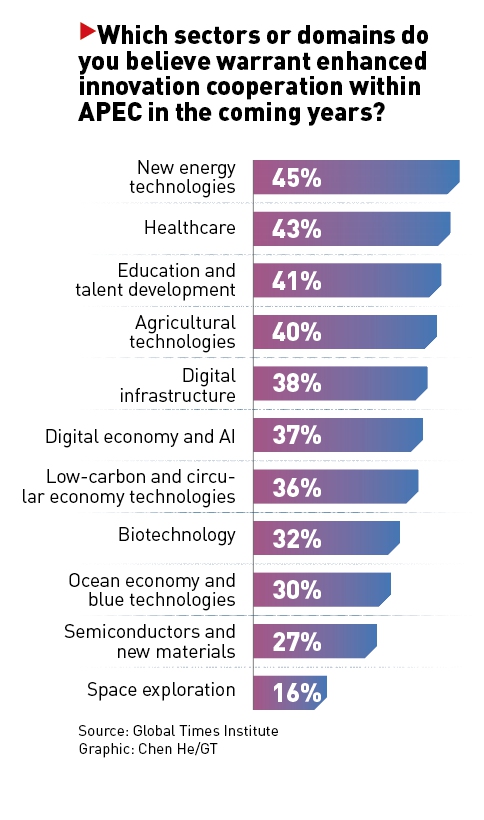
Looking ahead, respondents expressed various expectations for future cooperation under the APEC framework. In the area of trade and investment, the top priority was reducing tariffs and enhancing trade and investment facilitation. In digital economy cooperation, respondents favored cybersecurity and communications technologies. In the field of innovation, the most anticipated area was new energy technologies, followed by healthcare, education and talent development, and agricultural technology. Other popular choices included digital infrastructure, digital economy, and artificial intelligence, as well as technologies for low-carbon and circular economies.
In the area of sustainable development, clean energy and low-carbon technologies, along with climate change cooperation, ranked highest in terms of expectations. Biodiversity conservation, circular economy and marine ecological protection also drew relatively high interest.
Global Times
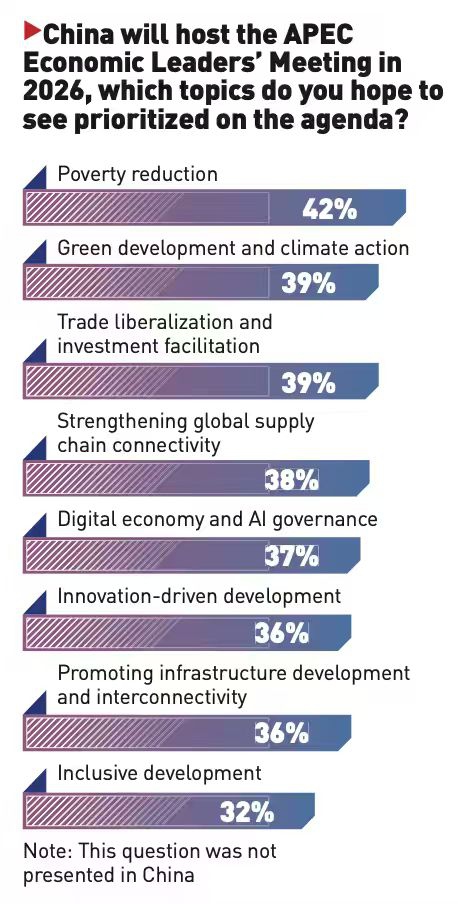
In 2026, China will host APEC for the third time. Regarding the agenda for the 33rd APEC Economic Leaders' Meeting, respondents across the Asia-Pacific most expected to see global poverty reduction as a key discussion point, followed by green development and climate change response, and trade liberalization and investment facilitation. Respondents from Indonesia, Peru, and Mexico showed a stronger preference for addressing global poverty. Those in the Philippines, Singapore, and the US paid more attention to securing global supply chains, while Malaysian respondents were most focused on the digital economy and AI governance.
Drivers of shared growth
RELATED ARTICLES