Airbus opens second Final Assembly Line in Tianjin for A320 Family aircraft
Operation marks a new level in China-Europe aviation industry cooperation
By in Tianjin Published: Oct 22, 2025 11:10 PM

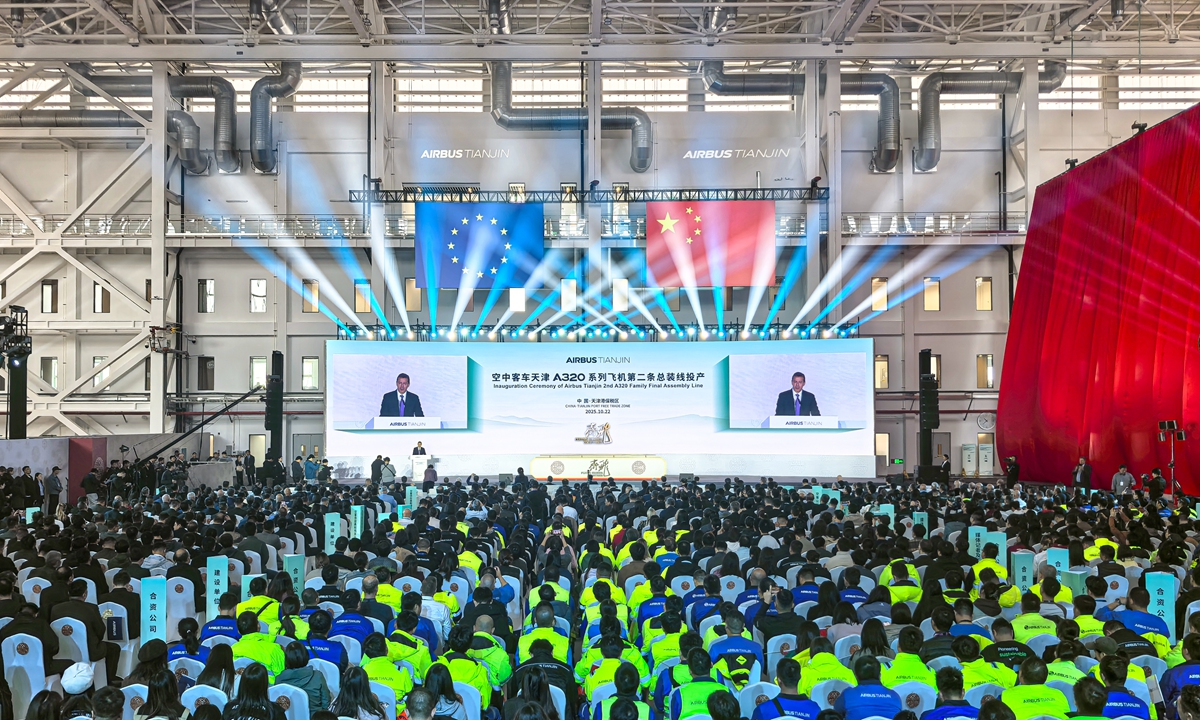
This photo shows the inauguration ceremony of Airbus' second Final Assembly Line (FAL) for A320 family aircraft in Tianjin, North China, October 22, 2025. Photo: VCG
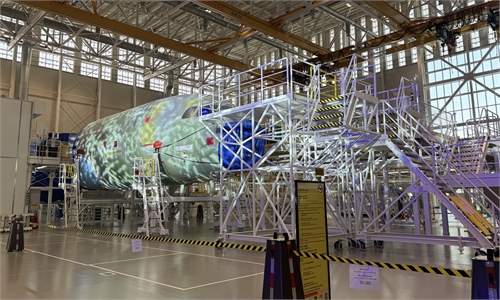
EU plane manufacturer Airbus opened its second Final Assembly Line (FAL) for the A320 family of aircraft in Tianjin on Wednesday, a testimony to the plane manufacturer's confidence in the prosperity of the Chinese aviation market and the strong and solid capabilities of its supply chains.
The inauguration comes as 2025 marks the 40th anniversary of cooperation between Airbus and China's civil aviation sector, when the first Airbus aircraft, an A310, was delivered in 1985.
Airbus CEO Guillaume Faury, speaking in Tianjin, said that in spite of difficulties, like Covid or other geopolitical challenges, "we are here, we continue to invest and we continue to ramp up," Faury said, as observed by a Global Times reporter on site in Tianjin.
Chinese Minister of Commerce Wang Wentao on Tuesday met with Faury. Wang said that in recent years, China's market scale has been steadily expanding, and it has become the world's second-largest consumer market and second-largest market for imports. China will continue to advance the modernization drive through a Chinese path and develop new quality productive forces, which will provide broad development space for foreign-funded enterprises, including Airbus, the minister said.
Wang expressed the hope that Airbus, taking the opportunity of the operation of the second A320 final assembly line in Tianjin, would continue to strengthen cooperation with China and provide more high-quality aviation products and services for China and the world.
Airbus is willing to continue deepening its roots in the Chinese market, and contribute to promoting economic and trade cooperation between China and France, as well as between China and Europe, Faury said.
The opening of our second A320 family FAL in Tianjin is a tangible showcase of our long-term commitment to the Chinese aviation industry. This is one of our latest, significant investments in the country, according to Faury.
Deepened cooperation
The new line will enable Airbus to significantly increase production close to its customers in China and beyond. It complements the global Airbus production network of 10 FALs, four in Hamburg, Germany, two in Toulouse, France, two in Mobile in the US, and two in Tianjin, according to the company.
Preparations to assemble the first aircraft are underway and full operation of the facility is targeted for early 2026.
This marks a new level in China-Europe aviation industry cooperation, turns a new page in their deepened collaboration, and represents a new achievement in their strategic partnership in high-tech industries, Bai Jingyu, an official in charge of innovation and high-tech industry policy with the National Development and Reform Commission, China's top economic planning body, said at the inauguration in Tianjin on Wednesday.
"We welcome the addition of Tianjin's second line to our global production system, as it provides us with the necessary flexibility and capacity to deliver on our plan to assemble 75 A320 family aircraft per month in 2027," Faury said.
"The A320 family has now become the best-selling and most successful commercial aircraft in history, with total deliveries surpassing those of the Boeing 737 family, despite having entered the market 20 years later," he said.
It is important to note that Airbus's industrial contribution in China extends beyond exporting aircraft assembled in Tianjin," George Xu, CEO of Airbus China said. "This includes the fact that wings for many A320 family aircraft are manufactured in China, and the system integration for some large Airbus components is also completed here."
He emphasized that this approach is precisely how Airbus is supporting the Chinese aviation supply chain in going global and achieving export goals.
"Notably, since 2023, Airbus has begun scaling the delivery of Tianjin-produced aircraft to non-Chinese customers," Xu added. "Feedback from these international clients regarding the on-time delivery and product quality of China-made Airbus aircraft has been exceptionally high," Xu said.
Data from Airbus China showed that the first FAL in Tianjin, which started production in 2008 has assembled here roughly 780 aircrafts and is expected to reach the landmark of 800 aircraft by the end of this year, and the second FAL will double the capacity.
Last year, 25 percent of the aircraft that were assembled in Tianjin was delivered outside of China, including to Europe, Asia and the Middle East. The second FAL is a critical facilitator for Airbus's global A320 family ramp-up plan to deliver 75 aircraft per month in 2027, Airbus said.
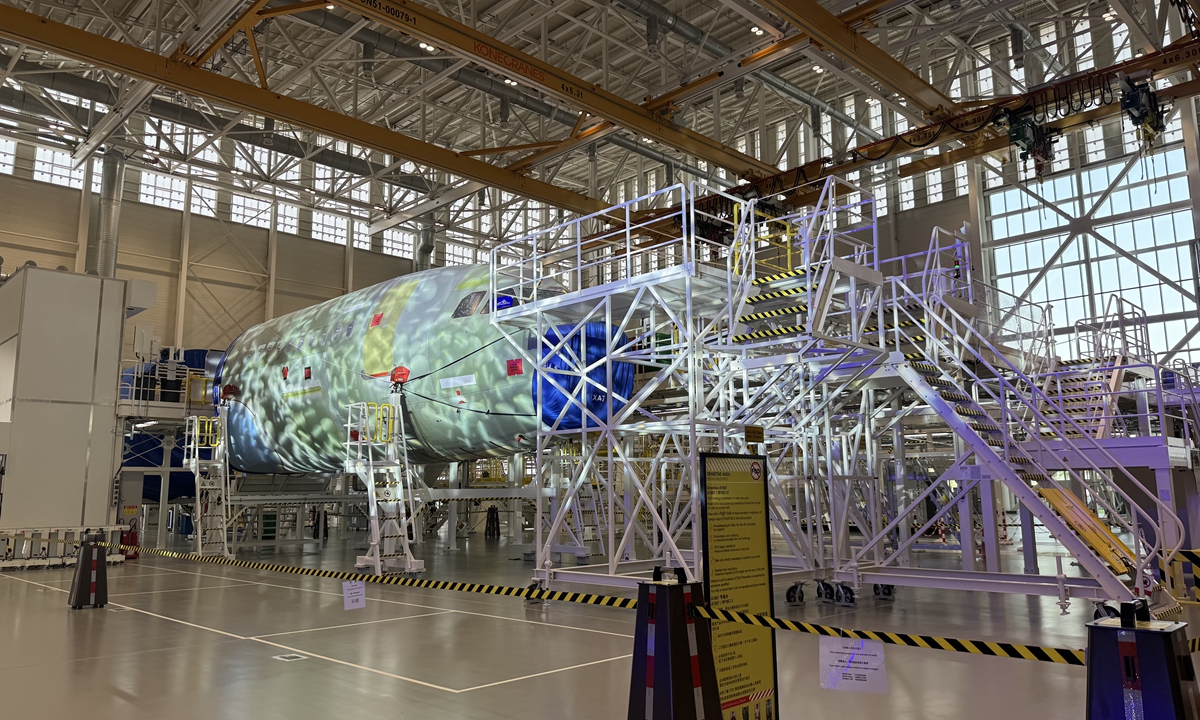
This photo shows Airbus' second Final Assembly Line (FAL) for A320 family aircraft in Tianjin, North China, Oct. 22, 2025. Photo: Tu Lei/GT
Enhanced supply chain cooperation
During the inauguration, several speakers highlighted the importance of supply chain cooperation between China and the EU, according to Global Times reporter's observation on site.
To support the smooth and stable operation of the second FAL, we have invested in and established the Aviation Industry Corporation of China (AVIC) Tianjin Company to provide door-to-door production and supply services for major wing components and fuselage systems. This initiative offers more efficient and streamlined support for the final assembly process, according to Wei Yingbiao, general manager of AVIC, a state-run aerospace conglomerate headquartered in Beijing.
The inauguration of Airbus' second FAL is not only a landmark achievement in China-Europe aviation industry cooperation, but also a powerful demonstration of its resilience and the solid confidence between the partners. Furthermore, it serves as a vivid example of the Chinese aviation industry's commitment to opening-up and its proactive integration into the global supply chain, Wei said.
The launch of Airbus's second FAL in China underscores its confidence in the global demand for the A320 family, Qi Qi, a veteran market watcher told the Global Times on Wednesday.
In his view, the final assembly of an aircraft requires the systematic integration of over ten thousand core components and parts sourced from nearly one thousand suppliers.
From Airbus' perspective, this expansion of production capacity in China is expected to involve more companies from China's aviation manufacturing sector into its upstream and downstream industrial chains, which is crucial for supporting and ensuring the production capacity of the two assembly lines in Tianjin, Qi said.
RELATED ARTICLES