FM refutes EU’s illicit unilateral sanctions against Chinese companies
Move undermines bloc’s ‘strategic autonomy,’ expert says
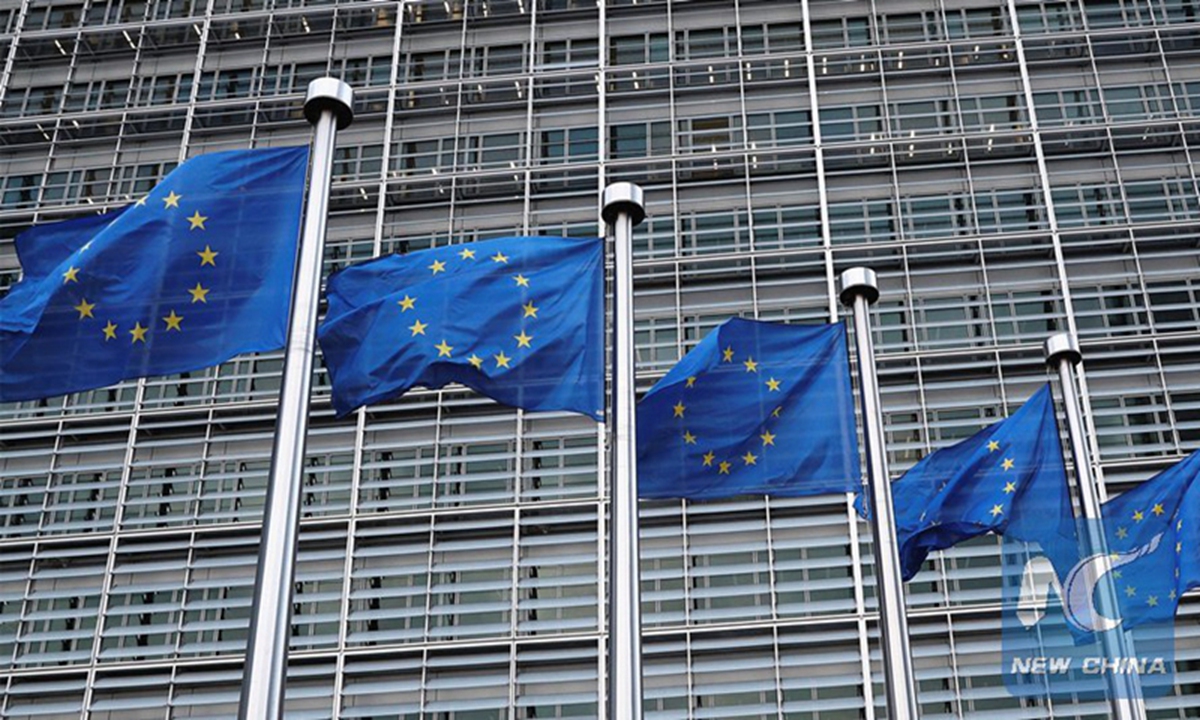
The European Union flags in front of EU headquarters in Brussels, Belgium. Photo: Xinhua
Responding to EU's latest package of sanctions against Russia, which will also target 12 Chinese firms and three Indian companies for allegedly helping Russia circumvent Western sanctions on technology transfers, Chinese Foreign Ministry spokesperson Guo Jiakun said China strongly deplores and firmly rejects the EU's repeated illicit unilateral sanctions against Chinese companies over Russia-related issues. China has lodged protests with the EU side."We have stressed on multiple occasions that China did not create the Ukraine crisis, nor is China a party to it. China is committed to promoting talks for peace. We never provide lethal weapons to any party to the conflict, and strictly control the exports of dual-use items," Guo said.
The spokesperson noted that most countries, including EU members and the US, continue to trade with Russia. The EU is in no position to point fingers at the normal exchanges and cooperation between Chinese and Russian companies.
In response to a media inquiry regarding the EU's sanctions, which also for the first time sanctioned large Chinese refineries and oil traders, a Chinese Ministry of Commerce (MOFCOM) spokesperson stated on Thursday that despite China's repeated representations and warnings, the EU has acted arbitrarily, once again listing Chinese companies in the 19th round of sanctions. China expresses strong dissatisfaction and resolute opposition to this move, the spokesperson said.
China has consistently opposed unilateral sanctions that lack a basis in international law and are not authorized by the UN, the MOFCOM spokesperson said, noting that the EU's actions violate the spirit of the consensus reached by Chinese and European leaders, seriously undermine China-EU economic and trade cooperation, and affect global energy security.
US Treasury Secretary Scott Bessent announced on Wednesday that the US is sanctioning Russia's two major oil companies - the state-owned company Rosneft and the privately owned company Lukoil - and called on Russia and Ukraine to agree to an immediate ceasefire, according to a press release by the US Department of the Treasury. On the same day, EU member states reached a consensus on the 19th round of sanctions against Russia.
A Bloomberg report also on Wednesday said that US President Donald Trump has planned to talk with China about the purchase of Russian oil.
"This reflects that the EU, on the surface, proclaims 'strategic autonomy' in its China policy, but in reality lacks genuine independent capability and proactive initiative, blindly following the US," Zhao Junjie, a senior research fellow at the Institute of European Studies at the Chinese Academy of Social Sciences, told the Global Times on Thursday.
Zhao pointed out that over the past decades, Europe has relied on US and NATO protection, but in digital economy and new productive forces, the EU lags far behind China and the US in technology application, with both upstream and downstream industrial chains influenced by the two countries.
This is not the first time that EU listed Chinese entities in sanctions against Russia. Its 17th package of sanctions against Russia listed 75 entities including five from China. On July 18, 2025, the EU added two Chinese financial institutions to the sanctions list in its 18th round of sanctions against Russia. In response, China's Ministry of Commerce (MOFCOM) announced on August 13 that it would take countermeasures against two EU financial institutions, effective immediately.
Zhao further noted that the EU's repeated alignment with the US in pressuring China reflects that its leaders are constrained by domestic populist and far-right forces, resulting in short-sighted and irrational decision-making that is unable to fundamentally address the challenges facing its economic development.
Economic and trade cooperation between China and Europe is inherently mutually beneficial, Zhao said, calling on Europe to abandon its geopolitical misperceptions and prejudices toward China, as well as its anxiety stemming from viewing China as a zero-sum competitor in critical technology sectors.
China's Commerce Minister Wang Wentao held a meeting via video link with EU Commissioner for Trade and Economic Security Maros Sefcovic at the latter's request on Tuesday, during which both sides had in-depth exchanges of views on key China-EU economic and trade issues, including export controls and the EU's anti-subsidy case on Chinese electric vehicles, according to the MOFCOM.
When asked about the upcoming China-EU dialogue, the Chinese Foreign Ministry spokesperson Guo Jiakun said on Wednesday that China-EU economic and trade relations are shaped by their mutual complementarity and are win-win in nature.
Guo noted that China hopes the EU will honor its commitment of supporting free trade and opposing trade protectionism, provide an open, transparent and non-discriminatory environment for businesses from all countries, take concrete actions to uphold the principles of market economy and WTO rules, and properly address trade differences through dialogue and consultation.
RELATED ARTICLES