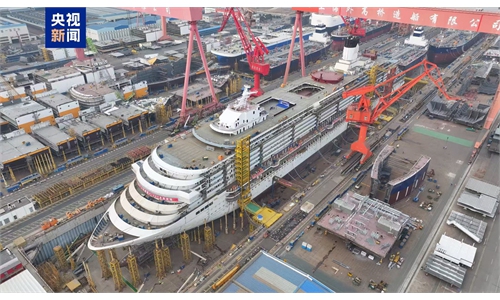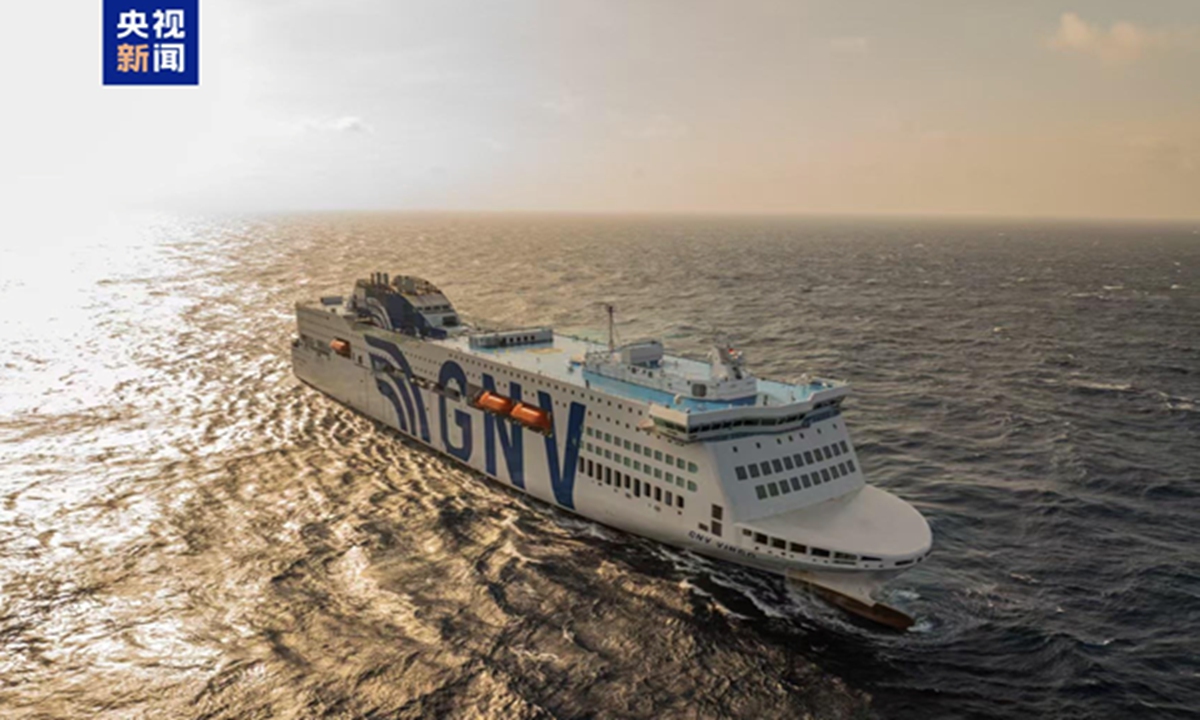
China's first self-developed large dual-fuel RoPax ship for export, built by Guangzhou Shipyard, is delivered in Nansha, South China's Guangzhou Province on October 23, 2025. Photo: screenshot of China Media Group's report
China State Shipbuilding Corporation (CSSC) said on Thursday that the country's first self-developed large dual-fuel RoPax ship for export, built by Guangzhou Shipyard, was delivered in Nansha, South China's Guangzhou Province, according to China Media Group (CMG).
The RoPax ship can run on both fuel oil and cleaner liquefied natural gas, and the shipyard holds fully independent intellectual property rights, CMG reported.
The 12-deck vessel is equipped with facilities such as a buffet restaurant, café and observation lounge, offering 485 cabins and capacity for 1,800 passengers and over 550 cars. Designed for short-distance sea transport between islands or coastal cities, it is a high-tech, high value-added ship, according to the report.
A representative from Guangzhou Shipyardl, a subsidiary of CSSC, revealed that the LNG power system on the vessel can store about 1,000 cubic meters of liquefied natural gas, providing power for approximately five days of sailing. The vessel's interior is fully domestically sourced.
Following delivery, the dual-fuel RoPax ship will operate on the route between Genoa and Palermo, Italy.
Bian Yongzu, executive deputy editor-in-chief of Modernization of Management magazine, told Global Times on Thursday that the maritime sector is entering a crucial stage of clean-energy transformation. "As one of the world's main modes of freight transport, shipping is moving toward cleaner energy — a major trend for the future that will help reduce emissions, lower long-term costs and spur technological innovation," he said.
Bian noted that China, as the world's largest shipbuilding nation, plays a key role in driving the global green transition. "China currently accounts for nearly 60 percent of global shipbuilding," he said. "Its progress in developing clean-energy vessels will have a profound impact on the global shipping industry and further accelerate the sector's shift toward sustainability."
According to Bian, China's achievements in clean-energy shipbuilding are backed by a strong industrial base and technological foundation. "Such progress requires both solid industrial capacity and market acceptance," he explained. "China's mature industrial system and technological accumulation have made breakthroughs like the full localization and clean-energy integration of the latest dual-fuel RoPax ship possible."
China remained the global leader in shipbuilding across three key metrics — output, new orders, and order backlog — in the first three quarters of 2025, according to data released by the Ministry of Industry and Information Technology (MIIT) on its website.
From January to September 2025, China's completed shipbuilding output reached 38.53 million deadweight tons (DWT), up 6.0 percent year-on-year; new orders totaled 66.60 million DWT, down 23.5 percent; and as of the end of September, order backlog stood at 242.24 million DWT, up 25.3 percent year-on-year.