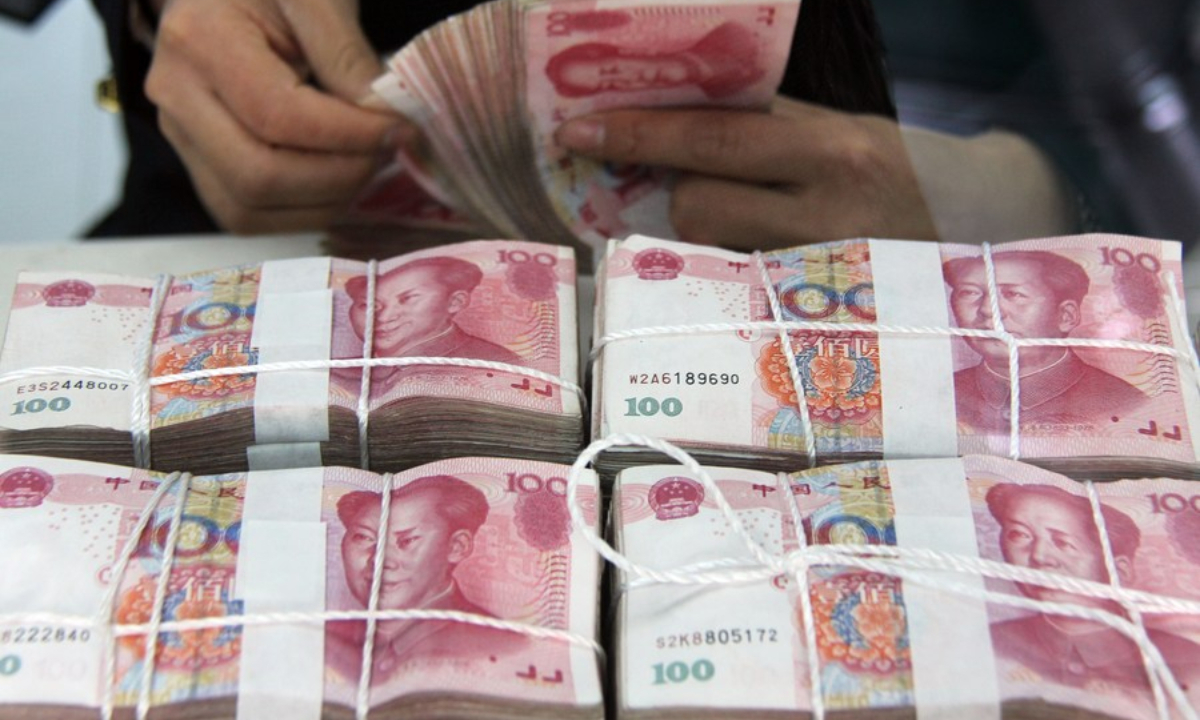
File photo shows a worker counts Chinese currency Renminbi banknotes at a bank in Tancheng County of Linyi City, East China's Shandong Province. Photo: Xinhua
In September, the yuan's share in global payments reached 3.17 percent, up from 2.93 percent in August, according to SWIFT data released on Thursday. This marks continued progress in yuan's internationalization, in line with the growing adoption of the currency in cross-border transactions amid the global economic transition, analysts said.
A recent report from the Bank for International Settlements confirmed the yuan's status as the world's fifth-largest trading currency, with its global transaction share at 8.5 percent, up 1.5 percentage points from 2022, the largest rise among all currencies.
Other recent research reports have similarly highlighted the notable growth of yuan usage in cross-border trade settlements and trade financing between 2024 and 2025.
This trend has been noticed by Chinese exporters, who told the Global Times at the ongoing 138th Canton Fair that an increasing number of overseas customers, especially those from emerging markets such as Southeast Asia, Central Asia and Africa, are actively requesting to settle their deals in yuan.
"Many foreign customers now opt for yuan settlement. It wasn't us who initiated it; it was the clients who proposed it," a manager of Jiangsu Jinpeng Group Co, a producer and seller of electric tricycles, told the Global Times at the 138th Canton Fair.
Overall, the proportion of clients using the yuan for trade settlement has surged, with the number roughly doubling, the manager said.
Analysts noted that since the launch of yuan-based cross-border trade settlement in 2009, the internationalization of the yuan has gained pace. Correspondingly, institutional arrangements for the currency's cross-border use and supporting financial infrastructure have continuously improved.
A recent report conducted by China Construction Bank attributed the yuan's rise in its usage to international geopolitical changes, certain countries erecting tariff barriers and US interest rate fluctuations, which have reduced emerging markets' reliance on the US dollar.
Against this backdrop, yuan's usage in cross-border transactions is steadily increasing, with the trend particularly pronounced in Global South economies. Southeast Asia, the Middle East, Africa and Central Asia are increasingly adopting the yuan as a trade settlement currency, the report said.
In June 2025, the Bank of China released its 2025 white paper on yuan's internationalization, revealing that in 2024, its domestic and overseas institutions completed cross-border yuan settlements exceeding 43 trillion yuan ($6.04 trillion), up 31 percent year-on-year, while cross-border yuan clearing volume reached 131.4 trillion yuan, up 49 percent.
A report released by China International Capital Corp on September 30 further noted that Washington's abuse of the US dollar's status and widespread tariff impositions have eroded its credibility. It argued that the US role as the world's ultimate consumer will decline, deepening trade among non-US markets and reshaping international economic relations and supply chains. Financially, the weakening of the US dollar's functions is leading to fragmentation and diversification of the global monetary system, the experts said.
Global Times
RELATED ARTICLES