ARTS / CULTURE & LEISURE
Location of Yue State capital confirmed by new archaeological discoveries
By Published: Oct 23, 2025 11:01 PM

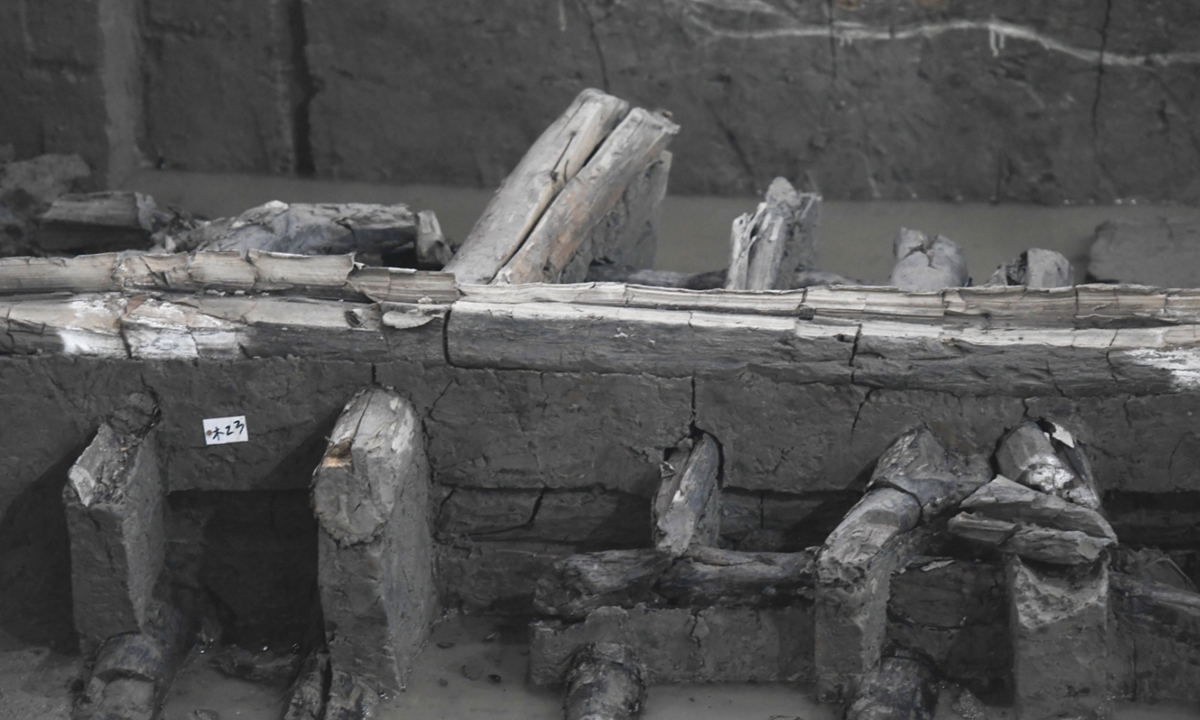
The Jizhong site in Shaoxing Photo: VCG
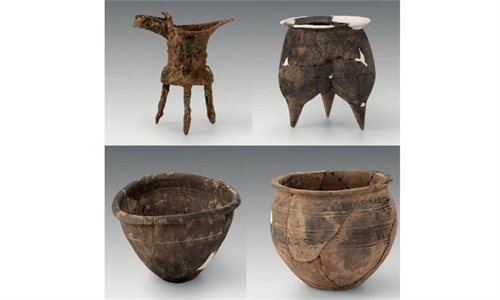
New archaeological findings have emerged from the ancient city of Shaoxing, a site already famous for its role as the capital established by King Goujian during the Eastern Zhou Dynasty (770BC-256BC). King Goujian is a legendary figure in Chinese history who is remembered for his perseverance in overcoming defeat and avenging himself against his foes.At the Tashan and Changfang sites, Neolithic sand-tempered pottery, red pottery, jade artifacts and other relics were unearthed from a depth of three meters below the surface for the first time. Above these Neolithic layers, archaeologists discovered, for the first time, a clearly defined high-ranking sacrificial site from the Yue State.
The accumulation of relics from different eras resembles a cross-section of an "underground history book," chronicling the region's evolution across 6,000 years of history, Luo Peng, the project leader and deputy director of the Shaoxing Institute of Cultural Relics and Archaeology, told the Global Times on Thursday.
Among these new discoveries, the Yue State sacrificial site stands out. Inside the sacrificial trenches, archaeologists found densely distributed stamped hard pottery jars covered with woven fabrics, primitive porcelain bowls, tin ge (a type of ancient weapon) and other ritual vessels. The hard pottery jars contained bones or entire skeletons of horses, cattle and deer. Based on the arrangement and overlapping of these artifacts, it can be inferred that multiple high-level sacrificial activities were held at this site, Li Longbin, director of the Shaoxing Institute of Cultural Relics and Archaeology, told the Global Times on Thursday.
The significance of this sacrificial site lies in the critical connection it establishes between the Tashan and Changfang sites and the Jizhong site, which is only 400 meters away. According to Li, this sacrificial site and the architectural foundations previously discovered at the Jizhong site together form the core area of the Yue State capital, once again providing solid archaeological evidence that King Goujian established it as the capital.
Luo added that the unearthed artifacts, which reflect sacrificial activities, closely align with de-scriptions in ancient texts, providing important references for studying the ceremonial systems of the Eastern Zhou Dynasty.
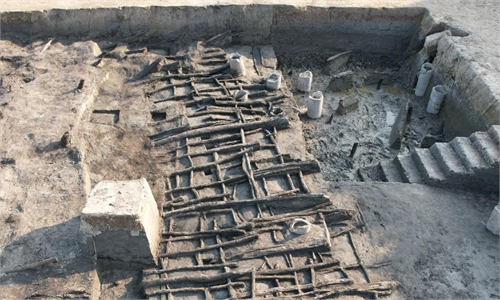
At the Tashan and Changfang sites, researchers also uncovered a relic consisting of a rammed-earth wall and wooden posts. Experts speculate that this structure might be related to the foundations of the Yue State's palace wall. If this speculation is confirmed, it would mean that the Tashan site and the large palace architectural foundations already discovered at the Jizhong site con-stitute two key nodes of the Yue State capital's palace and ceremonial districts. This would provide crucial physical evidence for reconstructing the layout of the Yue State capital, according to the Hangzhou Daily.
In the northwest area of the Jizhong site, archaeologists also discovered numerous relics sporting writing, including intact inscribed bricks bearing the phrase "Kuaiji Wall" and bamboo slips with phrases such as "Shanyin Shou Bao." Li disclosed that more than 200 bamboo slips were found in a well. With the support of experts from the archaeological research center of the National Cultural Heritage Administration, these bamboo slips are currently undergoing cleaning, deciphering and preservation.
RELATED ARTICLES