ARTS / CULTURE & LEISURE
Shang Dynasty tombs in Shanxi shed light on early cultural landscape
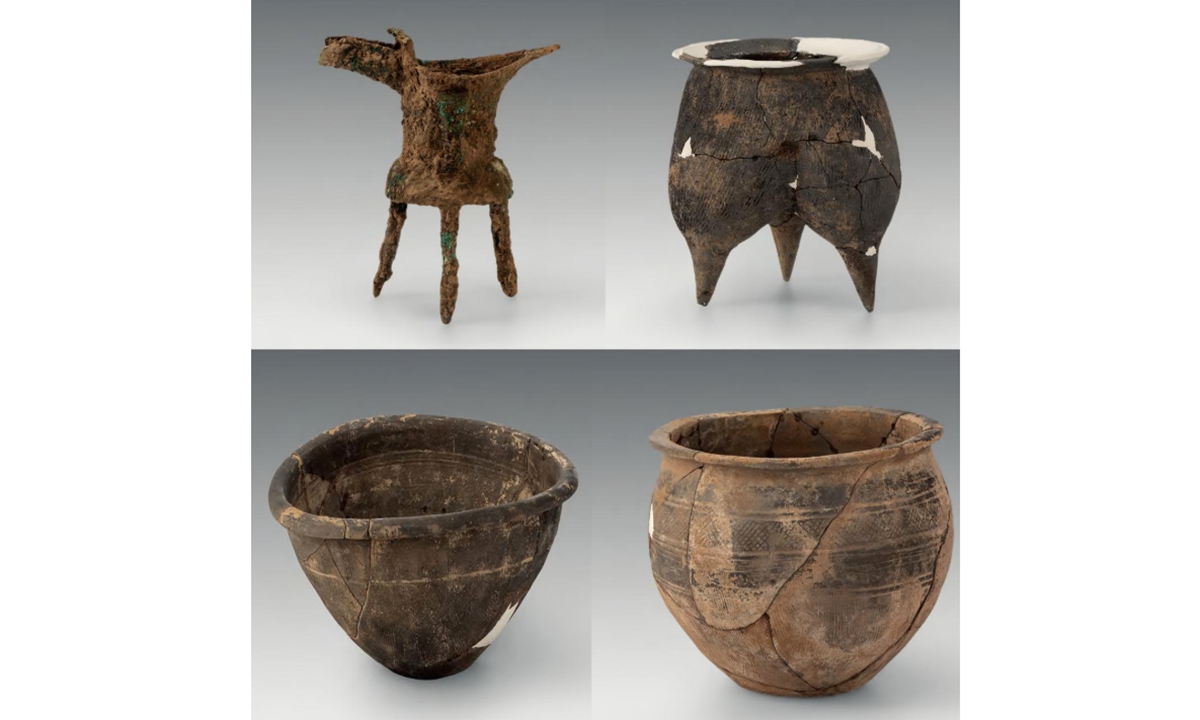
Photo: Courtesy of Shanxi Cultural Relics Bureau
Chinese archaeologists have uncovered four Shang Dynasty (c.1600BC-1046BC) tombs in North China's Shanxi Province that have yielded a treasure trove of pottery and jade artifacts, offering new insight into the spread of early Shang culture in southern Shanxi, according to the Shanxi Provincial Institute of Archaeology.
The discovery was made at the Yuancun site in Peijie township. Situated in the southern part of Yuancun village, the site is an ancient settlement primarily dating from the Neolithic period to the Xia (c.2070BC-c.1600BC) and Shang dynasties. No early Shang tombs had previously been found in this area.
From August to December 2023, a new excavation of the Yuancun site was conducted, during which archaeologists uncovered 38 items including house foundations, ash pits, kiln sites, and tombs spanning multiple eras from the Neolithic through the Warring States Period (475BC-221BC), Song Dynasty (960-1279) and Jin Dynasty (1115-1234). A large number of artifacts were unearthed, including pottery, bronze ware, jade, and bone tools.
Most of the findings belong to the Miaodigou culture of the Neolithic period. However, among the relatively few early Shang relics, four well-preserved tombs stood out due to their rich burial goods, including pottery tripods, ritual wine vessels, bulging-belly basins, and jade-handled implements.
Two of the tombs, labeled M8 and M12, were discovered in the central part of the northeastern excavation area. The two lie parallel to each other along a northeast-southwest axis, with contemporary ash pits scattered nearby. The other two tombs, M15 and M16, were found along the southern edge of the southwestern excavation zone, surrounded by early Shang ash pits and house remains that appear to cluster in the vicinity.
"All four tombs are rectangular vertical pit graves oriented north-south, with single burials in either prone or extended supine positions," Liu Yancheng, a member of the excavation team from the School of Archaeology at Jilin University, told the Global Times on Tuesday.
Liu noted that M8 contained six grave goods, while M12 yielded seven items, including a pottery jar, two basins, a bronze wine vessel and a knife. M16 comprised three pottery vessels, while M15 had a single li cooking vessel as its burial good. "Many of these artifacts, particularly the pottery vessels from M8, M12, M15, and M16, were found to have been deliberately smashed, which involved intentionally breaking pottery as part of a funerary rite," Liu said.
The shapes and decorative patterns of the artifacts closely resemble those from the second phase of the lower layer of the Erligang culture, indicating that the burials date to the second stage of the first phase of early Shang civilization. Based on both the material characteristics and the site's geographic location, the four tombs have been attributed to the Dongxiafeng style of the Erligang cultural system.
The Dongxiafeng site served as a major settlement during the Xia-Shang transition, while the smaller Yuancun site downstream likely ranked lower in scale and status.
The discovery of tombs containing bronze ritual vessels at Yuancun, however, suggests that this site may have been home to mid- or lower-ranking elites and possibly functioned as an important node along the route linking Salt Lake to Dongxiafeng, a corridor that may have facilitated cultural and political exchanges during the early Shang period.
"The presence of bronze ritual artifacts in these relatively modest burials provides significant clues about the sociopolitical structure of early Shang communities in this region," Liu noted. "It helps us understand how elite culture and ritual practices spread from central settlements like Dongxiafeng to peripheral ones such as Yuancun."
Experts say the discovery fills a key gap in the archaeological record of southern Shanxi's early Shang culture, offering valuable material for future comparative studies of the Erligang cultural sphere and its regional variations.
RELATED ARTICLES