ARTS / BOOKS
Richness of Chinese language makes Finnish version flow beautifully: Counselor
Tourism helps two peoples understand each other better: Diplomats
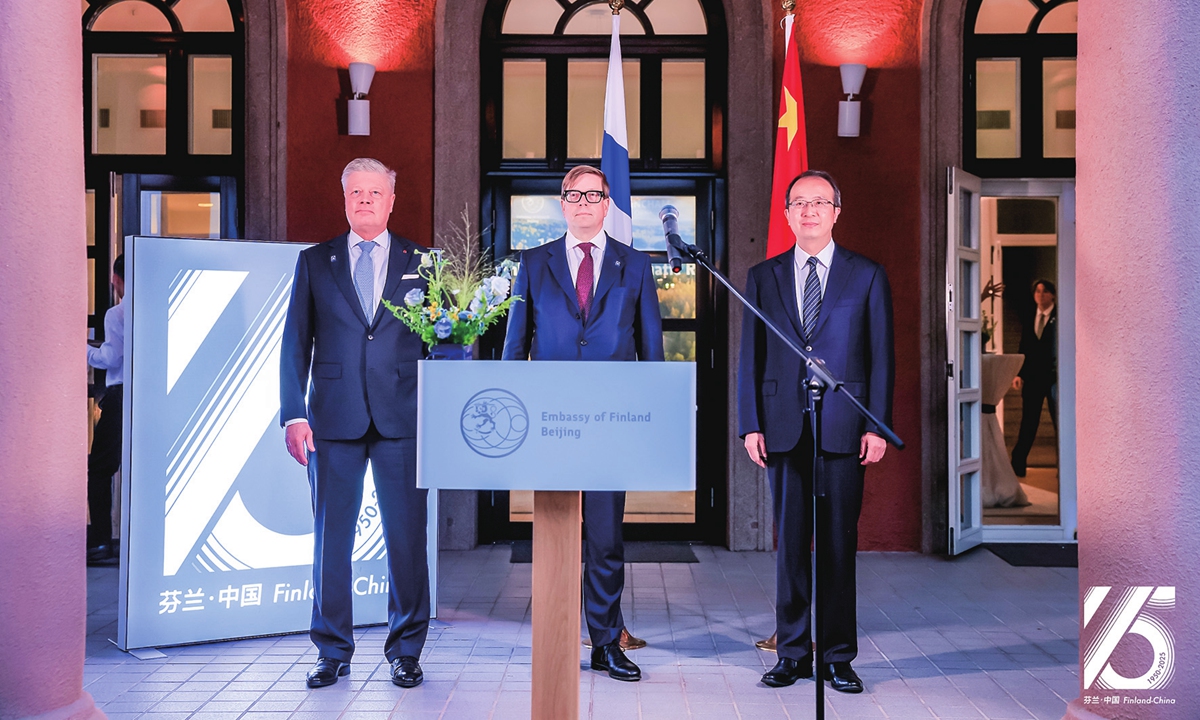
Ambassador of Finland to China Mikko Kinnunen (left), Ambassador Jukka Salovaara, Permanent State Secretary of the Ministry for Foreign Affairs of Finland (center) and China's Assistant Foreign Minister Hong Lei at the reception in Beijing, on October 15, 2025 Photo: Courtesy of the Embassy of the Republic of Finland in China
On different occasions, Finnish diplomats have told the Global Times that China's unilateral visa-free policy, which went into effect in early November 2024, to facilitate easier travel for Finnish business representatives, students, and tourists, has helped enhance cooperation and strengthen bilateral relations between Finland and China. The Embassy of the Republic of Finland in China hosted a reception in Beijing on October 15 to celebrate the 75th anniversary of the establishment of diplomatic relations between China and Finland.At the reception, Ambassador of Finland to China Mikko Kinnunen said in his speech that strong commercial and economic cooperation has been the key element in Finland-China relations from the very beginning. It creates ties between our two countries and benefits the people both in Finland and China.
The reception was held at the Finnish Ambassador's Residence, where Ambassador Kinnunen welcomed the guests, saying, "As the 18th ambassador residing in this building, I am particularly happy to welcome you to the beautiful Garden and the Residence of Finland. In the beginning of our diplomatic relations, Chinese prime minister Zhou Enlai allocated this land and building to Finland."
Giving a brief overview of the relations between Finland and China in his remarks, Ambassador Jukka Salovaara, Permanent State Secretary of the Ministry for Foreign Affairs of Finland, said that Finland was among the first Western countries to recognize the People's Republic of China and establish diplomatic relations with the country in 1950.
"The establishment of diplomatic relations was followed by the swift development of sports diplomacy and trade relations. A team of 40 Chinese athletes traveled to Helsinki for the 1952 Olympics. The first trade agreement between Finland and China was signed in 1953," Secretary Salovaara said.
He added: "We came to know China's economic, technological, and social development that proceeded in an unprecedented way. It is fair to say that both countries have greatly benefited from the expansion of contacts and cooperation in multiple fields," and stressed that the multilateral system is obviously important to both countries.
Upon invitation, Assistant Foreign Minister Hong Lei attended the reception. In his remarks, Hong said that China is ready to work with Finland to uphold the original aspiration of establishing diplomatic relations, carry forward traditional friendship, and continuously promote new developments in China-Finland relations.
"Although China and Finland are geographically distant, our friendly exchanges date back centuries. As early as the 18th century, Finnish scholars traveled to China by sea, embarking on the exploration of an ancient and mysterious civilization," said Hong.
Standing at this new historical starting point, China looks forward to working with Finland to stay true to the founding purpose of our diplomatic ties, carry forward their traditional friendship, and elevate bilateral relations to a higher level. "By doing so, we can deliver more benefits to our two peoples and make greater contributions to global peace, stability, development, and prosperity," he remarked.
On October 15, at a press conference, Ambassador Kinnunen affirmed China's unilateral visa-free policy has helped enhance cooperation and strengthen bilateral relations between Finland and China.
"Finnish people are very happy about that. Obviously, it makes [it] easier to travel to China. It's particularly good for business people. So I think it has been appreciated very much. We have been thankful for China's decision," said Ambassador Kinnunen, noting that business people may travel on short notice with no hassle or trouble. At the same time, Finland is seeing Chinese tourist numbers picking up, longer stays, and spending more during their trips. Ambassador Kinnunen vowed to continue to work to expand tourism exchanges with China.
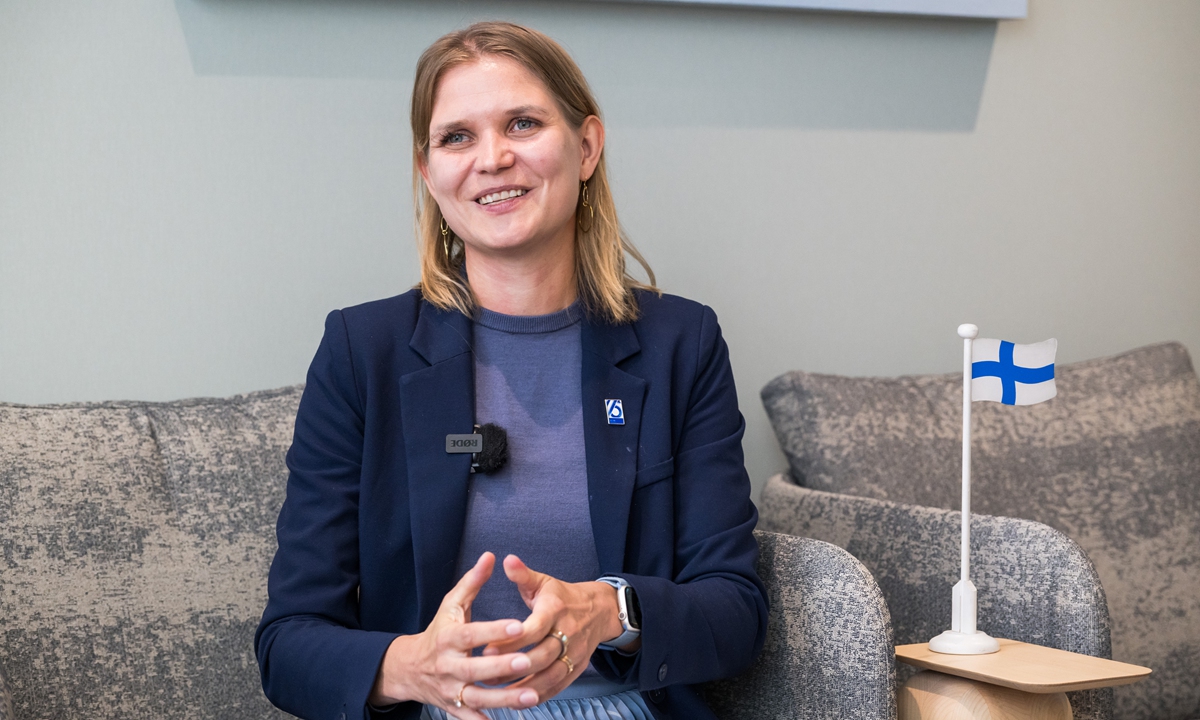
Press and Cultural Counsellor of the Embassy of the Republic of Finland in China Janna Laine in Beijing, on October 22, 2025. Photo: Chen Tao/GT
In an exclusive interview on October 22 with the Press and Cultural Counsellor of the Embassy of the Republic of Finland in China, Janna Laine, the counselor said that thanks to the visa-free policy, the visit is becoming more convenient."When you actually visit and meet the local people and talk to them, you will realize that there are so many common things. All countries share similarities."
Real life people-to-people contacts help people to see the similarities that are common for both countries. "When it comes to culture, I feel many cultural fields are meant to convey messages and stories, no matter whether it is through visual arts, poetry, music, theater, or literature. Through cultural exchange, both Finnish and Chinese people can see there are talented and hardworking people in both countries," she told the Global Times.
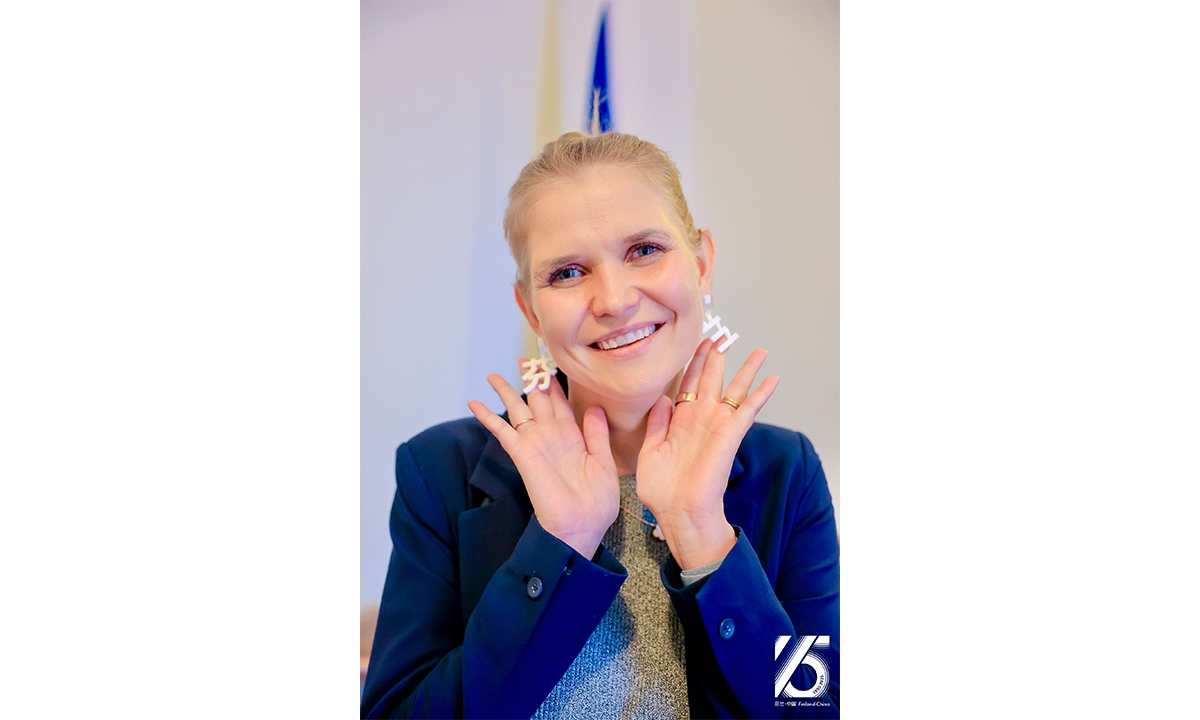
Press and Cultural Counsellor of the Embassy of the Republic of Finland in China Janna Laine at the reception in Beijing, on October 15, 2025 Photo: Courtesy of the Embassy of the Republic of Finland in China
On the day of the celebration reception for the 75th anniversary of bilateral diplomatic ties, Laine was wearing a pair of earrings with Chinese characters reading Fen Lan (Finland). She placed a customized order for the occasion, in her own words, it was an idea that she thought of while talking to a colleague and "I let my mind wander a bit and something interest comes up."Beyond elite circles, in successful grassroots or community-driven projects that have broadened access to Chinese and Finnish culture, what impressed Laine most is that book translations are a powerful way to reach wide audiences.
Laine has been working as a diplomat in China for five years and she is also a sinologist.
"I know many cases where the translator him- or herself takes an interest in a certain book and is decided to translate it into Finnish or Chinese. As a Finn who can speak some Chinese, I especially enjoy reading Chinese literature translated into Finnish. When translated into Finnish, you can see the richness of the Chinese language, which makes the Finnish version flow beautifully," said the avid reader.
From her point of view, when a book is translated, it means a new door is opened for readers to reach a better understanding of another country. "Books are also good windows to open the stories more deeply and thinking of the authors' world," she said.
Talking about leveraging digital and hybrid cultural formats in cultural exchanges, Counsellor Laine said that virtual exhibitions are a great initiative, but we are not quite there yet. "So far in my opinion nothing beats an offline art exhibition or discussion event. Online platforms could be used to create contacts and preliminary discussions, but at the end of the day, I feel real life connections make the real difference," Counsellor Laine elaborated.
Focusing on real life connections, the Embassy of the Republic of Finland in China organized Ice Hockey match in May, where Chinese delegates were invited to feel the charm of the winter sport. The hands-on experiences among Chinese children impressed her greatly. "You put them on the ice, even for the first time, 20 minutes later, [they] can already skate a little bit; it's very impressive," said Laine.
RELATED ARTICLES