China, US can address concerns through equal-footed talks
Healthy bilateral relations to benefit global economic stability: expert
China US
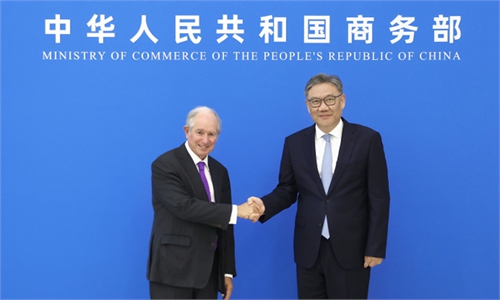
The first four rounds of China-US economic and trade consultations have demonstrated that, so long the two parties respect each other and conduct equal-footed negotiations, they could find ways to address each other's concerns, find a path to coexistence, and promote the healthy, stable, and sustainable development of China-US economic and trade ties, China's Commerce Minister Wang Wentao said in Beijing on Friday.
Wang noted that China, as a responsible major country, has consistently opposed "decoupling," and it has firmly safeguarded the security and stability of global production and supply chains.
China's Ministry of Commerce announced on Thursday that Vice Premier He Lifeng, who is also a member of the Political Bureau of the Communist Party of China Central Committee, will lead a delegation to Malaysia from October 24 to 27 to hold economic and trade consultations with the US side.
The two sides will hold talks on important issues in China-US economic and trade relations in accordance with the important consensus reached by the heads of state of the two countries during their phone calls this year, a ministry spokesperson said in a statement.
The meeting in Malaysia follows recent trade talks between Chinese and US delegations in Madrid in September, Stockholm in July, London in June, and Geneva in May.
"Minister Wang's remarks clearly demonstrate China's consistent stance in addressing China-US trade issues. Throughout the previous four rounds of consultations, China has steadfastly upheld the fundamental principles of mutual benefit, win-win cooperation, and mutual respect to advance dialogue and negotiation. This position has remained unchanged," Zhou Mi, a senior research fellow at the Chinese Academy of International Trade and Economic Cooperation, told the Global Times on Friday.
By reiterating this view amid new challenges in bilateral relations, China is signaling a proactive willingness to promote the stable development of China-US economic and trade ties, Zhou noted.
He Weiwen, a senior fellow at the Center for China and Globalization, said that China has always advocated that the two countries should engage in dialogue on the basis of equality and mutual benefit, rather than allowing negotiations to become a tool for seeking unilateral gains by the US side.
Following the Madrid talks, the US introduced a batch of unilateral restrictive measures against China, such as expanding the scope of control over businesses with the Affiliates Rule and persisting with the implementation of Section 301 measures targeting China's maritime, logistics and shipbuilding enterprises. These measures have seriously harmed Chinese interests and severely undermined the atmosphere of bilateral economic and trade talks, a spokesperson from MOFCOM said on October 12.
He Weiwen told the Global Times that if the US truly wants to improve bilateral relations, it should abandon the misguided mindset of erecting trade barriers and pursuing the "America first" policy.
As two major countries, it is normal for China and the US to hold different views. The key lies in moving toward each other on the basis of existing consensus, rather than continuously introducing new issues and complications, which would only make negotiations more difficult, Zhou said.
"If the two sides implement the consensus reached and achieve further alignment on existing and emerging issues during the talks in Malaysia, it will lift market expectations," Zhou said.
A stable China-US relationship enables both sides to focus more resources and efforts on promoting mutually beneficial economic and trade cooperation, rather than redundant investments or adversarial development models, Zhou noted.
"Healthy and sustainable China-US ties not only benefit the enterprises and people of both countries, but also contribute positively to global economic stability and the resilience of industrial chains," He Weiwen said.
RELATED ARTICLES