From Chongqing to the world: How Belt and Road Initiative helps accelerate China’s car exports
By Zhang Yiyi in Beijing and in Chongqing Published: Oct 24, 2025 11:53 PM
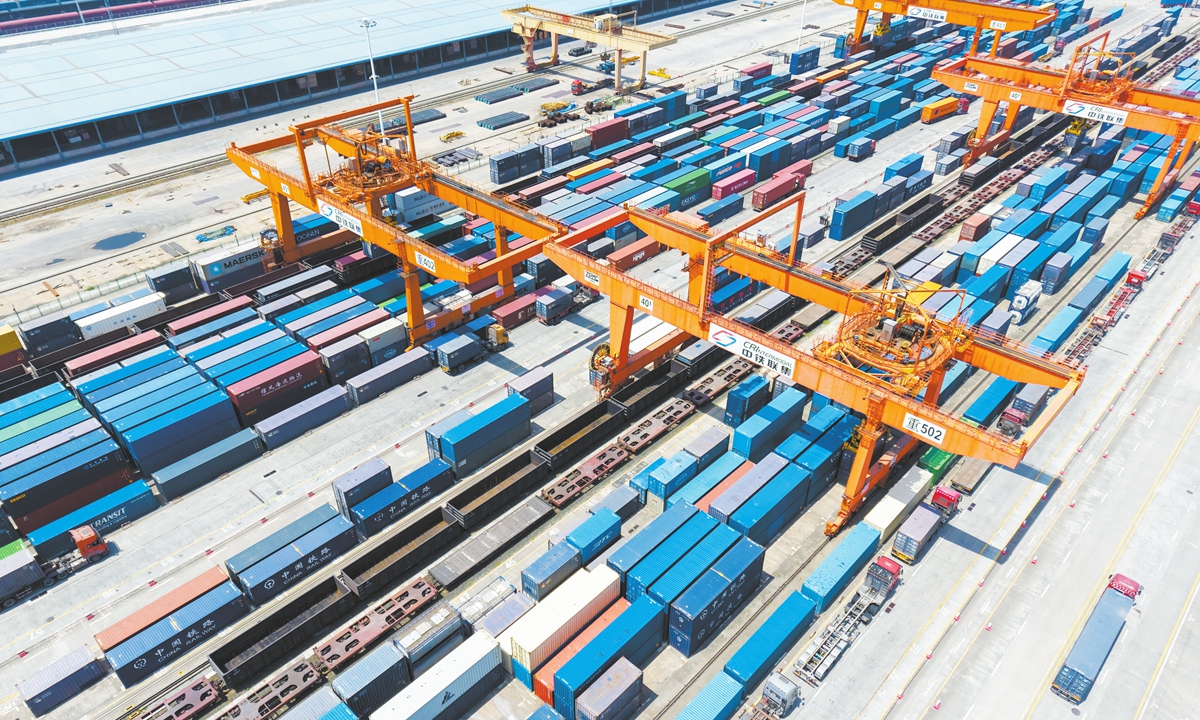
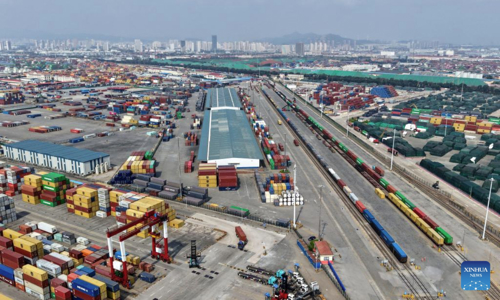
Containers are piled up at the railway port in Shapingba district, Southwest China's Chongqing Municipality, on April 17, 2025. Photo: VCG
At a logistics terminal on the banks of the Yangtze River in Southwest China's Chongqing, rows of newly assembled Chinese-made auto vehicles gleam under the autumn sun, ready to embark on their Belt and Road journeys by rail and sea.
Once a landlocked "rear guard," Chongqing has now become a "front-runner" of China's opening-up, linking western China with markets across Asia, the Middle East, and Europe through the New International Land-Sea Trade Corridor.
Over the past decade of the Belt and Road Initiative (BRI), the transformation has been striking: factories once focused on domestic demand are now shipping vehicles worldwide, and China's inland regions are increasingly integrated into global supply chains. Automobiles have become one of the signature products of Chongqing manufacturing and a rising force in the city's foreign trade.
In 2023, Chongqing officially launched the "Yuche Going Global" initiative, aiming for the city's annual vehicle exports to account for 10 percent of the national total by 2027. The plan underscores Chongqing's ambition to make its homegrown auto brands recognized across the world, according to a local report.
Data from Chongqing Customs show that in 2024 the city exported 477,000 vehicles, up 29.6 percent year-on-year, with a total export value of 43.11 billion yuan ($5.9 billion), a 30 percent increase — marking an important acceleration in the "Yuche Going Global" drive as Chongqing-made cars reach the world's six continents.
According to the National Development and Reform Commission's 2024 report, "We encouraged new-energy vehicle enterprises to upgrade and restructure their operations, get stronger, and do better." The report highlighted the growing importance of new-energy vehicle exports in China's foreign trade.
Racing outward
Chongqing, known as "China's Auto City," is accelerating its "Yuche Going Global" initiative, integrating itself into the global auto supply chain through rail-sea logistics. "The BRI has helped Chinese carmakers build an overseas industrial layout," said Yang Lianchen, an economist in the marketing department at the Chongqing Railway Logistics Center. "By linking inland factories with seaports, the corridor shortens delivery time and lowers logistics costs."
At the Chang'an Automobile booth during a recent trade fair, staff workers told Global Times that the company's product mix has shifted dramatically. "In the past, our exports were mainly fossil fuel-powered cars positioned for affordability," one representative said. "Now, the world recognizes China's new-energy vehicles. We've launched higher-end models with stronger brand value that are welcomed in Southeast Asia, the Middle East and elsewhere."
Changan's global expansion reflects this shift. According to Tan Benhong, deputy Party secretary of Changan Automobile, the company's products have been exported to 103 countries and regions, with overseas sales reaching 405,000 units between January and August, 2025. By 2030, Chang'an aims to achieve annual production and sales of 5 million vehicles, of which 60 percent will be new-energy models and 30 percent will be sold overseas, becoming a world-class auto brand.
As a homegrown Chongqing automaker, Seres was among the first to respond to the BRI. Its new-energy vehicles are now sold in 62 countries across Europe, the Americas, Africa and Southeast Asia, with over 300 dealers and total exports exceeding 500,000 units, according to Chongqing Daily.
The industry is not only exporting vehicles but also entire value chains. "Our assembly plants in Thailand and other markets bring production closer to consumers while creating local jobs," said a Changan staff member. "It's about sharing growth opportunities, not just selling cars."
"Nowadays, many Chinese original equipment manufacturers and suppliers are choosing Belt and Road markets as ideal destinations to set up plants and make investments, banking on the sustained momentum of win-win cooperation under the BRI, Wang Jimin, a member of board of Ningbo Jifeng Auto Parts Co, a supplier of car seats, told Global Times on Wednesday on the sidelines of the 32nd China-SAE Congress & Exhibition, an industry forum held in Chongqing. The willingness for cooperation by local business partners and government authorities in those markets is notably higher, which greatly facilitates business operations, Wang said.
"Chinese automakers are now expanding their footprint worldwide," said Chai Zhanxiang, deputy secretary-general of the Automotive Sub-Council of the China Council for the Promotion of International Trade. In 2024, China exported more than 6 million vehicles, including over 2 million new-energy cars — marking the third consecutive year that China has ranked as the world's largest automobile exporter.
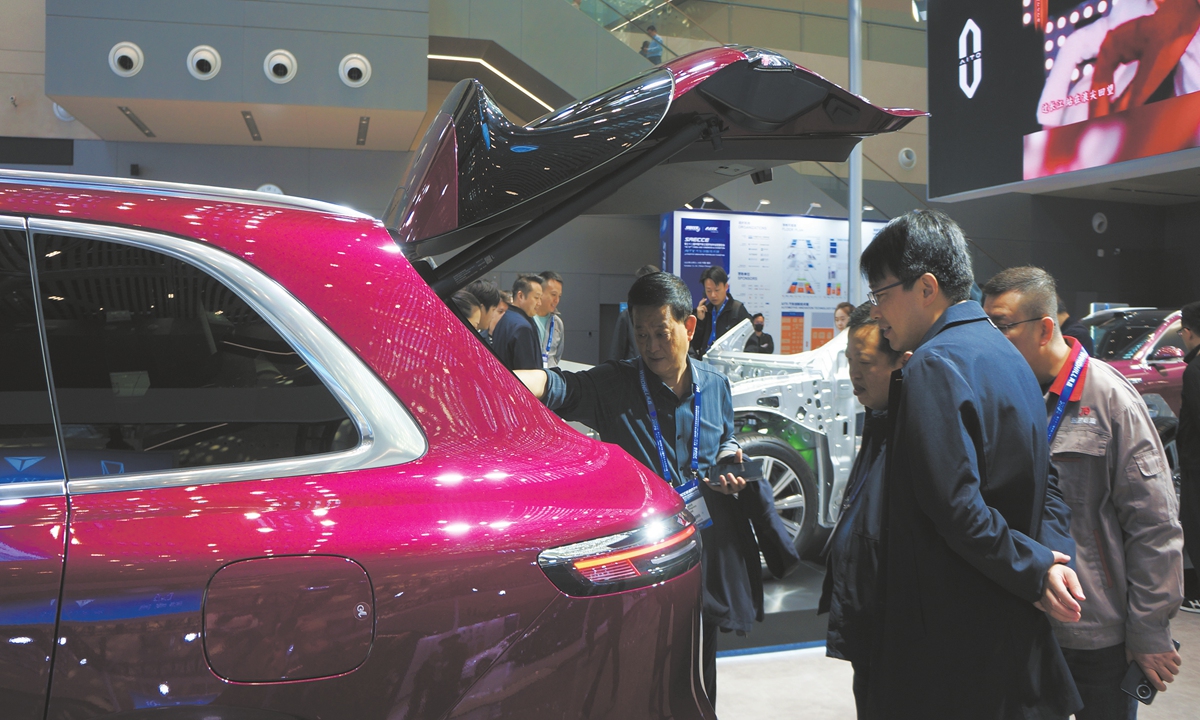
Visitors gather round a car on display at the 32nd China-SAE Congress & Exhibition in Southwest China's Chongqing Municipality on October 22, 2025. Photo: Chu Daye/GT
Building green links
Beyond automakers, China's supporting industries are moving outward too. From October 13 to 18, a Chinese delegation from the China Association of Automobile Manufacturers visited the UAE to study charging infrastructure, coinciding with the 2025 UAE Future Mobility Expo. The visit aimed to strengthen policy coordination and corporate cooperation in China-Arab green energy development, the organizers said.
Western China's opening-up is gaining momentum. According to Wang Jun, deputy head of the General Administration of Customs, the region's foreign trade surpassed 4 trillion yuan in 2024, accounting for 9.2 percent of China's total. In the first three quarters of 2025, trade grew 10.2 percent to 3.21 trillion yuan, driven by rising exports of electronics and high-end equipment through key corridors such as the New International Land-Sea Trade Corridor.
Song Wei, a professor at the School of International Relations and Diplomacy at Beijing Foreign Studies University, told Global Times on Thursday that the BRI has opened unprecedented opportunities for China's western regions, transforming them from inland hinterlands into new frontiers of opening-up.
"Projects such as the New International Land-Sea Trade Corridor have effectively connected cities like Chongqing and Chengdu with Central Asia, Europe, and ASEAN, creating a multi-directional logistics network linking the west to global markets," Song said. "This not only reshapes regional trade routes but also drives industrial upgrading, enabling western provinces to take part in high-end manufacturing and global supply chains."
Song noted that the automobile industry exemplifies how the BRI is integrating China's inland manufacturing into global value chains.
"With the rise of logistics hubs and international railway and maritime routes, Chinese automakers are extending their full industrial chains abroad — from production and supply to after-sales service," she said. "Chongqing's growing role as a manufacturing and export base shows how inland regions are now at the forefront of global industrial cooperation."
Beyond car exports, Song said, China's engagement in the BRI has deepened in both quality and scope. "More Chinese enterprises are investing and building plants in partner countries, helping to cultivate local technical talent, strengthen industrial systems, and share advanced manufacturing know-how," Song said. "This shift from 'going out' to 'integrating in' reflects a more mature stage of China's participation in the Belt and Road — one that promotes mutual development and long-term, win-win cooperation."
RELATED ARTICLES