ARTS / CULTURE & LEISURE
40 iconic spots in Old Summer Palace faithfully digitized anew
Innovation breathes new life into lost landscapes
By Published: Oct 26, 2025 10:21 PM

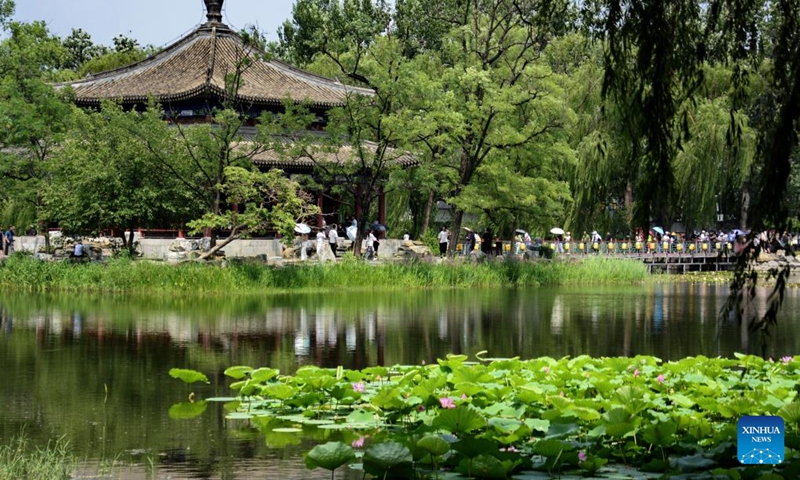
Visitors enjoy blooming lotus flowers at Yuanmingyuan Park in Beijing. (Xinhua/Li Xin)
An academic symposium on the research and protection of the Old Summer Palace (Yuanmingyuan) was held in Beijing on Saturday, during which the achievements of the digital restoration of the ancient site were released for the first time. By harnessing multiple cutting-edge digital technologies, researchers have vividly recreated the magnificent appearance of 40 scenic spots at the park as they existed around the ninth year of Emperor Qianlong's reign (1744) during the Qing Dynasty (1644-1911). Portions of this digitized achievement have already been incorporated into several virtual reality (VR) cultural tourism projects at the park.According to a Sunday press release from the Yuanmingyuan administration office, the project integrates a wealth of historical sources, most importantly 40 scenic illustrations of the palace painted by court artists Tang Dai and Shen Yuan during the Qing Dynasty. This resulted in a comprehensive panoramic image of all 40 scenic spots. The restoration team from the Central Academy of Fine Arts (CAFA) developed an original database of Qing-style architectural models, utilizing parameterized design and modular construction techniques alongside industry-leading digital tools. The project was further supported by 3D scanning and Geographic Information System technologies, allowing for a faithful recreation of the landscape as it appeared in 1744.
The 40 colored painting scrolls depicting Yuanmingyuan took nine years to be completed and were lost during the looting and burning of the palace by Anglo-French allied forces in 1860.
The project, jointly undertaken by the Yuanmingyuan administration office and the AI and digital cultural heritage research center of the CAFA, took two years to complete. The digital restoration achieves accurate representation of architecture, vegetation, and water systems. Real-time rendering and dynamic interaction using high-precision 3D digital models bring the garden's splendor to life under different times of day and varying weather conditions. This not only digitally revives a Yuanmingyuan that has long been lost to history, but also reveals image information and spatial relationships between scenic spots that could not be intuitively grasped from ancient paintings alone.
"Digitally restoring the Yuanmingyuan landscapes helps remedy the regret created by the loss of its garden architecture, offering a direct visual impression. At the same time, such methods deepen our research into the culture and ruins of Yuanmingyuan, and are beneficial to its future application for UNESCO World Heritage Site status," Liu Zheng, a member of the Chinese Society of Cultural Relics, told the Global Times on Sunday.
He added that this initiative not only reveals the profound significance of Yuanmingyuan itself, but more importantly, serves as a demonstration and inspiration for the protection and research of other major heritage sites, showing how similar digital approaches can revitalize large-scale heritage resources.
The year 2025 marks the 165th anniversary of the destruction of Yuanmingyuan. This year's symposium focused on three major topics: digitalization and protection of the Yuanmingyuan heritage site, research on garden design and ecological environment, and studies of Yuanmingyuan's role in the history and culture of the Qing Dynasty. Twenty-eight research achievements were presented and discussed, with the aim of using interdisciplinary exchange to explore new avenues for the conservation and revitalization of Yuanmingyuan and other large heritage sites across China.
The symposium also highlighted significant progress in archaeological exploration and protective restoration of core sites within Yuanmingyuan, such as Zhengjue Temple, Han Jing Hall, and Ruyuan Garden. Many precious artifacts have been properly preserved. At the same time, ongoing efforts to restore the garden's water ecology and maintain the original landscape have not only reestablished the historical water system, but also improved the overall ecological environment of the heritage area.
The CAFA is one of the key members of the Yuanmingyuan research university alliance. The alliance includes eight top universities, such as Beijing Jiaotong University, Tianjin University, Beijing Foreign Studies University, and Peking University. In recent years, the alliance has established a research model of alternating between annual academic symposia and annual exhibitions of achievements. By 2024, the alliance had carried out more than 70 interdisciplinary research projects, covering areas including landscape restoration, archaeological excavation, and digital protection.
RELATED ARTICLES