China's high-tech manufacturing profits rise 8.7% in first nine months: NBS
Nation's high-tech manufacturing drives strong industrial rebound
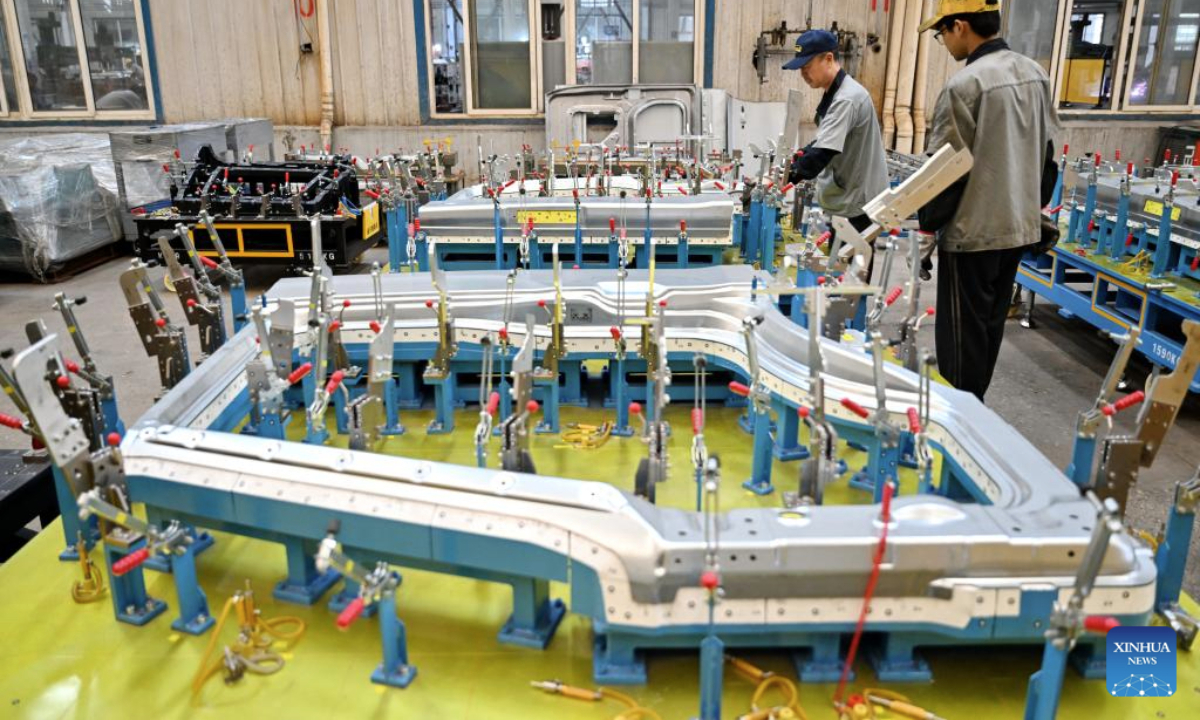
Technicians check product quality at a mold company in Botou, north China's Hebei Province, Sept. 24, 2025. (Xinhua)
China's industrial firms posted faster revenue growth in the first nine months of 2025, with operating income up 2.4 percent year-on-year, driven by a rise of 8.7 percent in the profits of the high-tech manufacturing sector, according to data released by the National Bureau of Statistics (NBS) on Monday.
Major industrial firms recorded 5.37 trillion yuan ($745.8 billion) of profits from January to September, up 3.2 percent year-on-year, the highest cumulative growth since August last year, the NBS said.
Profits in the high-tech manufacturing sector rose 8.7 percent year-on-year, accelerating by 2.7 percentage points from the January-August period and contributing 1.6 percentage points to overall industrial profit growth. In September alone, profits in the sector surged 26.8 percent, adding 6.1 percentage points to total industrial profit growth and serving as a key driver of high-quality industrial development.
Profits in aerospace equipment manufacturing rose 11.3 percent, while advances in automation and smart technologies led to surges of 81.6 percent in smart devices, 39.7 percent in electronic components, and 25.5 percent in specialized electronic equipment. Profits in optical and precision instrument manufacturing grew 45.2 percent and 17.5 percent, respectively, according to the NBS.
Bian Yongzu, a senior researcher at the China Institutes of Contemporary International Relations, told the Global Times that China's high-tech manufacturing sector has maintained robust growth momentum, with profits posting double-digit gains in September. This reflects the combined effect of industrial innovation and strong policy support. In recent years, China has introduced measures — including financial and fiscal incentives — to encourage technological innovation, significantly boosting enterprises' research and development investment and competitiveness.
He noted that universities and research institutes have been strengthening their innovation capacity and cultivating a large pool of talent, providing a solid foundation for technological development and industrial transformation. China's high-tech products are becoming increasingly competitive globally, underscoring the steady progress of the country's innovation-driven growth strategy.
According to Bian, China's vast manufacturing base and well-developed supply chains provide ideal conditions for the rapid application and large-scale growth of high-tech industries. The country's diversified industrial structure also offers ample scenarios for new technology deployment, allowing scientific achievements to translate more efficiently into real productivity and fostering a healthy innovation ecosystem.
According to the NBS, profits in the manufacturing sector grew 9.9 percent year-on-year from January to September, accelerating by 2.5 percentage points from the January-August period. Profits in the electricity, heat, gas and water production and supply industries rose 10.3 percent, up 0.9 percentage points, while the mining sector saw a decline of 29.3 percent, with the drop narrowing by 1.3 percentage points. In September alone, profits of major industrial enterprises increased 21.6 percent year-on-year, 1.2 percentage points faster than in August.
Profits improved for enterprises of all sizes, with notable gains among private-sector and foreign-funded firms. In the January-September period, profits of large, medium-sized and small industrial enterprises above designated size rose 2.5 percent, 5.3 percent and 2.7 percent year-on-year, respectively. By ownership type, private enterprises' profits grew 5.1 percent, while foreign and Hong Kong-, Macao- and Taiwan-invested firms' profits rose 4.9 percent. Profits of shareholding companies increased 2.8 percent, and losses among state-owned enterprises further narrowed, according to the NBS.
Yu Weining, chief statistician at the NBS, said that as global conditions grow more complex and economic pressures persist, China will focus on expanding domestic demand, strengthening internal circulation, and promoting synergy between the domestic and international markets to boost confidence and ensure steady, high-quality industrial growth.
RELATED ARTICLES