China's benchmark stock index surpasses 4,000 points in morning trade
Once-in-a-decade milestone underscores improvement in market sentiment, investors' confidence
By Published: Oct 28, 2025 11:15 PM


Stock market Photo:VCG
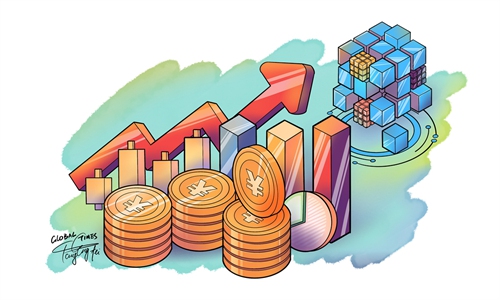
China's benchmark Shanghai Composite Index briefly surpassed 4,000 points during trading on Tuesday morning, reaching its highest level since August 19, 2015. The rally is primarily driven by various factors, including the government's supportive measures and optimism about the country's fundamentals.
The Shanghai Composite Index at one point reached 4,010.73 on Tuesday morning, and it edged down 0.22 percent to 3,988.22 at the close. The index has gained 19 percent year-to-date as of Tuesday. The benchmark index has broken the 4,000-point level in 2007, 2008 and 2015.
At the close, the Shenzhen Component Index fell 0.44 percent, and the Nasdaq-style ChiNext Index declined 0.15 percent.
The combined turnover of the Shanghai and Shenzhen bourses totaled 2.15 trillion yuan ($296.5 billion), shrinking by 192.3 billion yuan from the previous trading session.The daily trading volume has exceeded 1 trillion yuan for more than 100 consecutive trading days.
"This is a milestone moment for China's stock market, as the benchmark index has breached the 4,000-point psychological level for the first time in a decade. The bullish trajectory underscored a significant improvement in market sentiment and investors' confidence," Yang Delong, chief economist at Shenzhen-based First Seafront Fund, told the Global Times on Tuesday.
From a technical perspective, the 4,000-point level is a critical psychological barrier in China's stock market. Thus, remaining above that level could attract fresh capital and pave the way for further gains, analysts said.
Yang said that this round of gains is mainly led by technology industries including humanoid robots, chips and semiconductors, solid-state batteries, innovative drugs, and the low-altitude economy, whose development has been gaining momentum amid government's policy support and China's industrial upgrade tide.
According to observers, the15th Five-Year Plan (2026-30) released last week also offered a boost and reinforced market confidence. The plan set a number of major objectives over the next five years, including significant advancements in high-quality development and substantial improvements in scientific and technological self-reliance and strength.
"China's economic will see significant improvement in its quality and we expect sci-tech innovation to be a main force in the development trajectory," a manager of a Shenzhen-based private equity fund surnamed Zhu told the Global Times on Tuesday. She noted that this will in turn draw in more long-term capital that could play the role of a stabilizer in the market.
Yang stressed that the capital market serves as a "critical nexus" connecting technology and industry. On the one hand, it injects vital funding into early-stage hard-tech start-ups through primary market private equity and venture capital funds. On the other hand, it facilitates the listing and financing of more innovative technology enterprises via the secondary market, enabling them to grow into industrial giants.
The Shanghai Stock Exchange (SSE) on Tuesday released the names of the first group of enterprises listed on a sci-tech growth tier on the country's Nasdaq-style Science and Technology Innovation Board, also known as the STAR Market.
Li Chao, vice-chairman of the China Securities Regulatory Commission, said at a listing ceremony on Tuesday that the latest move marks a new step indicating the capital market's support for technological innovation and the development of new quality productive forces.
As more corresponding measures under the top-level design of the 15th Five-Year Plan (2026-30) are rolled out, the country is poised to see acceleration in the shift of new economic gears that further consolidate the fundamentals. Upbeat expectations about the fundamentals will play "an increasingly dominant role" in driving the medium-term trajectory of the stock market, Zhu noted.
Several global financial institutions have recently released research reports expressing optimism about Chinese equities.
For example, Goldman Sachs said that Chinese stocks could rise by about 30 percent through the end of 2027, driven by compound annual profit growth of 12 percent and a valuation expansion of between 5 and 10 percent, the South China Morning Post reported.
RELATED ARTICLES