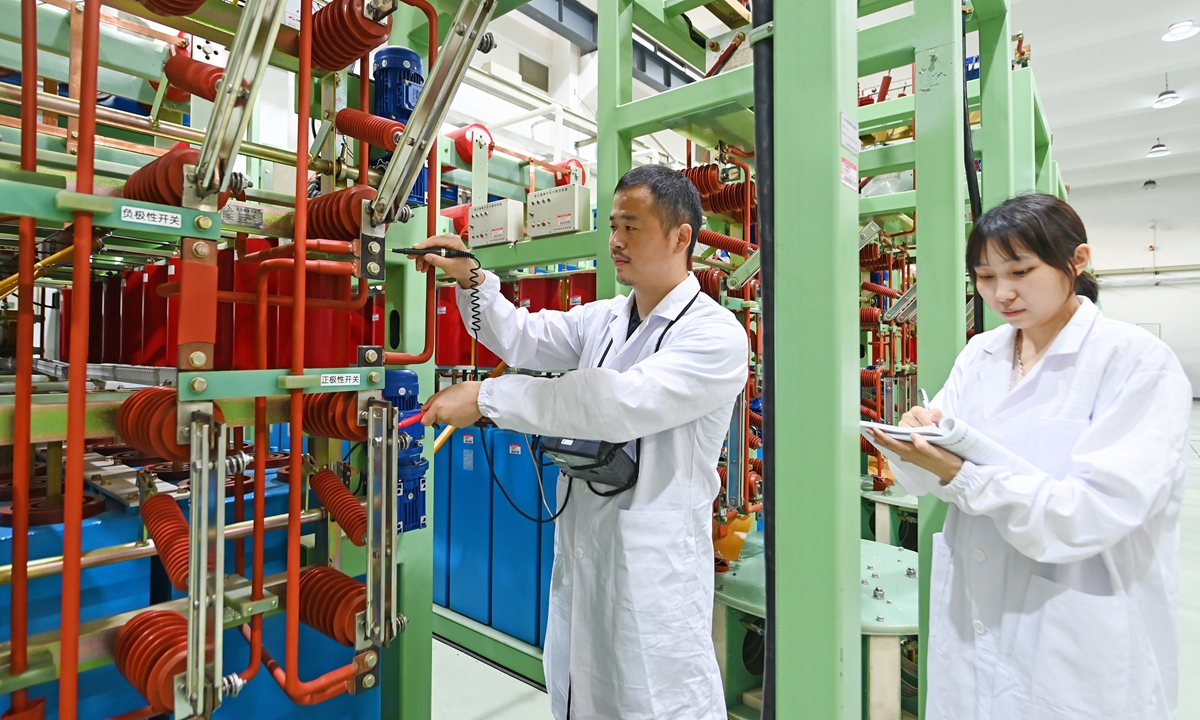
Researchers perform an engineering test in Wuhan National High Magnetic Field Center at Huazhong University of Science and Technology in Wuhan, Central China's Hubei Province on February 8, 2025. Photo: VCG
A study published on Tuesday shows that China is catching up with the US as a global science leader, with Chinese scientists heading nearly half of all collaborations with their American counterparts by 2023.
Analysts note that this shift underscores China's sustained investment in research and development, the rapid expansion of talented team, and its rising role in guiding the direction of global research.
The report, published in the Proceedings of the National Academy of Sciences (PNAS), used extensive data from nearly 6 million scientific publications to document a marked shift in team leadership from Western countries to China, according to the PNAS' website.
In particular, the report found that in US-China scientific collaborations, the proportion of team leaders from Chinese institutions grew from 30 percent in 2010 to 45 percent in 2023.
"China is on track to lead the world in science," a Bloomberg report said earlier. If the trend holds, China will reach parity with the US in 2027 or 2028 — the point at which both sides lead an equal share of joint research.
Researchers at Wuhan University, University of California, Los Angeles, and the University of Chicago used a machine-learning model to identify project leaders from contribution statements and authorship data. The authors said this approach offers a more nuanced way of tracking scientific power than traditional metrics such as publication counts or citation indexes, which measure volume rather than influence, per Bloomberg.
"Chinese scientists are leading more joint research projects, reflecting their growing influence in the global scientific community," Wang Peng, an associate researcher at the Beijing Academy of Social Sciences, told the Global Times on Wednesday. "While scientific leadership is complex, China's rapid development makes approaching a leading position increasingly feasible," he said.
The analysis also found China gaining ground in critical technology areas that are focal points of technological development. In eight of 11 critical technology areas identified by the US National Science Foundation, including artificial intelligence, semiconductors, energy and materials science, Chinese researchers are expected to achieve leadership parity with the US before 2030.
The authors modeled what would happen if the US and China decoupled scientifically — halving or even ending their collaborations. In both cases, China's global "lead share" would rise, because Chinese researchers are more likely to lead projects with European and other foreign partners than with the US, Bloomberg citing the paper said.
Wang stressed that robust policy support has fostered a favorable research environment, while China's economic strength provides strong material backing. "Also, improvements in the education system have cultivated a large pool of high quality talent, and a shifting research culture has spurred greater innovation among scientists," Wang added.
The newly adopted China's 15th Five-Year Plan for National Economic and Social Development reflects strong policy support, calling for efforts to strengthen strategic, forward-looking, and systematic planning for basic research, direct a greater share of total R&D spending toward this field, and increase long-term, stable support.
"As a result, China's contributions are introducing new research approaches and diverse directions for scientific inquiry," Wang said. "They are set to drive more breakthroughs in key fields, supporting global industrial upgrades, and promoting the worldwide sharing and application of scientific achievements, ultimately enhancing people's quality of life."
The country's growing role will optimize global innovation resources, break geographic barriers, foster a multipolar research landscape, and intensify collaboration and competition, ultimately boosting global innovation, according to Wang.
Official data show China allocated about 33.3 billion yuan ($4.7 billion) since 2012 to educate foreign students, mostly from Africa and South Asia, under the Belt and Road Initiative (BRI) that China launched in 2013.
The study showed that by 2018, almost half of all international students in China came from Africa and South Asia, and the paper finds that Chinese researchers now lead most collaborations with the nations participating in the BRI, per Bloomberg.
RELATED ARTICLES