Exclusive interview with executive director of APEC Secretariat: Looking forward to 'well-organized' leaders' meeting in China in 2026
By and Xing Xiaojing in Gyeongju Published: Oct 29, 2025 10:13 PM

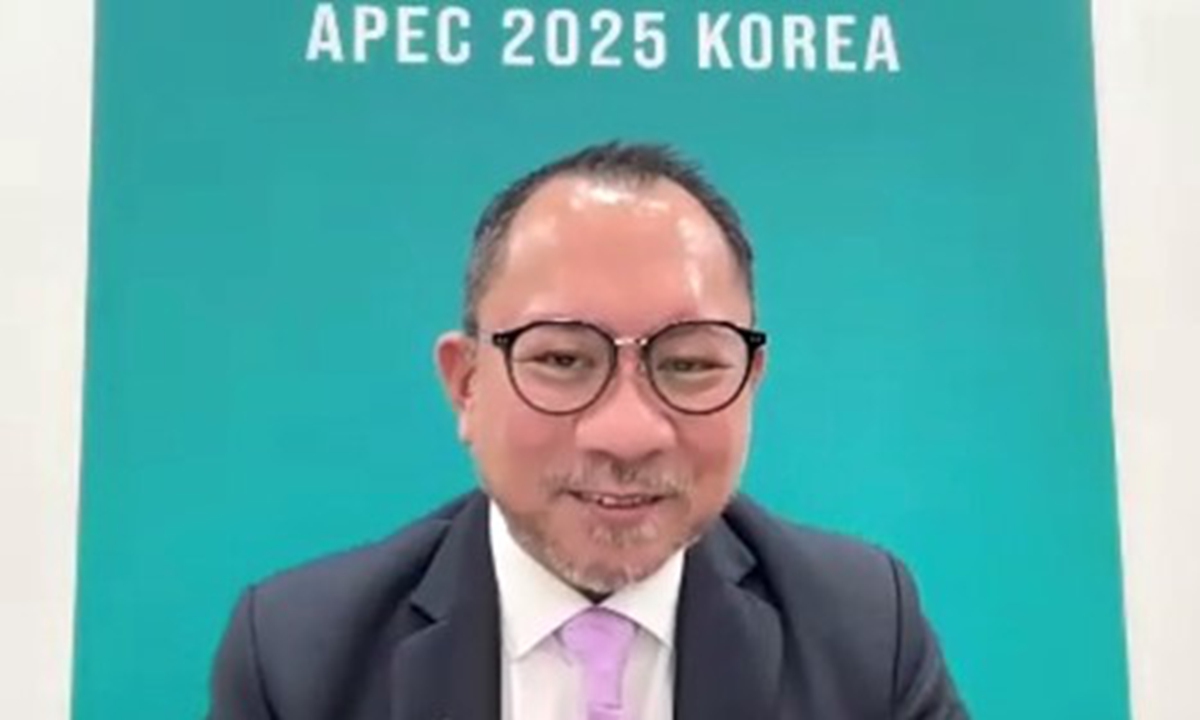
Eduardo Pedrosa, executive director of the APEC Secretariat, participates in an exclusive interview with the Global Times via video link from Gyeongju, South Korea, on October 28, 2025. Photo: Wang Cong/GT
China has a lot of experience in hosting international meetings, and it is expected to convene a well organized Asia Pacific Economic Forum (APEC) Economic Leaders' Meeting in 2026 and make steady progress toward the APEC's the Putrajaya Vision 2040, Eduardo Pedrosa, executive director of the APEC Secretariat, told the Global Times on Tuesday.
In an interview from Gyeongju, South Korea, where this year's APEC Economic Leaders' meeting is scheduled to take place from October 31 to November 1, Pedrosa discussed a wide range of topics - from major issues to be discussed at the meeting such as trade policies and artificial intelligence (AI) to China's major role in the APEC community.
As regional and global trade faces tremendous challenges due to rising protectionism and unilateralism in certain economies, many around the world are looking at how APEC economic leaders will address the issue.
In this regard, the APEC provides a crucial platform for frank discussions, according to the head of the APEC Secretariat.
"The great thing about APEC is that it's a non-binding forum. So we have a chance to speak frankly amongst each other, articulate the problems that we face, why we're adopting the different policies that we have and engage in a genuine conversation on what lies behind our policies," Pedrosa said.
While there are many talks about uncertainty in trade, Pedrosa argued that cooperation remains the key focus. "What I would say is watch out for cooperation when you don't expect it. We live in this world where everyone is talking about volatility and uncertainty, but from the APEC process, look out for more cooperation than disagreement," he said when asked about what should the world watch for at this year's meeting.
Asked specifically about tariffs and trade protectionism from certain economies, Pedrosa said that at relevant meetings for trade, "we had very frank discussions about trade policy. Why are tariffs being imposed? what each economy would expect from each other so that these tariffs would come down?"
The head of the APEC Secretariat further noted that the APEC looks beyond the tariffs and looks forward to high-quality growth.
"Looking forward, what we really need to do is have high quality growth. And that comes through greater productivity, ensuring that our markets are structured and favoring more inclusive [growth]," he said. "Tariffs are one part of the story. That's true, but there are other parts of the story that need to be talked about. And that includes, for example, services, our economies today are broadly, much more service driven."
Asked about the key outcomes of this year's APEC, Pedrosa mentioned two aspects. "The first is that we have a successful APEC leaders' meeting that everyone comes together and find ways to have a productive discourse on the trade and the state of the world today; The second is different framework for addressing issues of mutual importance," he said, referencing talks about AI.
In the interview, the APEC Secretariat chief also talked about China's role and contributions to the APEC, as China is set to host the 2026 APEC Economic Leaders' Meeting.
"It'll be the third time that China has hosted APEC. There's a lot of experience in hosting these international meetings. So we'll be looking forward to, again, a very well organized set of meetings and also building on the work of the previous APEC hosts have undertaken and make progress towards the APEC's Putrajaya Vision 2040," Pedrosa said.
The Putrajaya Vision 2040, adopted by APEC economic leaders in 2020, envisions "an open, dynamic, resilient, and peaceful Asia-Pacific community by 2040, for the prosperity of all our people and future generations."
The Chinese side has urged APEC economies to "act in solidarity and cooperation to meet the challenges, fully deliver on the Putrajaya Vision 2040, build an Asia-Pacific community with a shared future, and start a new era in Asia-Pacific development.
Moreover, while hosting the APEC Economic Leaders' Meeting in 2014, China proposed the building of a Free Trade Area of the Asia-Pacific. During the interview on Tuesday, Pedrosa said that various regional trade deals including the Comprehensive and Progressive Agreement for Trans-Pacific Partnership and the Regional Comprehensive Economic Partnership are seen as "pathways towards a Free Trade Area of the Asia Pacific. Our work in this field is to try and build understanding around those pathways."
Meanwhile, China has also put forward a slew of major initiatives to promote global cooperation, including the Global Development Initiative and the Global Governance Initiative.
Asked about China's initiatives, Pedrosa said that there have been many initiatives, partnerships and agreements among economies that have been proposed to address various issues and respond to "tremendous and rapid changes in the way we live."
"So that's a great way for us to think about all of these initiatives. And how we can take them forward in ways that we can share with each other what has worked and what hasn't worked? And that's very much in the spirit of APEC that we will bring these initiatives to the table and see and share what has worked for us and what kind of configuration has worked, and even the kind of frameworks and engagement that is required," he said.
RELATED ARTICLES