At APEC, China contributes strength to building a sustainable future in Asia Pacific
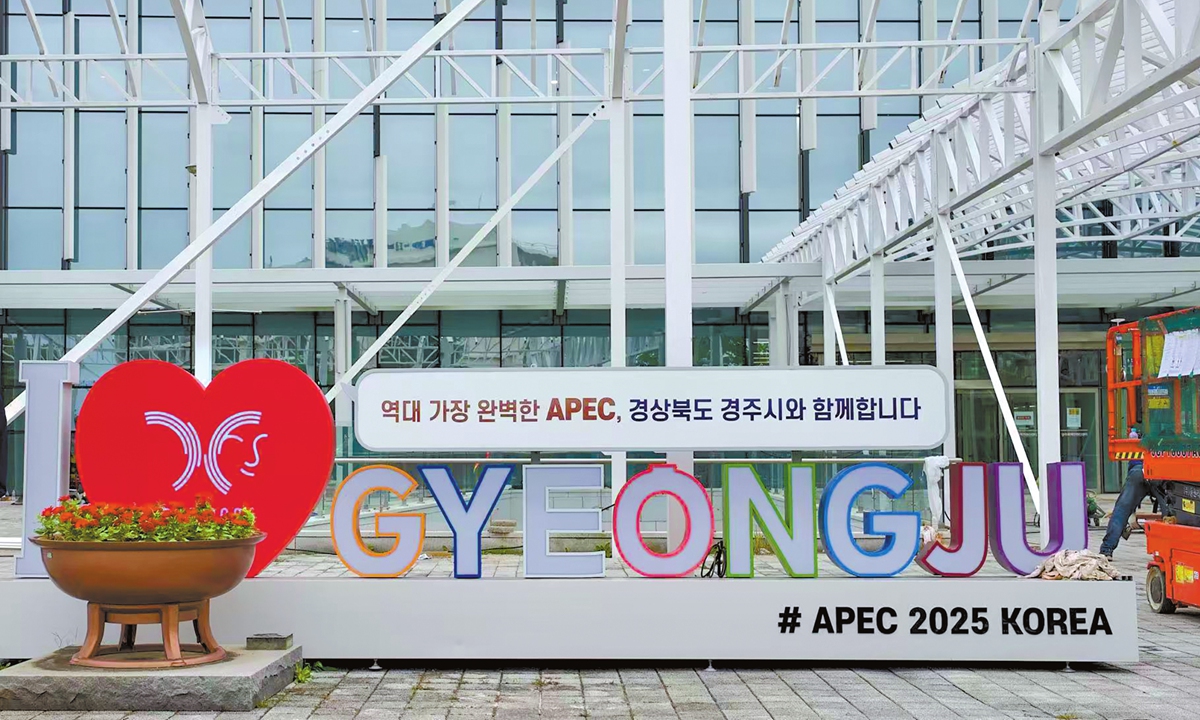
An exterior view of the Gyeongju Hwabaek International Convention Center shows signs welcoming the upcoming 32nd APEC Economic Leaders' Meeting. Photo: Liu Yang/GT
The 2025 APEC Economic Leaders' Meeting will kick off on Friday, with all sides expecting the regional cooperation mechanism to inject fresh impetus into global trade and technological collaboration. As a key engine of growth in the Asia-Pacific, China has demonstrated a firm commitment to expanding high-level opening-up and deepening regional cooperation, in order to promote innovation-driven development and contribute China's strength to building a sustainable future.
As the highest-level, broadest, and most influential economic cooperation mechanism in the Asia-Pacific region, APEC has drawn global attention for its potential to reshape trade, diplomacy, and the global technology landscape.
The 2025 APEC Economic Leaders' Meeting, themed "Building a Sustainable Tomorrow," focuses on three priorities — strengthening connectivity, promoting innovation, and fostering inclusive growth and prosperity. These priorities are in line with APEC's core objectives of trade and investment liberalization, business facilitation, and economic and technical cooperation.
As the host, South Korea is set to steer the meeting's focus toward two pressing issues: artificial intelligence (AI) transformation and demographic change. The discussions are expected to spotlight collaborative opportunities in AI and digital transformation. It could spark new AI partnerships and pave the way for coordinated statements on digital governance, resilient supply chains, and sustainable development, signaling the region's intent to shape the future of technology and innovation.
This year's APEC meeting also provides a key diplomatic platform for regional economies to exchange views on key issues. The latest World Economic Outlook from the IMF highlights the Asia-Pacific region's robust economic momentum, reaffirming its role as a key engine of global growth. However, amid rising uncertainties in global trade policies, regional economies confront pressures that underscore the need for closer coordination among Asia-Pacific economies. Engagements within APEC are expected to help shape regional trade directions, clarify rules, and promote deeper economic integration.
The multilateral trading system currently faces mounting protectionism and unilateral measures, prompting concerns across Asia-Pacific economies about its long-term stability. China has long served as a key engine of regional and global growth, actively providing international public goods. Through initiatives and free trade agreements such as the Belt and Road Initiative, the Regional Comprehensive Economic Partnership (RCEP), and the Asian Infrastructure Investment Bank (AIIB), China has helped developing countries advance infrastructure development, transfer green technologies, and enhance financial connectivity, supporting both industrialization and digital transformation.
China's Global Governance Initiative puts emphasis on sovereign equality, international rule of law, multilateralism, the people-centered approach, and real results. This vision, aimed at amplifying the voice of emerging markets and developing countries, provides a clear framework for action.
A key step in this direction is to leverage platforms such as APEC to actively advocate for reforms to the international monetary and financial system, including expanding the use of Special Drawing Rights, promoting diversified currency settlement mechanisms, and strengthening regional financial safety nets. Such reforms are essential to mitigate the spillover effects from fluctuations in any single currency, guide the orderly adjustment of global asset allocation, and ultimately foster a more balanced and inclusive international economic order.
Despite lingering uncertainty in the Asia Pacific, China's determination to pursue high-level opening-up remains firm. The foundation of China's development lies in the depth of its domestic reforms and the economy's intrinsic resilience, and high-quality development in China will also continue to make great contributions to regional and global growth.
The author is a professor in the Department of Economics at The Chinese University of Hong Kong (CUHK) and the associate director of the CUHK-Tsinghua University Joint Research Center for the Chinese Economy.

Shi Kang, professor in the Department of Economics at The Chinese University of Hong Kong (CUHK) and the associate director of the CUHK-Tsinghua University Joint Research Center for the Chinese Economy. Photo: Courtesy of Shi Kang
RELATED ARTICLES