China’s AI development shows impressive results, bright prospects, driven by strong policy support: expert
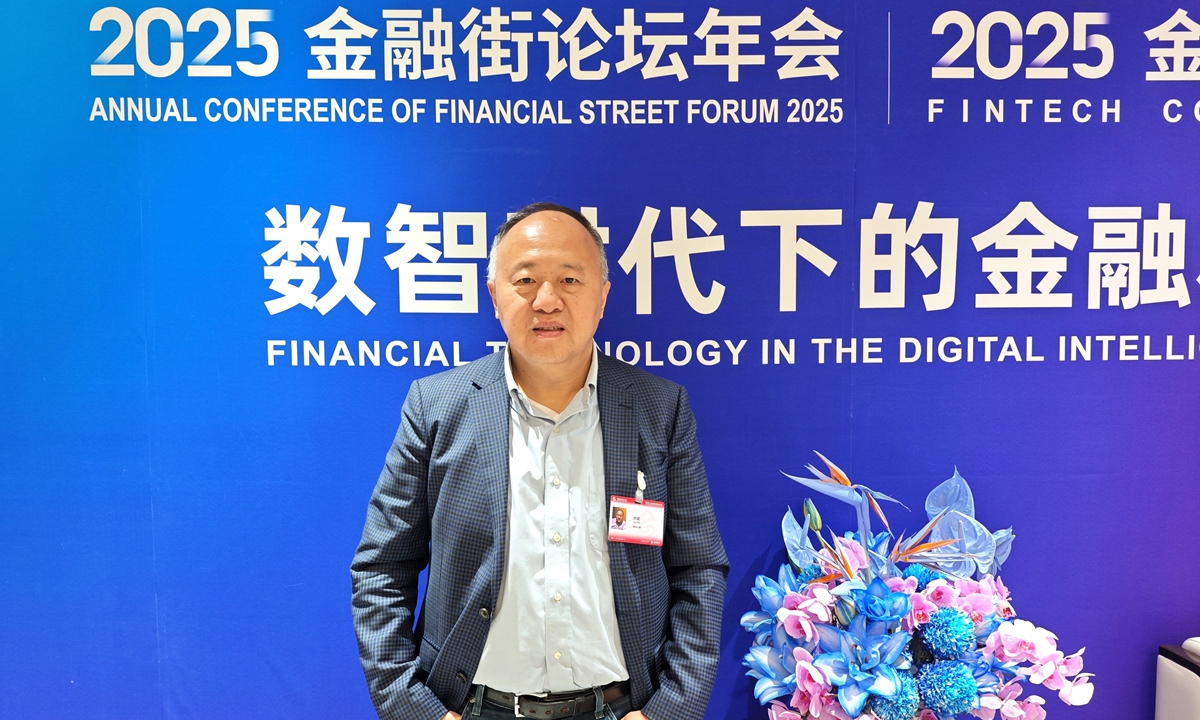
Jun S. Liu, a member of the US National Academy of Sciences Photo: Yin Yeping/GT
"Chinese society as a whole embraces artificial intelligence (AI) in an unprecedented way, which I haven't seen in other countries, and I feel really excited about this development," Jun S. Liu, a member of the US National Academy of Sciences, told the Global Times in an interview in Beijing on Thursday.
Liu used three words to describe AI development in China: "positive, encouraging, and stimulating." China is making technologies broadly welcomed by the public, he said, citing examples such as AI-driven autonomous driving, which is highly competitive in terms of cost and accessibility.
His remarks came at the Annual Conference of Financial Street Forum 2025 on Thursday, where China's rapid AI development was among the highlighted subjects of the latest trends.
According to the latest data from the National Data Administration, China's overall strength in AI has achieved a comprehensive and systematic leap, with AI-related patents accounting for 60 percent of the global total, the People's Daily reported. In 2024, the number of data enterprises nationwide exceeded 400,000, and the data industry reached a market size of 5.86 trillion yuan, industry data shows, the report said.
China's AI development—particularly in large language models—is comparable to that of the US and some other leading countries, Liu said.
Moreover, China's booming unicorns, such as DeepSeek and Unitree Robotics, have made impressive progress in deploying and implementing AI technologies, placing them among the world's top tier, the American scholar noted. "It's amazing that Chinese companies, and mostly young people, can make such progress at a fraction of the cost and in relatively little time," he added.
Commenting on China's AI sector, Liu said that both government initiatives and market forces are driving the industry's growth. He pointed to the government's supportive AI policies as well as strong market demand for digitalization, such as the widespread use of cashless payments.
Another factor driving growth is education, said Liu. Over the past decades, China's higher education system has been very solid—"probably among the strongest in the world." Chinese universities train students rigorously in technology-oriented disciplines such as mathematics, physics, and chemistry, he noted, emphasizing how the country's long-term focus on science and technology education has contributed to its technological progress.
"With the current policy push and commitment from the government, I think development will only become faster and more advanced," Liu said.
RELATED ARTICLES