GT Voice: India’s industrial drive provides an opportunity to deepen China co-op
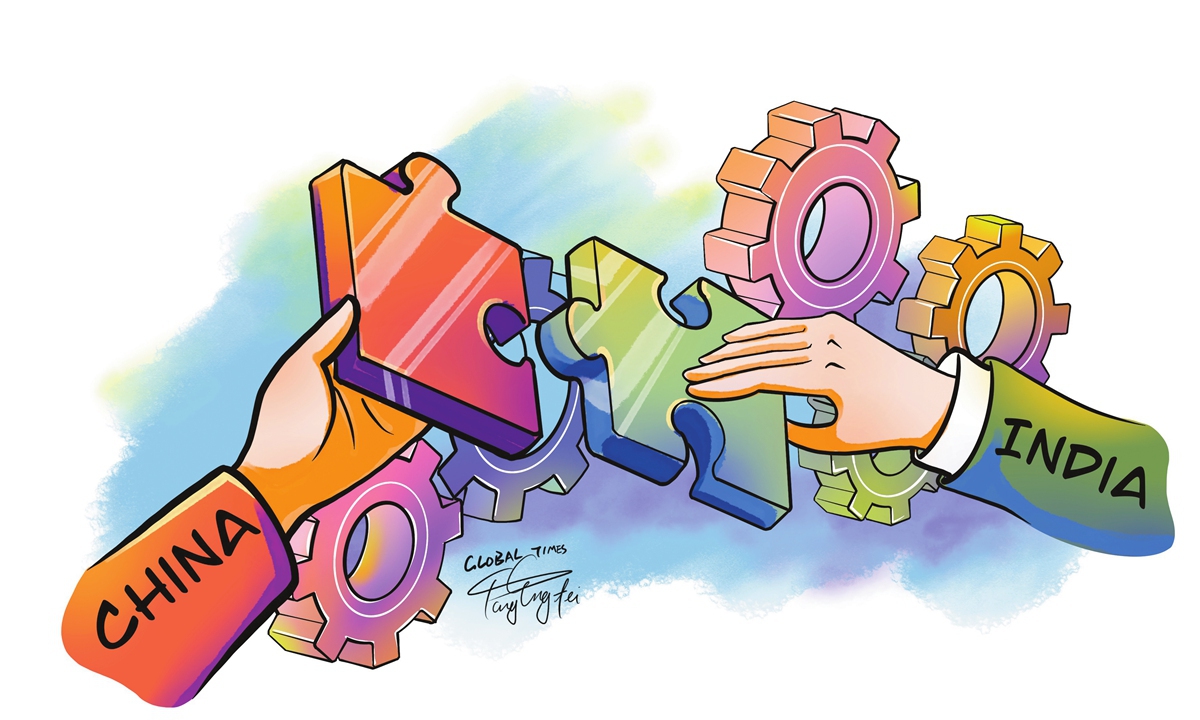
Illustration: Tang Tengfei/GT
Western media outlets often frame India's manufacturing drive through a narrow lens of competition with China, overlooking how India's pursuit of industrial self-sufficiency actually opens significant opportunities for China‑India cooperation.On Wednesday, CNBC reported that "India is dependent on China for electronic components. Now it's trying to change that." The story revealed that in a move aimed at cutting India's import dependency for electronic components, the Indian government this week approved its first seven projects worth $626 million under its $2.7 billion electronic component manufacturing programs.
This zero-sum narrative, which portrays India's efforts to boost manufacturing development as a confrontation with Chinese manufacturing, fundamentally ignores the deep interdependence built into global supply chains. Industrial advancement has always been driven more by collaboration and specialization than by isolation.
Closer China-India supply chain cooperation actually benefits India's push for self-reliant manufacturing. Their complementarities represent an integral dimension of the ongoing transformation within the global manufacturing landscape.
India's push for self-reliant manufacturing is an inevitable step toward its manufacturing upgrade. Historically, emerging industrial nations often need to undergo a transition from relying on imports to nurturing domestic industries, and India is no exception. Notably, this transition does not reduce the need for international collaboration; instead, it increases the demand for it.
India's electronics manufacturing industry has a long-standing gap between supply and demand due to the lack of domestic industrial scale, insufficient investment, and dependence on imported components. Projects approved by the Indian government are essentially aimed at helping India integrate better into the global industrial division system by filling gaps in the supply chain.
The first batch of the projects approved by India this time will help set up local production of electronic components such camera modules, multi-layered printed circuit boards (PCBs) and advanced high-density PCBs used in smartphones, wearable devices, medical and aerospace components, according to the Indian government.
India's Minister for Electronics and Information Technology Ashwini Vaishnaw said that "20 percent of our domestic demand of PCBs and 15 percent of camera module sub-assembly will be met through production from these [seven] plants," adding that about 60 percent of total production from these plants will be exported, according to the CNBC report.
China boasts a complete supply chain system and mature manufacturing technology in the electronics industry, while India demonstrates huge market potential and advantages in human resources. These strengths are not mutually exclusive and they naturally create room for complementarity.
Chinese and Indian companies have broad prospects for cooperation in areas such as component supply, technology transfer, and production capacity collaboration. As India works to build its domestic manufacturing capabilities, it needs deeper engagement with Chinese supply chains. This kind of cooperation will not weaken India's goal of industrial independence. On the contrary, it can provide more solid support for its industrial upgrading.
The core of self-reliance is to enhance industrial competitiveness, and global cooperation is an effective way to achieve this. In the current wave of globalization, no country can develop in isolation. In its pursuit of self-reliance, India needs to leverage external forces and resources, and China, as a key player in global manufacturing, is undoubtedly one of India's desired partners.
In an article published in The Hindu on September 11, Chinese Ambassador to India Xu Feihong emphasized that China and India should further expand exchanges and cooperation. He argued that the two countries should focus on development, which is their biggest common denominator, promote mutual support and success, and better facilitate trade and investment flows.
Western media outlets' misunderstanding stems from interpreting India's industrial policies solely through a geopolitical lens, turning a blind eye to the real-world examples. Countries like Vietnam, while receiving industrial transfers, have deepened investment cooperation with China.
For India's economy to move to the next level, it must break free from the role the West has assigned to it. Its efforts to promote manufacturing localization are an active attempt amid global supply chain adjustments, an opportunity not only for India's industrial upgrade but also for new possibilities in China-India economic cooperation. Both countries need to seize this chance, leveraging competition and complementarity to achieve coordinated development.
RELATED ARTICLES