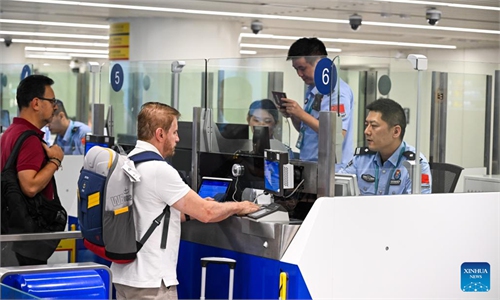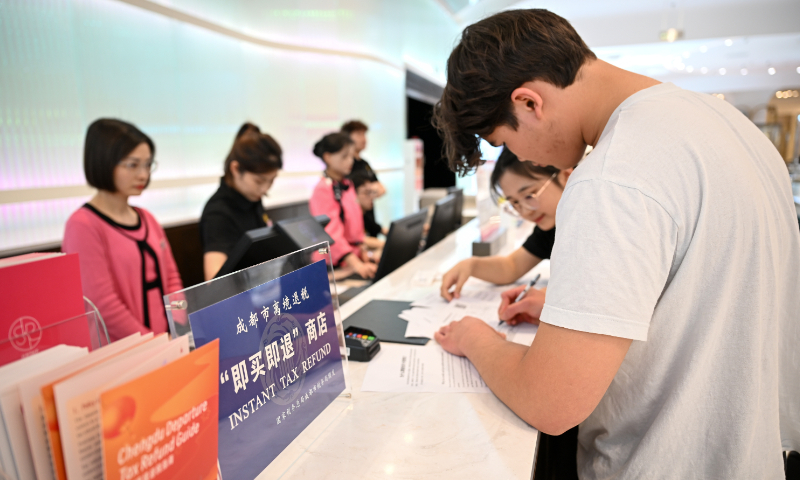
A Dutch consumer (right) handles tax refund procedures at a shopping mall in Chengdu, Southwest China's Sichuan Province, on April 27, 2025. Photo: VCG
China will improve its duty-free shop policy starting on November 1, 2025 to further boost consumption, the Ministry of Finance (MOF) said on Thursday. The plan includes expanding product selections for travelers and easing approval requirements for duty-free store operations.
Insiders noted that the move reflects China's more open and inclusive approach to aligning its duty-free economy with global consumption trends, while representing a proactive step toward institutional opening-up and the creation of a more business- and consumer-friendly environment.
The notice, jointly issued by five ministries including the MOF and the Ministry of Commerce, aims to encourage the return of overseas spending, attract foreign visitors, and promote the sound and orderly development of the duty-free retail sector.
It specified that China will refine the management of tax refund and exemption policies for domestic goods, actively support the sale of domestically produced items in outbound port and downtown duty-free shops, and encourage the inclusion of more high-quality products that embody traditional Chinese culture, further increasing the share of domestic goods in duty-free stores.
Moreover, the nation plans to include a wider range of high-tech and innovative products in duty-free store offerings, further enriching travelers' shopping options.
The notice stated that more portable consumer goods will be included in the business scope of duty-free stores, adding popular items such as mobile phones, mini drones, sporting goods, health supplements, over-the-counter medicines and pet food.
Notably, China will ease approval requirements for duty-free stores by delegating authority over the establishment of outbound port duty-free shops and adjustments to the operating entities of both outbound and inbound port stores. It will also refine the method for determining their operating areas and support local governments in optimizing the overall layout of duty-free stores based on regional conditions, according to the MOF.
Delegating approval authority for duty-free stores' establishment and operation shows China's determination to deepen business environment reforms and transform government functions, said Bian Yongzu, executive deputy editor-in-chief of Modernization of Management magazine.
"This move gives local governments greater flexibility to plan duty-free shop layouts based on regional conditions and better align policies with local needs," he said. With stronger local initiative, the duty-free sector is expected to gain new momentum and further facilitate the flow between domestic and international economic cycles, Bian said.
The notice also pledged to improve convenience and supervision measures for duty-free shops, supporting online reservation services for outbound, inbound and downtown stores. Travelers will be able to order goods at downtown duty-free shops and collect them at inbound port stores, further enhancing the overall shopping experience.
"Optimizing duty-free shop product structures will spur sales and job growth, benefiting households, businesses and the government. Consumers will gain more choice and enjoy better value, while companies can boost their revenues and supply-chain activity. The government, in turn, benefits from stronger employment and a more vibrant market," Bian said
Bian noted that developing the duty-free economy is a natural trend as China moves toward greater economic maturity. He said that experience in developed markets shows that the more advanced a duty-free system is, the more attractive the market becomes. As the world's second-largest economy, China's efforts to refine its duty-free policy will draw more international brands, upgrade industries, and enhance its consumption structure.
The MOFCOM recently released data on China's consumption in the first three quarters, showing continued expansion in inbound spending. The growth was driven by coordinated policies such as the widening of visa-free access and improvements to tax-refund procedures, with the popularity of "traveling in China" and "shopping in China" continuing to rise, the MOFCOM said.
In the third quarter, China recorded 20.134 million inbound and outbound trips by foreign nationals, up 22.3 percent year-on-year, including 7.25 million visa-free entries, an increase of 48.3 percent, data from the National Immigration Administration showed.
RELATED ARTICLES