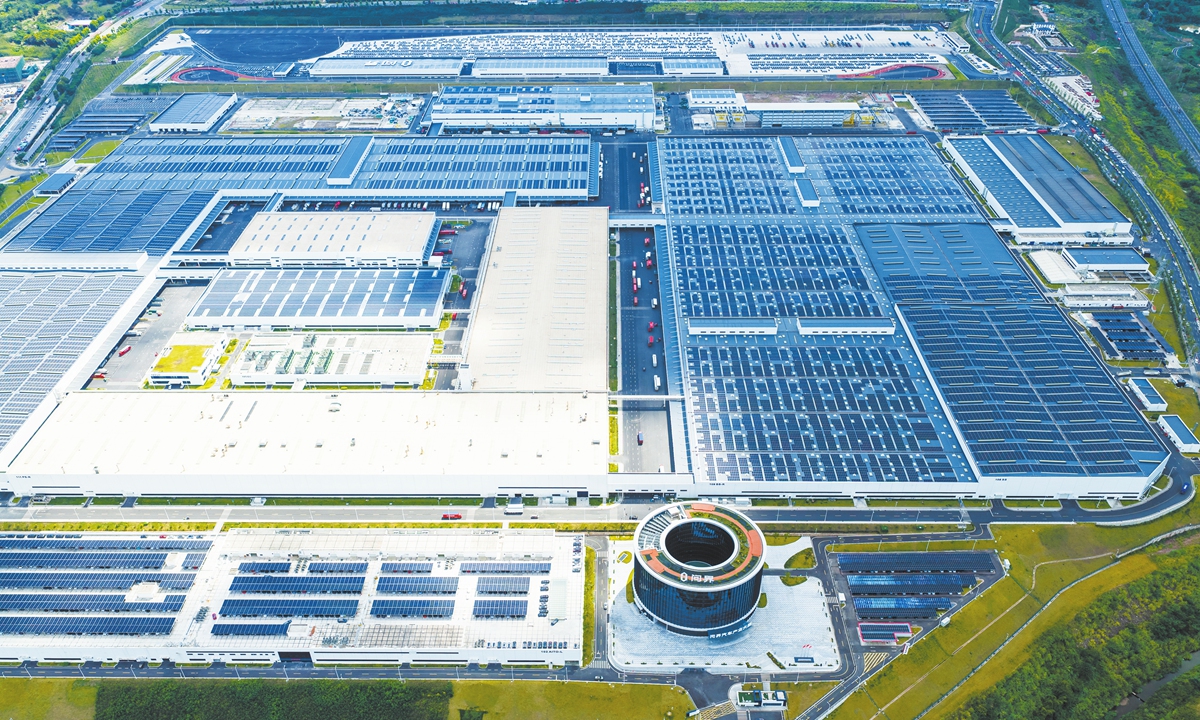
An aerial view of the Seres Auto super factory in Liangjiang New Area, Southwest China's Chongqing Municipality, on August 28, 2025. Seres has sold 304,629 new energy vehicles between January and September. Photo: VCG
As the 14th Five-Year Plan (2021-25) winds up, the adoption of the 15th Five-Year Plan (2026-30) has clarified China's strategic direction centered on high-quality development. Among the ideas of innovative, coordinated, green, open, and shared development, opening-up serves not only as an essential path to national prosperity, but also as a key lever for advancing global cooperation.
The Fourth Plenary Session of the 20th Central Committee of the Communist Party of China (CPC) emphasized "fully and faithfully applying the new development philosophy on all fronts" and "promoting high-standard opening-up to create new horizons for mutually beneficial cooperation."
China's opening-up is evolving beyond the traditional "bringing in" and "going global" model toward high-standard institutional opening-up, representing a qualitative shift from simply following international rules to actively reshaping them. This is achieved through lower tariffs, shorter negative lists, and the constantly improved business environment, all designed to leverage China's vast market as a magnet for global resources.
At its core, institutional opening-up seeks convergence with international norms in rules, standards, and governance. Pilot programs, from the Free Trade Zones (FTZs) to the Hainan Free Trade Port (FTP), act as "stress tests" for the new initiatives. Their goal is to lock in reforms that create a more law-based, market-driven, and internationalized system, making the benefits of openness more predictable, sustainable, and conducive to high-quality development and global win-win outcomes.
The 14th Five-Year Plan period saw institutional opening-up yield significant results. China shortened its negative list for foreign investment to 29 items, eliminated all manufacturing restrictions, and opened services such as value-added telecoms and healthcare. The 22 FTZs in China produced hundreds of innovative practices now applied nationwide, and cross-border e-commerce pilot zones fueled new trade models.
Amid rising global protectionism, China's leadership has responded with a clear signal: greater external pressure demands even greater openness.
By advancing institutional opening-up, China is mitigating the so-called "decoupling" risks and leveraging its vast market to attract global capital, technology, and talent. This reinforces the message that "investing in China is investing in the future," while using external competition to drive upgrades in state-owned enterprises, finance, and more.
The newly adopted 15th Five-Year Plan prioritizes high-standard opening-up, with key breakthroughs expected in three areas: services and digital rules, green development and capacity cooperation, and financial opening.
In green development and capacity cooperation, China is expected to ease equity restrictions across the new energy supply chain. This will facilitate the creation of China-EU "zero-carbon industrial parks" and support leading companies in solar, energy storage, and hydrogen to establish operations in regions such as the Middle East and Latin America.
On financial opening-up, China is well positioned to broaden market connectivity in stocks, bonds, futures, and foreign exchanges, deepening engagement with high-standard agreements like the CPTPP and DEPA and pioneer international rule alignment in areas such as the digital economy and competition policy to create replicable models.
Through the virtuous cycle of institutional opening-up and high-quality development, China will continue to serve as a key engine of global economic growth, offering the world the upgrading dividends from its 1.4-billion-consumer market.
Global opportunities
Amid global supply chain reconfiguration, China is turning challenges into opportunities. As the US imposes more trade barriers, China, on the contrary, is further expanding opening-up, welcoming companies such as Apple and Tesla to expand their investments in China. Meanwhile, it is actively tapping markets in Southeast Asia, the Middle East, and Latin America to diversify export risks.
By opening proactively, China has seized the initiative. Its vast market acts as a global public good, demonstrating that win-win cooperation is more reliable, beneficial, and sustainable than containment policy. From a rational standpoint, the US should also open further to global investors, because protectionism cannot build a great nation; only openness and inclusiveness can create a fair, stable, and sustainable international economic order.
Currently, the core challenges of globalization stem from internal imbalances in Western nations - uneven income distribution and slow industrial upgrading - which fuel protectionism and structural friction between new and traditional sectors.
Western countries should focus on internal reforms: redistribution, skills training, and infrastructure investment can turn anxiety into momentum. Opening to Chinese investment in infrastructure, new energy, digital equipment, and high-end manufacturing would help rebuild local supply chains. Easing high-tech export controls would also help competition in AI, chips, and biotech return to the lab.
Drawing on its FTZ experience, China may offer its constructive proposals to the WTO covering areas such as competitive neutrality for state-owned enterprises, tiered management of cross-border data flows, and the transparency in green subsidies. It may also promote yuan settlement in sectors such as oil, natural gas, iron ore, and green metals, and advocate a more balanced international monetary system based on Special Drawing Rights.
China's opening-up also offers a meaningful reference for other developing economies. Openness does not require sacrificing autonomy; rather, it enables countries to embed their comparative advantages into global value chains, harness technological spill-overs, and advance industrial upgrading along a sustainable path.
This approach begins with infrastructure connectivity to cut costs, followed by institutional opening to ensure fair competition, and culminates in leveraging market scale and finance for long-term growth. Developing countries may selectively integrate specific resources or industrial segments into Chinese supply chains, foster higher-value brands, and achieve the leap from raw material exports to industrial modernization.
Looking forward, China's expanding high-standard opening-up is poised to create greater opportunities, including rising consumer demand for global agricultural, cultural and education services, supply chain integration helping the landlocked countries become regional hubs through overseas zones and rail networks, and green technology exports enabling its partners to leapfrog high-carbon development.
By pursuing win-win cooperation, China offers a workable model for balancing domestic development with global integration. Through sustained high-standard opening-up, it will not only strengthen its own economic resilience, but also provide the world with rich experience and tangible development benefits.
The author is a professor in the Department of Economics at The Chinese University of Hong Kong (CUHK) and the associate director of the CUHK-Tsinghua University Joint Research Center for the Chinese Economy.
bizopinion@globaltimes.com.cn
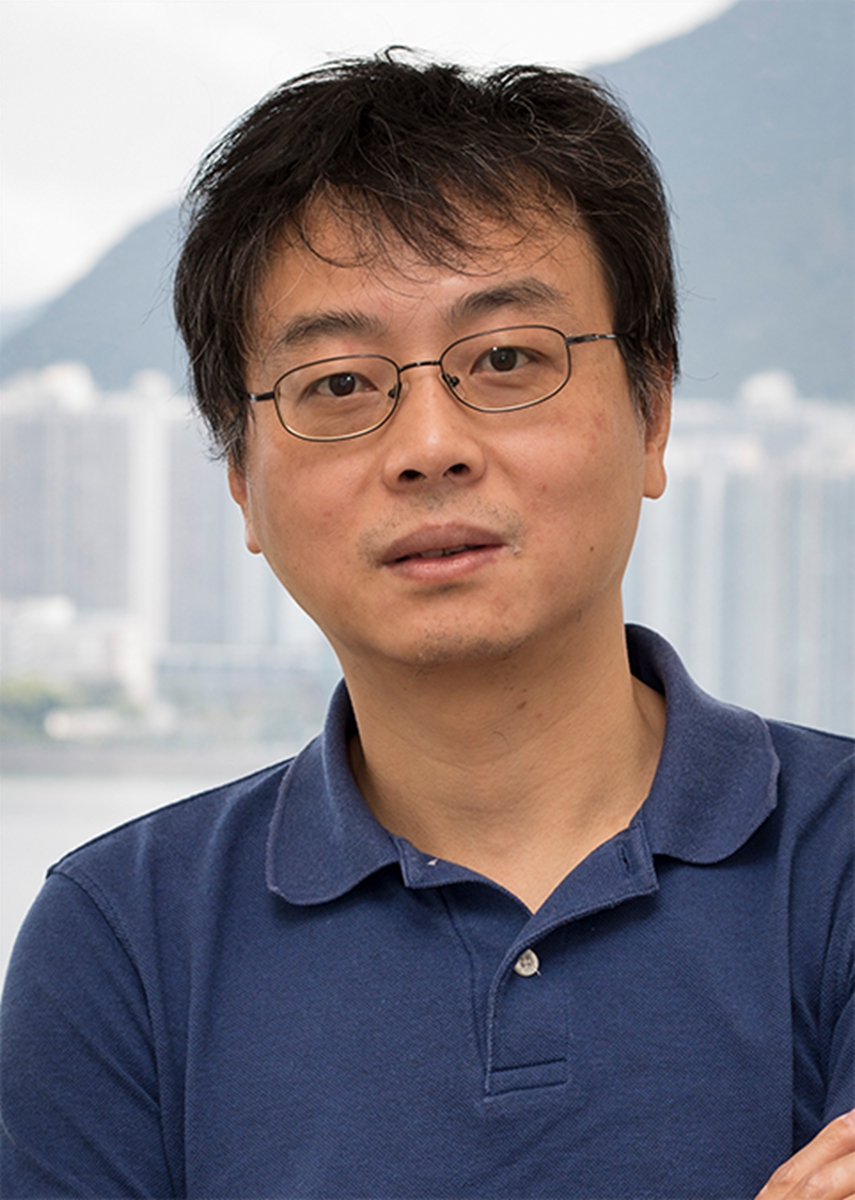
Shi Kang Photo: Courtesy of Shi Kang
RELATED ARTICLES