ARTS / CULTURE & LEISURE
Chinese humanoids lead international soccer contest, driving AI innovation to real-world uses
Robotics beyond the arena

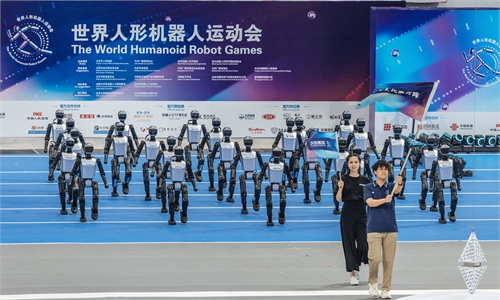
A humanoid robot performs at the opening ceremony of the school football month event launched in Beijing in September. Photo: VCG
At a recent conference showcasing the latest developments and applications in robotics and embodied intelligence, China's robotics developer Booster Robotics unveiled its entry-level platform, the Booster K1.
The platform, intended for research teams and general users, provides a development environment for robots to perform tasks and adapt through constant learning. The demonstration at the conference brought to mind the 2025 RoboCup held in Brazil, where Chinese robots drew international attention.
Back then, Tsinghua University's Hephaestus team made history by winning the humanoid league championship with their T1 robots from Booster Robotics Humanoid AdultSize Soccer Competition. It was the first time in RoboCup's 28-year history that a Chinese team had claimed the top prize in its most competitive category.
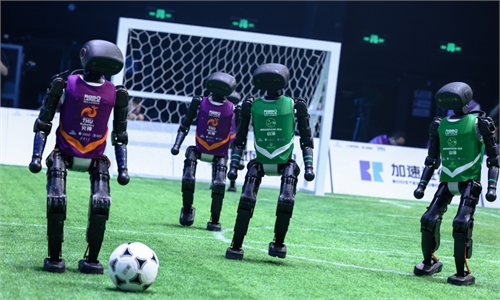
Known as the "World Cup of Robotics," the RoboCup introduces a competition with 10 full-sized humanoid robots competing in a 5-vs-5 format entirely under AI-driven autonomous control, with no human intervention. At the event, the robots were observed adjusting formations, dribbling, passing, and shooting with coordinated movements, demonstrating real-time decision-making on the field.
Behind Tsinghua University's Hephaestus team lies more than two decades of continuous scientific exploration, a journey that has transformed robotic soccer from a distant challenge into a vivid display of embodied intelligence in action.
Autonomy in motion
The team, led by Zhao Mingguo from Tsinghua University's Department of Automation, has participated in RoboCup almost every year since its founding in 2004.
"While the robots are learning how to play soccer, we are learning how to make them think," Zhao recalled.
"Over the years, the Hephaestus Team's technology has evolved from mechanical coordination and gait control to brain-inspired dual-arm manipulation, through countless trials and redesigns," he said.
To address issues such as slow movements and delayed decision-making, the Hephaestus team innovatively added a visual learning module before gait training. This allowed the robots to "see" and directly decide their next action, whether to dribble or shoot. After thousands of training sessions, the robots' offense and defense coordination became increasingly smooth and natural, according to the Xinhua News Agency.
The team also taught robots a shooting posture where the "foot twists slightly to one side," which makes the ball faster and improves accuracy by nearly 20 percent.
However, playing soccer is just the first step in exploring humanoid robots' growing capabilities.
From labs to life
Just at the conference, Booster Robotics launched sales for 100 units of its Booster K1 model, targeting the education, home, and developer markets. Cheng Hao, CEO of the company, said that in the future, humanoid robots will come in a wide variety of forms and price ranges.
"You saw how we used the K1 robots at the humanoid robot sports meet, and that was merely a scenario simulation and test," Zhao Weichen, vice-president of the company, told the Global Times.
"Now we've moved to the next stage. Using football or boxing demonstration videos to attract investment or buyers is already behind us," Zhao Weichen said. "What we're aiming for now is real delivery and actual deployment of robots in diverse settings."
According to Zhao Weichen, they track how actively these robots are being used in real life, as that data informs future product iterations.
It's not just Booster Robotics. Several leading robotics companies, including Noetix Robotics and Unitree Robotics, are also working to make humanoid robots accessible to ordinary consumers. The humanoid robot sports event in this sense, seems to have become a testing ground for the market.
When asked how far humanoid robots are from moving "from the sports field to real-life application," the market offered an unexpected answer. Taking Noetix Robotics' 94-centimeter Bumi robot priced from 9,998 yuan($1406) as an example, it received over 200 orders within three hours of its launch on October 23.
Jiang Zheyuan, CEO and chairman of the Noetix Robotics, told the Global Times that the robot is primarily designed to deliver emotional value, accompanying children and teaching them programming and English, making it a quick entry point into the household market.
Then why do sporting events still matter?
"It's clearly unrealistic to build an all-purpose home assistant robot right from the start. But that kind of robot involves many components and technologies, and you can often find the answers to them in these competitions," Zhao Mingguo explained to the Global Times.
According to Zhao Mingguo, a home assistant robot needs powerful environmental positioning capabilities, something that can be seen in soccer robots. It also requires motors with excellent heat dissipation and kinetic performance, technologies already well developed in track and field robots.
"The Games push robot makers to pursue the limits of each individual technology," he said. "Once these technologies are refined, they provide experience and valuable data for developing more complex robots."
The scholar noted that it took years after the invention of the steam engine for the steam locomotive to emerge, and the evolution of robot technologies and the eventual appearance of ground-breaking products would mostly likely follow the same pattern.
In Zhao Minguo's view, the Games serve as an effective way to identify weaknesses, drive technological innovation, enhance public understanding of robots, and build an entire robotics ecosystem.
Technologies tested and refined in these competitions today may soon shape the humanoid robots of tomorrow, bringing them from the arena into daily life.
RELATED ARTICLES