China becomes a reliable partner for other developing countries under its shared development concept

Amitendu Palit, a senior research fellow at the Institute of South Asian Studies in National University of Singapore Photo: Courtesy of Amitendu Palit
The Central Committee of the Communist Party of China (CPC)'s recommendations for the 15th Five-Year Plan period (2026-30) stressed that in the upcoming five years, the country will "fully and faithfully apply the new development philosophy on all fronts" and "seek to share opportunities and achieve common development with the rest of the world."
"Shared growth" is an important part of China's new development philosophy, which serves not only as a guideline for China's own development, but also offers a recipe for narrowing the global development gap.
"The international community should keep its eyes on the long run, honor its commitment, and provide necessary support to developing countries and safeguard their legitimate development interests. Equal rights, equal opportunities and equal rules should be strengthened, so that all countries will benefit from the opportunities and fruits of development," Chinese President Xi Jinping said in January 2021 at the World Economic Forum Virtual Event of the Davos Agenda via video link.
China's efforts to open up and engage with more countries are an encouraging signal. This will be particularly encouraging for several countries of the Global South that are getting increasingly worried over various forms of protectionism coming up in developed country markets, including tariffs and environment standards.
China has already signaled its intent to back down from claiming special and differential treatment for developing countries at the WTO. This will make other developing countries, especially poor and low-income ones, look at China as a major market for their exports and as a reliable partner in technological development.
The uncertainty in global trade and a variety of trade-restrictive measures have made it important for developing countries to diversify and explore alternative markets for reducing their dependence on the Western market. This creates the opportunity for developing economies to expand mutual trade among each other. They can explore framework agreements for expanding bilateral and regional trade. They can also work with each other in building rules for new-generation trade issues such as managing supply chains, digital trade and sustainability. These efforts, along with those to shore up the rules-based trade order of the WTO, should contribute significantly to stabilizing global trade.
In the first three quarters this year, China's total goods imports and exports in yuan-denominated terms rose to 33.61 trillion yuan ($4.73 trillion), hitting a new high. Especially, the country's foreign trade in the third quarter grew by 6 percent year-on-year, maintaining growth for the eighth straight quarter, official data showed on October 13.
According to the CPC's recommendations for the 15th Five-Year Plan period, focus areas recommended include innovation-driven, high quality economic growth, technological self-reliance, enhanced domestic consumption demand and greater openness for integrating with the world, which underlines the transformations being experienced by the Chinese economy, and the factors that will consolidate this transformation in the years to come. China is transforming to an economy where innovation will be the major driver of economic growth, and technology, especially a general-purpose-technology like artificial intelligence (AI), will drive industrial production and consumption.
A significant part of China's economic progress since the 1980s has been driven by the combination of cheap labor and capital, contributed by both domestic investment and export-oriented foreign direct investment. This model worked on the assumption that both labor and capital are strong factors in obtaining large increases in industrial output.
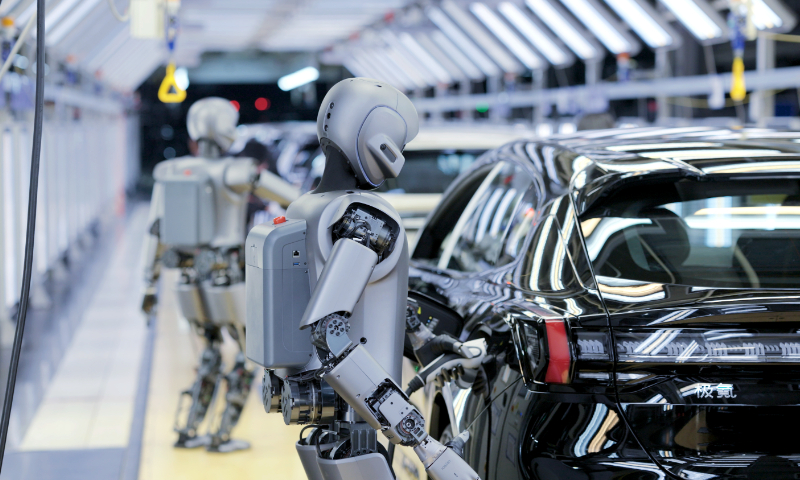
Dozens of UBTECH industrial humanoid robots carry out training tasks at a smart factory in the Qianwan New Area in Ningbo, East China's Zhejiang Province, on March 1, 2025. Photo: VCG
The new development philosophy in China considers technology and innovation as one of the most important factors for driving growth. So, there is a shift from the earlier model of production using cheap labor as a critical factor. While skilled labor remains critical to the new model, technology is the most essential factor driving industrial productivity and economic growth. China's advances in AI and innovation-driven advances in semiconductors, biotechnology, industrial machinery, electric vehicles, and software are expected to continue and to power growth.
China's economic growth should remain stable in the 15th Five-Year Plan period. On the supply side, the growth should be anchored by new innovations and their technological applications. On the demand side, both domestic consumption and exports should support growth. Innovation and technology-driven economic growth, while being stable, will bring results over a staggered period of time. On the other hand, domestic incomes will rise gradually for supporting consumption and maintaining growth.
The author is a senior research fellow at the Institute of South Asian Studies in National University of Singapore. opinion@globaltimes.com.cn
RELATED ARTICLES