China’s marine equipment maker secures first export order for high-end torque sensors
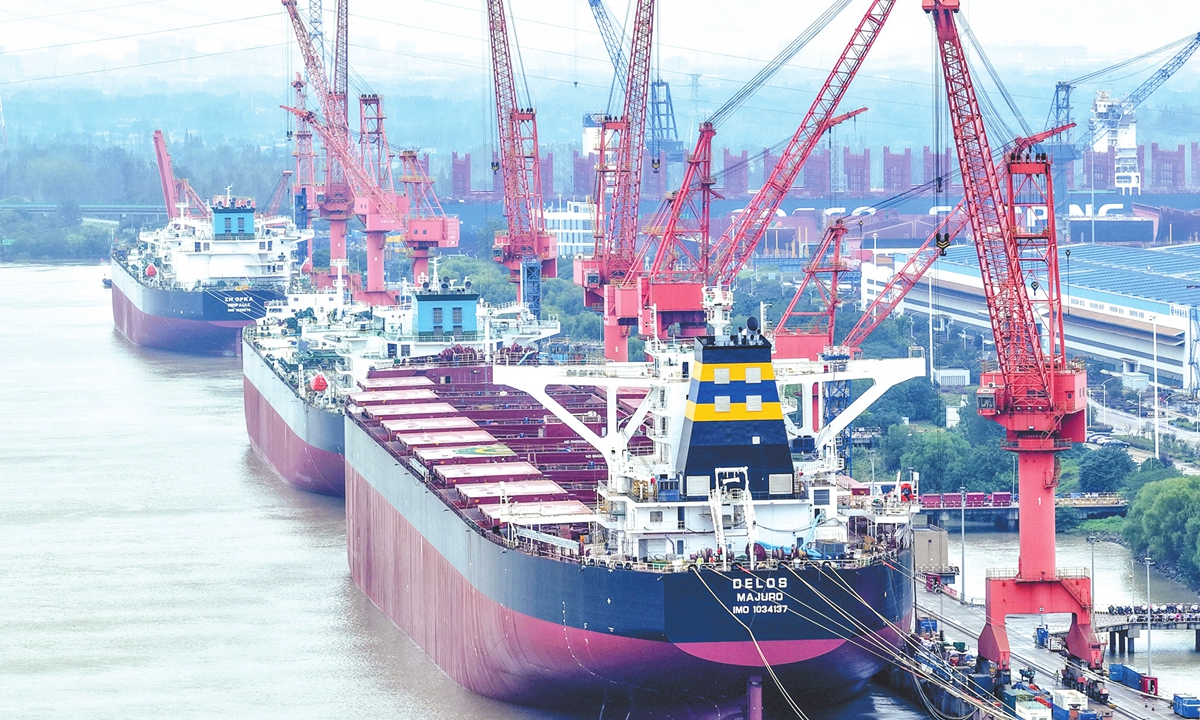
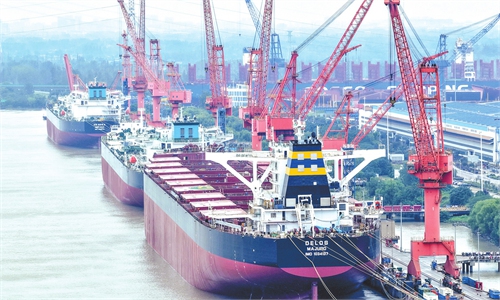
Vessels are under construction at a shipyard in Yangzhou, East China's Jiangsu Province, on October 21, 2025. In the first nine months, China's shipbuilding completions, new orders, and order backlogs accounted for 53.8 percent, 67.3 percent, and 65.2 percent of the global total in terms of deadweight tonnage, remaining the world leader. Photo: VCG
China State Shipbuilding Corp's (CSSC)704 Research Institute has won a contract to supply high-torque sensors for four large liquefied natural gas dual-fuel ro-ro passenger ships ordered by Mediterranean Shipping Co, the first use of China-developed high-precision marine instruments on high-end export vessels.
The order breaks the long-held foreign monopoly in this field, chinanews.com reported on Tuesday.
Dual-fuel engines, capable of running on both gas and oil, feature a complex technical structure. Torque sensors enable precise engine control by continuously collecting real-time torque output data, providing essential input for control systems, and significantly improving operational reliability, accuracy and safety, according to the report.
The deal represents a milestone for China's torque sensor industry and a major step forward in promoting the global application of high-end Chinese marine equipment, the report said.
According to China's General Administration of Customs, China's exports of ships and marine engineering equipment rose by 25.5 percent year-on-year in the first three quarters of 2025.
China's shipbuilding industry has maintained global leadership, accounting for 53.8 percent of the world's total shipbuilding output, 67.3 percent of new orders, and 65.2 percent of orders on hand by deadweight tonnage, according to China's Ministry of Industry and Information Technology.
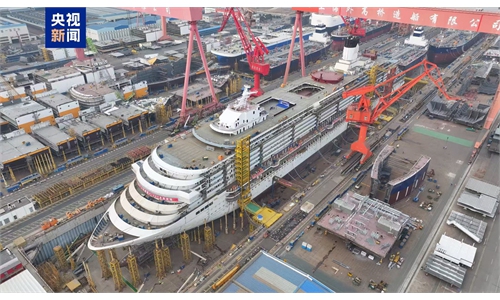
CSSC said on October 23 that China's first self-developed large dual-fuel RoPax ship for export, built by Guangzhou Shipyard, was delivered in Nansha, South China's Guangzhou Province, according to China Media Group.
The 12-deck vessel is equipped with facilities such as a buffet restaurant, café and observation lounge, offering 485 cabins and capacity for 1,800 passengers and more than 550 cars. Designed for short-distance sea transport between islands or coastal cities, it is a high-tech, high value-added ship, according to the report.
The dual-fuel RoPax ship will operate on a route between Genoa and Palermo, Italy.
Global Times
RELATED ARTICLES