IN-DEPTH / IN-DEPTH
Adapting to realities of today's world is essential: chief advisor to the President of Brazil
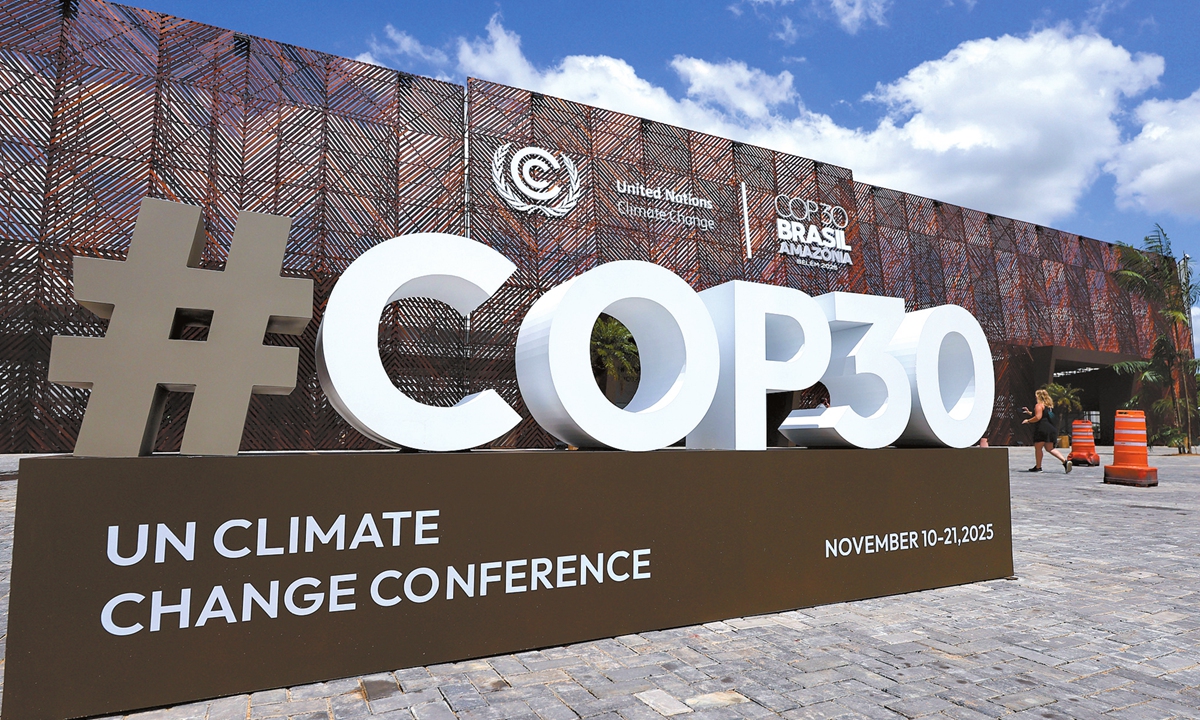
The COP30 logo is seen in front of the central building ahead of the 2025 United Nations Climate Change Conference on November 3, 2025 in Belem, Brazil. Photo: VCG
Editor's Note:In an era marked by unprecedented global transformations, the world stands at a critical crossroads, grappling with deepening deficits in peace, development, security, and governance. As humanity faces unparalleled challenges during this tumultuous period, Xi Jinping, general secretary of the Communist Party of China (CPC) Central Committee and Chinese president, has put forth a solemn call to action through the Global Development Initiative (GDI), the Global Security Initiative (GSI), the Global Civilization Initiative (GCI) and the Global Governance Initiative (GGI). The four pivotal initiatives address the pressing issues of our time, offering viable pathways and robust support for building a community with a shared future for humanity. Rooted in the rich historical experiences of the CPC's century-long struggle and infused with the wisdom of China's traditional culture, these initiatives are expected to unite the world in the pursuit of common progress and stability. To offer a deep understanding of the four global initiatives, and elaborate on their significance on a global scale, the Global Times has launched a series of articles.
Recently, the Global Times, Brasil 247, and the Chinese Embassy in Brazil have jointly organized an online dialogue titled "Global South Dialogue: The Global Governance Initiative and New Visions for Cooperation," inviting Chinese and Brazilian guests to discuss these issues. Below are highlights from the speech of Celso Amorim, chief advisor to the president of Brazi.
Brazil has always maintained a positive attitude toward reforming and improving the global governance system. We advocate establishing a global governance model that adapts to the realities of today's world, particularly by strengthening multilateralism. To this end, the global governance architecture established 80 years ago must be reformed and adjusted.
For example, it is crucial to enhance the representation and voice of developing countries in the United Nations Security Council, and the issue of veto power must also be discussed. The World Trade Organization needs to incorporate social issues and other aspects into its considerations. The same applies to international financial institutions. The World Bank should not be viewed as an institution that provides ordinary loans to private enterprises, but rather as a bank that promotes global development at a higher level and in broader areas. In this regard, the New Development Bank and other multilateral development banks are starting points on this path.
In all these aspects, Brazil takes a clear stance and firmly defends these positions within the UN, the G20, and the BRICS group. I am pleased that China shares similar views. As major countries of the Global South, Brazil and China have many similarities, as well as some differences, which is normal among nations. We hope for a more democratic, equal, and just world, aiming to build a planet where we can all coexist and thrive. To achieve this, we must comprehensively consider and prioritize various factors, including climate and environmental issues, which form the foundation of a new global governance system.
It should be noted that in 1945, or the years that followed, such as 1947 and 1948, when most of these international institutions were established, the vast majority of Global South countries, apart from Latin America, had not yet achieved national liberation or independence. As a result, they were significantly underrepresented in the international organizations created at that time. Adjusting this is absolutely necessary, and the world will greatly benefit from it. Of course, we must also strive to balance representativeness and effectiveness, but we cannot sacrifice representativeness for the sake of effectiveness.
RELATED ARTICLES