ARTS / CULTURE & LEISURE
Grand Egyptian Museum officially opens to public
Joint program promotes civilization exchanges
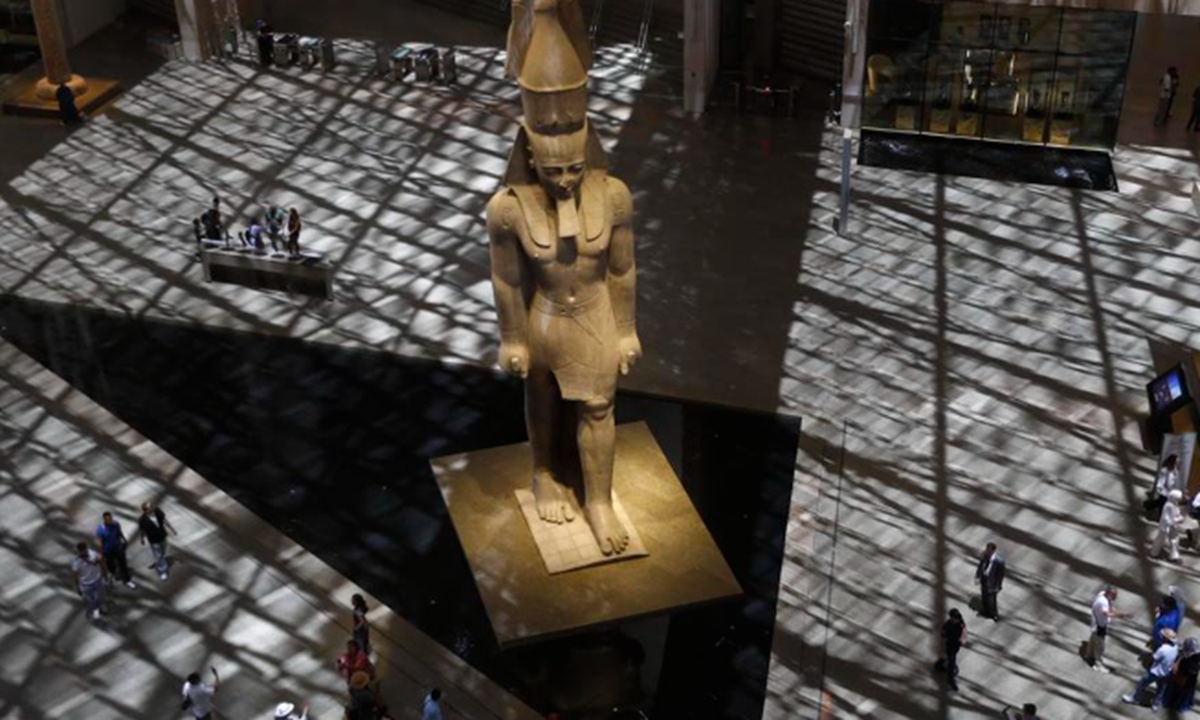
Tourists visit the Grand Egyptian Museum during a pilot run in Giza, Egypt, on June 12, 2025. (Xinhua/Ahmed Gomma)
After 20 years of construction, the Grand Egyptian Museum (GEM) finally opened its door to the public on Tuesday.Costing more than $1.1 billion, the museum is the world's largest archaeological museum dedicated to a single civilization. It houses over 100,000 ancient Egyptian artifacts, including the complete funerary collection of boy-king Tutankhamun. More than 5,000 items are being displayed together for the first time, as well as treasures such as the solar boat of King Khufu and the colossal Ramses II statue.
Often hailed as Egypt's "fourth pyramid," the museum itself is an architectural marvel. What surprises many is that the design was conceived by Chinese-American architect Shih-Fu Peng and his firm Heneghan Peng Architects of Ireland. Peng incorporated the Confucian ideal of "The Doctrine of the Mean," seeking harmony between modern architecture and the timeless grandeur of ancient monuments.
Entering the museum feels like embarking on a ceremonial journey. The visitor's path culminates in a grand staircase equivalent to six stories high, flanked by 87 statues of pharaohs and deities that guide guests upward. At the heart of the main atrium stands the towering, 3,200-year-old Ramses II statue, greeting visitors as both a guardian of Egypt's past and a symbol of its cultural rebirth.
Among those in attendance on the opening day was Liu Hudan, a Chinese photographer who planned to visit the museum in the early morning to be among the first visitors. "The highlight is, of course, the full collection of Tutankhamun's treasures," Liu told the Global Times. "I've been asked multiple times to act as a tour guide for the next few months by Chinese tourists on social media. Everyone wants to witness history."
Liu added that the construction had been full of challenges. "When the project started in 2005, I hadn't yet come to Egypt. By the time I arrived in 2020, it was still unfinished. Seeing the grand opening last Saturday with the drone show and fireworks was truly emotional. Many people have been waiting for this moment for years."
According to CCTV News, the Egyptian government expects the GEM to attract around 5 million visitors annually, which will greatly boost the country's tourism industry. "It is Egypt's gift to the world," Ahmed Ghoneim, CEO of the GEM, said in an interview with the Xinhua News Agency, noting that the museum "changes the context of tourism in Egypt and enhances cultural tourism."
"It is not only the heritage that we have, but rather how we show it."
He added that new infrastructure, including an airport, hotels, and leisure facilities, has been built near the museum to accommodate the influx of international tourists, especially those from China.
Coinciding with the museum's opening, a new China-Egypt joint archaeological project was also launched. The Shandong Institute of Cultural Relics and Archaeology confirmed to the Global Times on Tuesday that in cooperation with Peking University and Egypt's Supreme Council of Antiquities, the two countries have officially begun excavation at the Tell-Aziz site in Memphis, Egypt.
Yu Jiannan, head of the Shandong Provincial Department of Culture and Tourism and Shandong Provincial Cultural Heritage Administration, noted that both Shandong and Egypt are located in the lower reaches of great rivers, the Yellow River and the Nile. He expressed hope that this cooperation would deepen exchanges in excavation, exhibition, and heritage preservation, fostering continued dialogue between the two ancient civilizations.
This is not the first time China and Egypt have collaborated in archaeology. Previous joint missions at Saqqara have already reached their fourth phase, covering projects such as the excavation and digital restoration of coffins from the Temple of Bastet, as well as newly discovered Old Kingdom pyramids. Some of the latest findings were showcased in the widely acclaimed exhibition at the Shanghai Museum that ran for 13 months.
In recent years, the joint archaeological teams have employed advanced technologies, including micro-trace scanning, to classify and interpret cultural relics and imagery. The teams have also been developing a theoretical framework inspired by the Chinese philosophical concept of "creation from non-being," aiming to build a cross-cultural academic foundation for the interpretation of world heritage.
Together, Chinese and Egyptian scholars are preparing a trilingual publication series aimed at building a general catalog of Egyptian antiquities and establishing a digital image database of ancient Egyptian civilization in Chinese, Arabic, and English.
The ongoing Memphis joint excavation, which began in October, is scheduled to last over 100 days and is expected to significantly advance cultural and archaeological collaboration between the two nations. The Shandong Institute said it will ensure favorable conditions for the project's progress in the hopes of making it a model of China-Egypt cultural cooperation and international archaeological partnership.
RELATED ARTICLES