We have been advancing robots that ‘truly work,’ says Unitree Robotics founder
By , Ma Jingjing and Chen Zishuai in Shanghai Published: Nov 05, 2025 09:11 PM

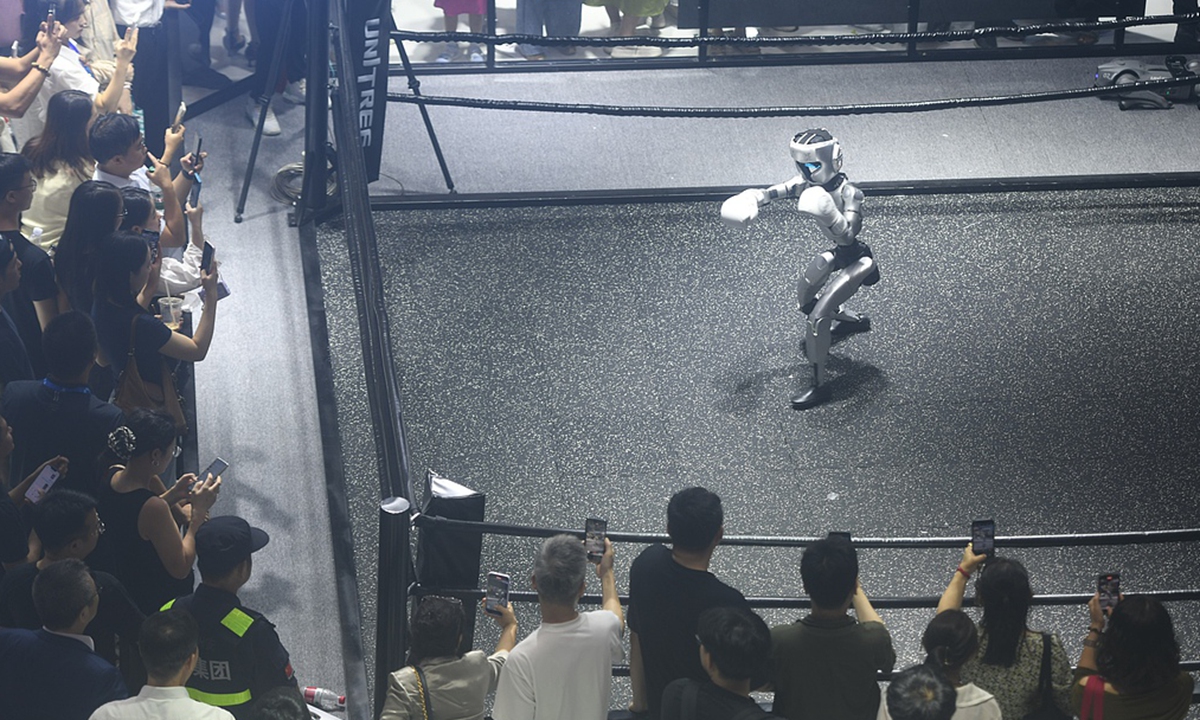
A Unitree robot performs boxing moves at the fourth Global Digital Trade Expo in Hangzhou, East China's Zhejiang Province, on September 25, 2025. Photo: VCG
Wang Xingxing, founder and CEO of Unitree Robotics, said that his company has been continuously advancing the goal of making robots "truly work."
"We have always believed that our objective is for robots to be widely applied in various scenarios such as factories and households in the future. Work is undoubtedly a rigid demand," he said.
He made the remarks at a sub-forum of the Hongqiao International Economic Forum at the ongoing eighth China International Import Expo (CIIE) in Shanghai on Wednesday.
China is spearheading a profound transformation fueled by the cultivation of what it terms "new quality productive forces" in the coming five years. At the very core of this ambitious shift lies a resolute commitment to translating cutting-edge technologies into burgeoning new industries, according to the Xinhua News Agency on October 26.
The country plans to turn next-generation industries, including quantum technology, bio-manufacturing, hydrogen energy and fusion energy, brain-computer interfaces, embodied intelligence and sixth-generation mobile communications, into new engines of economic growth, said Xinhua.
Wang said that they have spent a considerable amount of time developing dexterous hands - a core foundational component of humanoid robots. "However, globally, it remains highly challenging to implement end-to-end models in factories for actual work. We have been relatively low-key in promoting this aspect, but we have always placed great emphasis on it," he said.
He also noted that a most critical factor for humanoid robots, including embodied intelligence, currently is the pace of progress in robot large models - embodied intelligence models.
"I feel it is slightly slower than initially imagined, though overall progress remains quite rapid," he remarked. "Personally, I am relatively optimistic. I think that the current state is akin to the years before the release of ChatGPT — where the direction has been identified, but the critical point of actual realization has not yet been reached."
What might the true "ChatGPT moment" for embodied intelligence look like? Wang said that he has a simple, though not necessarily precise idea.
"I hope that at some point next year or the year after, our company or some laboratory anywhere in the world can achieve a scenario where, in an unfamiliar everyday setting, if you give a robot a voice or text command, it can successfully complete about 80 percent of the tasks," said Wang.
"We hope our company can achieve it within the next one to two years, but honestly, much of AI development still involves an element of probability and luck — some may succeed by chance. I believe that whoever achieves these goals next year or the year after will undoubtedly possess the world's most advanced embodied intelligence AI model," he added.
RELATED ARTICLES