ARTS / CULTURE & LEISURE
Peking Opera meets robotics, breathing new life into traditional art form

Illustration: Liu Rui/GT
China's first humanoid robot Peking Opera performance has drawn widespread attention, not only for its elaborate costumes or classic repertoires but also for the groundbreaking collaboration between a fully make-up robot and a human performer.
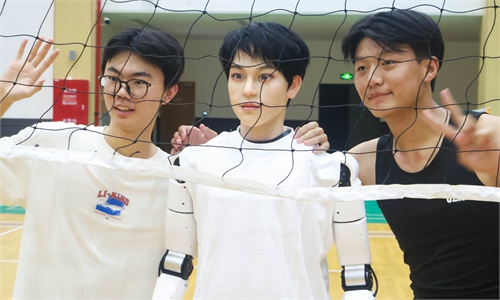
Viral clips from the debut of Farewell My Concubine show "Scholar 01," China's first robot doctoral student, stepping onstage at Shanghai's West Bund Art Center recently. Dressed in the imposing costume of the historical figure Xiang Yu, the robot walks, raises its arms and even shifts its gaze with the gongs and drums, performing side-by-side with Wang Yuchen, a Peking Opera major from the Shanghai Theatre Academy.
The sight of a humanoid machine reenacting one of China's most beloved opera tragedies immediately triggered widespread discussion. For some audience members, the performance was "full of futuristic charm," an inventive meeting of traditional opera and cutting-edge technology. For others, the scene raised questions about authenticity, artistic value and whether machines should occupy the same stage that generations of human performers have trained their whole lives to earn.
Yet what unfolded on stage touched something deeper than the novelty of a robot in face paint. The interaction of human breath and machine code suggested an unexpected possibility: That technology might extend rather than merely adorn the languages of traditional operas.
The robot wasn't improvising, but its precision lent a strange clarity to the stylized movements that have defined Peking Opera for centuries. Yu Xiang, the director of the performance, told the Global Time that it aims to offer a glimpse of what a codified, data-driven interpretation of the form could look like. One that can be repeated, fine-tuned and built upon in ways no human body would tolerate. To some, this fusion of algorithmic control and ritualized gestures felt like a genuine attempt to rethink what a stage can be.
And beyond the mechanics, an even more profound shift is taking place. The infusion of robotics and Peking Opera is breathing new life into the ancient art, drawing in youngsters.
After the performance, clips circulated rapidly on Chinese social media. Teenagers who had never watched a full traditional opera suddenly found themselves discussing face-painting styles.
A survey on the intangible heritage of opera shows that 67 percent of Gen Zers and millennials are interested in traditional opera, while more than 71 percent believe that cross-genre collaborations can infuse new life into the art form.
Whatever one makes of the aesthetics, it is clear that the production succeeded in expanding the conversation around Peking Opera. A robot dressed as Xiang Yu may not appeal to purists, but it does offer younger and global audiences an accessible doorway into a dense, centuries-old tradition. For a cultural form so often labeled "too distant," this is no small achievement.
Educators and opera instructors also noted the practical implications. "If a machine can demonstrate the timing of a gesture or the angle of a stance with exact reproducibility, it becomes a tool that could theoretically lower the threshold for learning. Digital renderings, interactive practice companions, motion-capture archives, these have long been discussed in theory but rarely put into practice with such visibility," Li Qingdu, the creator of the robot, told the Global Times.
Even those who are skeptical of robots onstage agree that the technology, if used wisely, can make traditional arts less intimidating for beginners.
But admiration has not been the only reaction, and should not be. As videos of the robot circulated online, so too did sharper criticism. In the comment session, some wondered whether the "innovation" was little more than technological spectacle masquerading as artistic progress. Others worried that, in the rush to attract attention, the art form's emotional core risked being overshadowed.
After all, what distinguishes a master of Peking Opera is not the accuracy of a gesture but the depth of feeling it contains: The quiver in a singer's voice, the breath that punctuates a movement, the shared understanding between performer and audience. A robot can reproduce a scene, but it cannot feel the consequences of betrayal, the weight of duty, or the tragic tenderness between characters.
There are also ethical and cultural anxieties at play. The risk of crowding out opportunities for young human actors in traditional operas is the most common concern. Some commentators welcome the robot as a tool to draw more people into the theater, only to add that they hope audiences will stay for the human performances, not for the spectacle of machinery in costume. In that sense, the reaction reveals a quiet but insistent boundary: Innovation is welcome, but not at the cost of the human heart of the craft.
And perhaps that is where the Shanghai experiment lands most thoughtfully, not as a triumph of machines over tradition, but as a reminder that the future of an ancient art depends on how carefully its guardians balance progress and preservation. Robotics can enrich the stage, but it should not replace the embodied intuition and emotional intelligence on which Peking Opera's survival depends.
The author is a reporter with the Global Times. life@globaltimes.com.cn
RELATED ARTICLES